Endotoxins
Endotoxins (~10-1000kDa) are structural components of bacteria (LPS is the best known) that are released from bacteria when they die. Endotoxins cause inflammatory responses in humans and animals (infections give you a fever) and in cultured cells. For most cell culture applications, you don’t have to worry too much about endotoxins. For monolayer permeability experiments, endotoxins matter. They can activate endothelial cells and negatively affect the monolayer integrity. Since a tight monolayer is necessary for accurate determinations of permeability coefficients of small molecules/nanoparticles, the lowest possible levels of endotoxin are desirable.
I bought an assay for endotoxins and posted the protocol here. In my previous post, I showed %TEER values for bEnd cells. The absolute TEER values in Ω-cm2) are lower than those reported in some of the literature. One of the reasons for these lower TEER values might be the presence of endotoxins in my culture media. Here, I tested the 2 culture media solutions and our water for endotoxin and calculated EU/mL from a simultaneous standard solutions curve.
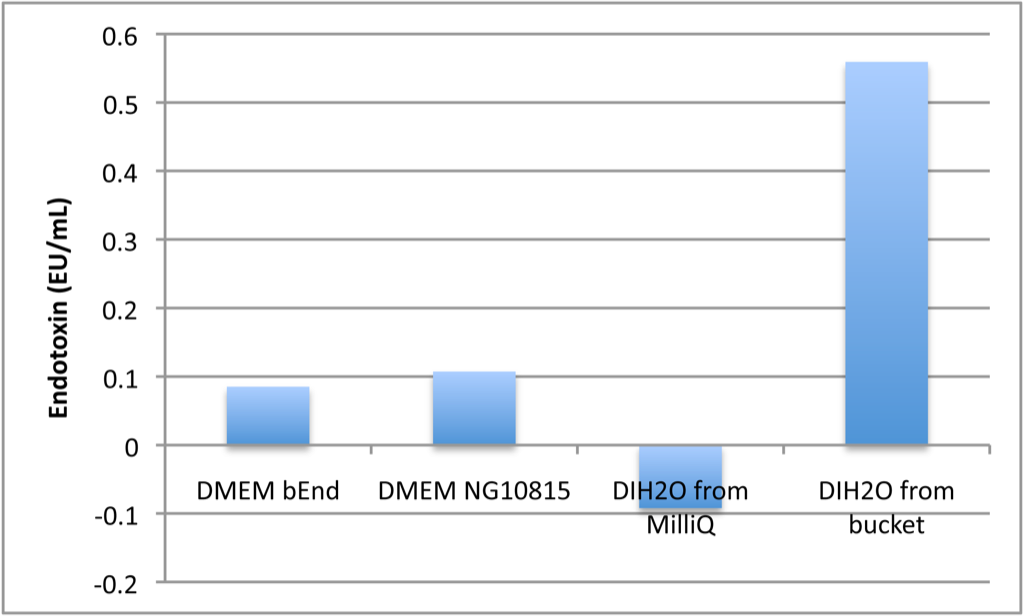
Unfortunately, this assay only allows you to run 14 samples at a time, so the ability to do duplicates is limited (hence no error bars). First, it is comforting to note that our DIH2O coming out of the MilliQ is clean. I took a sample of DIH2O from the plastic storage containers that we fill with DIH2O for convenience. That water has much more endotoxin than the source water, which must mean that there are endotoxins coating the inside of these buckets, or constantly opening and closing these containers allows bacteria to accumulate in these buckets. Both the bEnd3 and NG108-15 culture media showed a little endotoxin signal (~0.1 EU/mL). I’m not sure if this low of an endotoxin level can alter bEnd3 function but I’m switching all cell culture reagents to the lowest possible endotoxin levels available.