Cell counts on free-standing vs. supported pnc-Si
In most of the images I’ve posted of bEnd3 on pnc-Si, it seemed like there were more cells crowded onto the free-standing pnc-Si compared to supported pnc-Si. This post shows that this is indeed true.
To do cell counts, I stained cells with Hoechst 33342 (1uM in media) for 15 minutes @ room temperature and observed with the Zeiss at 20X. I acquired phase and UV images for each sample. I then did some image processing in MATLAB to create masks of the free-standing and supported pnc-Si (from the phase image) and applied these masks to the UV channel to yield images like these:

Next, I used Henry’s edge detection code to do cell counting. This method of cell counting is much better than our historical threshold-based versions. I display all of the relevant data in the title of these images. Here’s an example of the above images with counted cells:
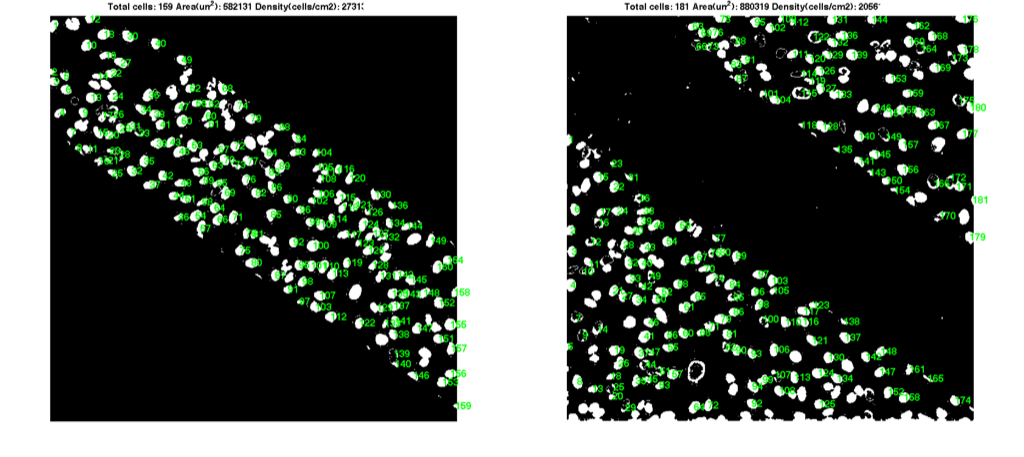 Even though the edge detection method is better than the threshold method, there are still some mistakes in cell identification. Therefore, I double-checked for cells on edges, undetected cells or other weirdness and adjusted the count (this usually changed the MATLAB count by less than 10%).
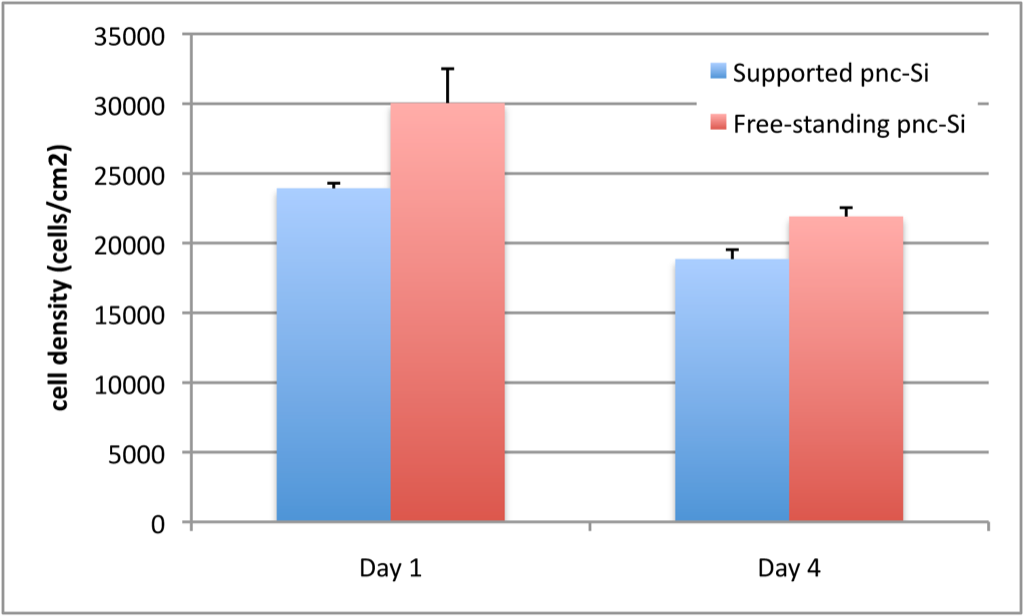
For the following graph, I used SC309 and SC612 with P13-18 bEnd3. I seeded at 50000 cells/cm2 then did staining and imaging after 1 day and 4 days. At both times, there are more cells on free-standing than on solid pnc-Si. This difference is statistically significant at day 4 via a t-test (n=6 for each column). I think the data at day1 is not statistically significant because cell attachment differences might affect cell density after 1 day but wouldn’t linger to day 4. Therefore, there are more cells on free-standing pnc-Si than supported pnc-Si.
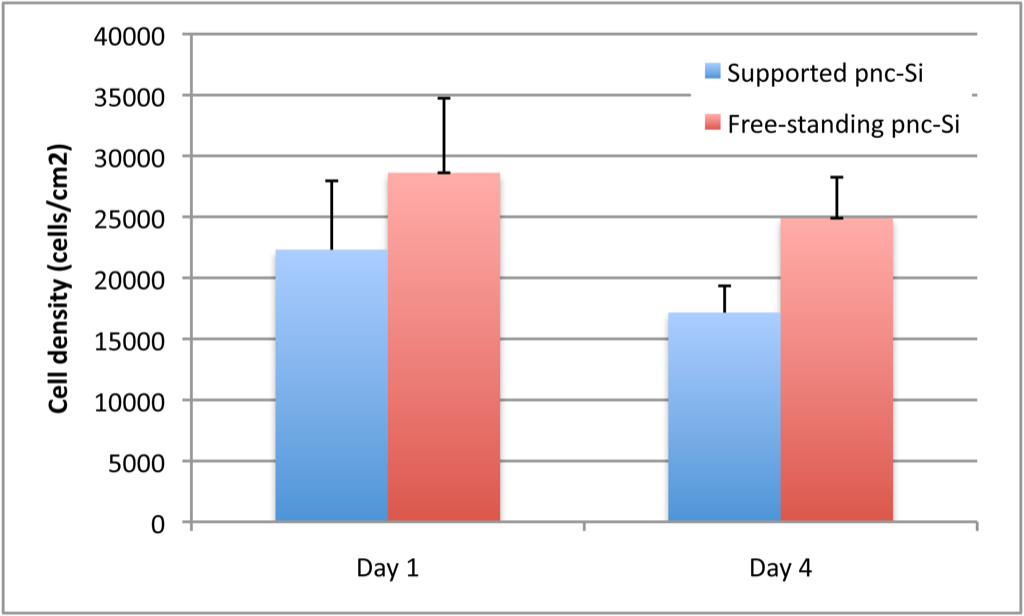
I repeated these experiments on SC348, the ‘non-porous’ wafer sample, and found the same results: Higher cell densities on free-standing compared to solid pnc-Si at both time points (haven’t done stats yet but they look significant, n=2 for each column). If cells on free-standing pnc-Si respond to permeability and recruit other cells to the pnc-Si window, then SC348 must be porous enough for cells to detect.