H2O2 crosses "nonporous" membranes
A couple weeks ago, I showed some preliminary data on H2O2 detection via the Amplex Red Assay, which is a project for one of our high school students. This generated some discussion at the last NRG meeting about diffusion through “nonporous” membranes. Jess wanted to look at very small molecule diffusion in her set-up so I did a couple experiments in order to take full advantage of the 100 assays that this kit forces you to do.
Specifically, I tested 1.) the stability of H2O2 stored on the bench vs. in the freezer 2.) the ‘activity’ of our H2O2 stock solutions (which are old) 3.) diffusion of H2O2 through SC348.
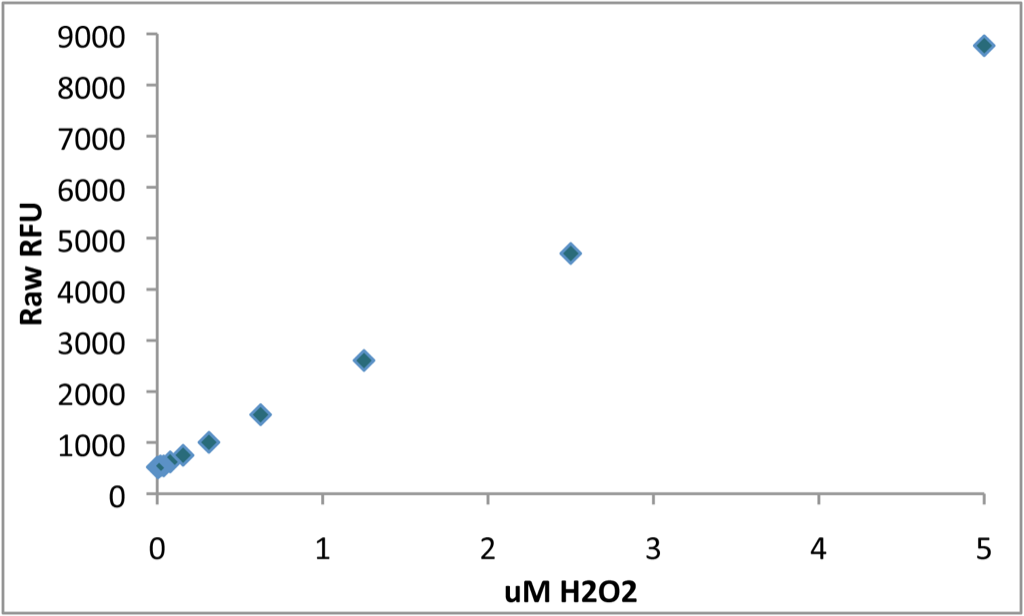
This time, I scanned the excitation and emission wavelengths of Amplex Red and decided on an optimal pair at 560/595. Again, the standard curve looks good. Here, the x-axis is the H2O2 concentration in the 96-well:
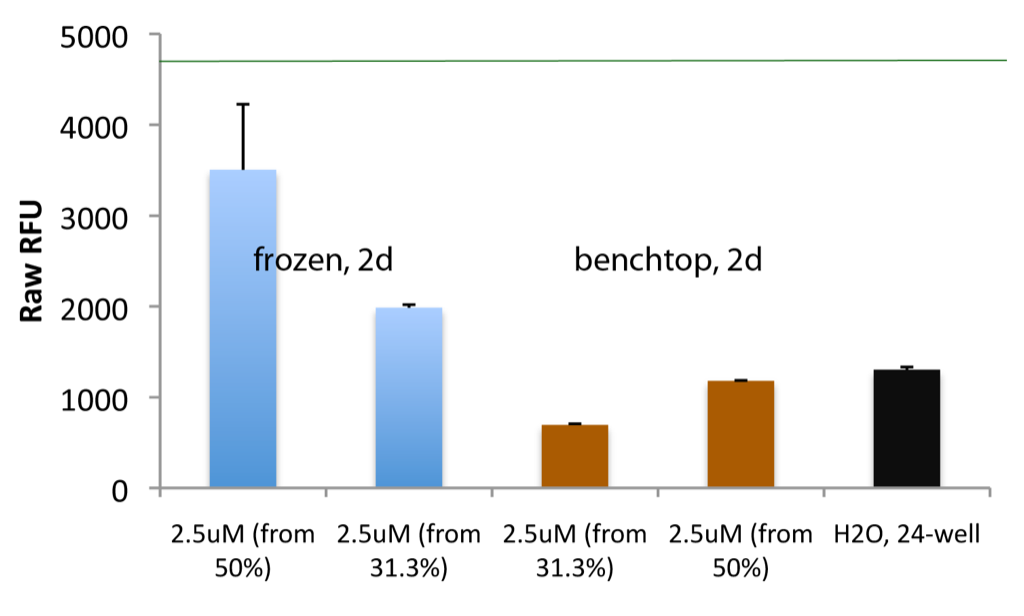 For this experiment, I made a 10μM H2O2 solution either from our 50% stock or 31.3% stock. I then either froze the 10μM solutions at -20C or left them on the bench for 2 days. Since the solution is diluted 1:4 for this assay, the final concentration was expected to be 2.5μM (indicated by the green line in the graph). There are a couple things to note. First, the benchtop concentrations are lower than the frozen, which indicates that H2O2 decomposition is faster at room temperature – not surprising. Second, the concentrations of the samples from the 50% stock and the 31.3% stock are different. This indicates that I either made a mistake during dilution or the stock solutions have degraded at different rates over time and we don’t really know what their concentration is anymore. Third, since all values are lower than the expected RFU (green line), there was either decomposition during the 24-hour experiment, a dilution error or degraded stock solutions.
Check these links for TEMs of SC348.


Diffusion of H2O2 through SC348:
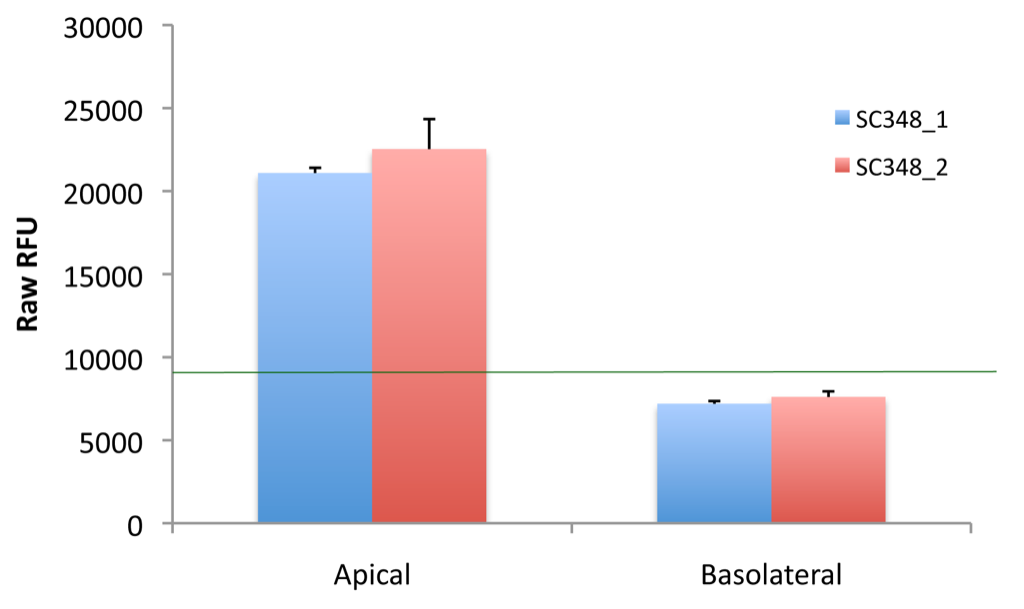 I made 2 SC348 Sepcons (pinhole-free) so I would have duplicate measurements. I loaded the apical well of the Sepcon with 0.2mL of 120μM H2O2, filled the bottom well with 1mL DI H2O and spun the plate at 100rpm for 24 hours. The expected equilibrium concentration based on the standard curve is shown with the green line.
The H2O2 got through this membrane even though it looks nonporous in the TEMs! In fact, it looks like the system was close to equilibrium (ignoring the probable non-linearity in the apical well RFU measurement).
How many pores would be needed for the system to come to equilibrium?
Here’s a very rough evaluation of this question:
If you have 5nm pores (diameter) you need about 10% porosity for this to hit equilibrium with H2O2. That equals 20130 pores/micron squared. That’s a lot of really tiny pores that we may just barely pick up with pore processing.
If you have 10nm pores you will only need .01% porosity or 14 pores per micron squared. The bigger the pores get, the required porosity drops more significantly. So maybe you can get away with wafers where you don’t see pores in the viewing window but actually have enough porosity for H2O2 to go through. Those pores however would probably need to be bigger than 10nm in diameter.