NSF Proposal: Tunable dielectrophoretic separation of nanoparticles with ultrathin microporous silicon membranes
Blanca, Tom, Aytug and I are working on a proposal to NSF that will be submitted Oct.29th to the Chem. & Bio. Separations Program of the CBET division. This is a joint 3-year project between Blanca’s and Tom’s labs. Basically, we are combining Blanca’s insultator-dielectrophoresis with the microporous version of the SiO2 (or SiN) ultrathin membrane to develop tunable nanoparticle separation techniques. The microporous membrane will act as an insulator structure to create E-field gradients. I’m showing a couple of the key figures from the proposal below and the summary objectives statements to give the general idea of what we’re proposing.
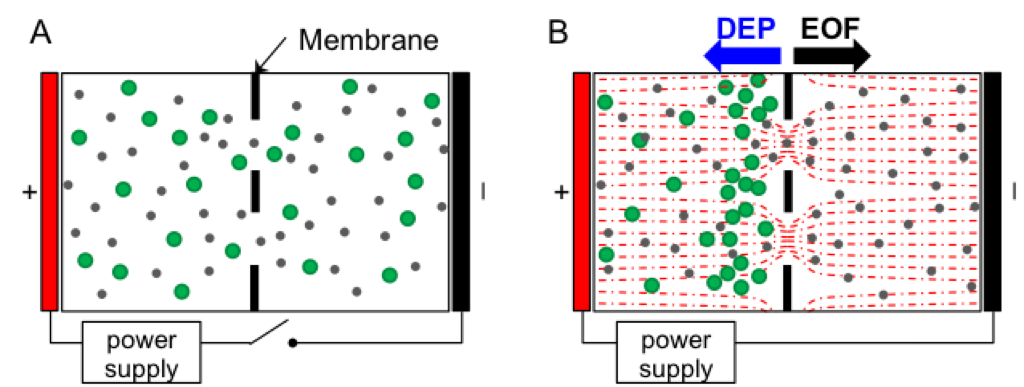
Figure 1: Conceptual illustration of hybrid DEP- ultrathin membrane system. (A) With no electric field, all particles smaller than the pore diameter pass through the membrane with fluid flow or diffusion. (B) With an electric field, EOF drives all particles according to the field direction, while DEP drives all particles away from the membrane according to the field gradient resulting from the field lines bending (red dashed lines) through the pores of the insulating membrane. Larger particles experience larger DEP force, resulting in their retention upstream of the membrane. Smaller particles experience weaker DEP, and EOF carries them through the pores. Alternatively, transmembrane pressure can be used in place of EOF for neutrally charged membranes, while DEP will still retain larger species upstream of the membrane.
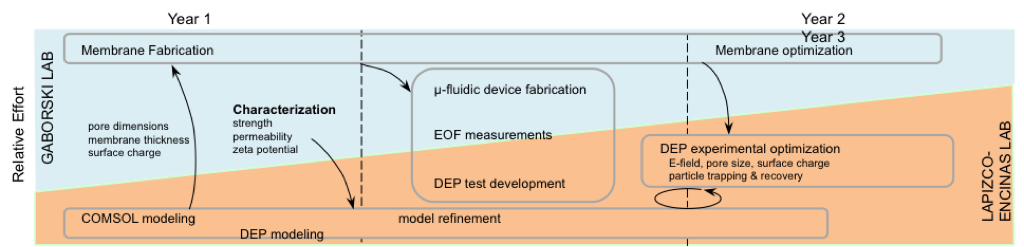
Figure 2: Timeline of proposed program illustrating the relationship of efforts in the two labs and shift in emphasis from membrane development initially to DEP optimization and demonstration in the final year.
Objectives
To demonstrate the efficacy of this hybrid approach to tunable nanoparticle separation, we propose creating ultrathin membranes with a variety of geometries and surface charges, and using these as an insulator structure in iDEP studies with model fluorescent nanoparticles ranging from 20 to 200 nm. This size range encompasses that of many nanoparticle separation applications including water purification and separation of larger constituents from blood. Additionally, this enables us to optimize the performance of the hybrid separation device for tunable prefiltration of samples for subsequent ultra- and nanofiltration. There are several commercially available model fluorescent particle lines to choose from, making them a convenient route to this initial development effort. It should be noted that the basic principle of iDEP will apply to any particle that is dielectric (polarizable).
Specifically, we propose the following research objectives:
- Membrane structures with permeability > 10,000 mL/(cm2 s bar) and strength sufficient to support 1 bar of differential pressure.
- Removal efficiency for isolation or prefiltration: >90% removal of target particles.
- Sieving selectivity for particle separations: ability to differentiate within a factor of two (e.g., 50 from 25 nn, 200 from 100 nm, etc.).
- Proof-of-concept demonstration of virus particle trapping using non-enveloped adeno associated virus (~20 nm) and adenovirus (90-100 nm) as analogs for Hepatitis A and other water-borne disease causing viruses.