Similar Posts
Five-layer structure (2)
ByJoe QiIn order to verify the validity of the result of the five-layer structure I did last time, I deposited another wafer with NOSON stack, which has the identical thickness as that of the last time. The annealing condition is also same as the last time, which is 1 minute holding time at 1000C with a…
Material changes
There’s been a flurry of activity regarding Jess’ recent discoloration post. Specifically, there is a discussion about the recent materials changes that have taken place due to the rebuilt CVC sputterer. This post is meant to supplement the ongoing materials discussion. I have noticed that films deposited post-rebuild seem to have less background texture and…
Film stress in free standing films of MgF2
The process to create free standing films of MgF2 requires the film stack to survive a few different kinds of stresses. First, there is thermal stress from the mismatched coefficients of expansion (MgF2 expands about 5-10x more than silicon/silicon nitride), the stress of deposition (adatoms not finding their lowest energy position), and other mechanical stesses…
A new idea to fabricate nano pocket membrane
Starting in July of 2021, we began a new idea fabricating the nano pocket membrane to capture and release the EVs. From then until now we have successfully fabricated nano pocket membranes by using a lithography method. We faced challenges in parylene etching and resolve it by using two etching machines, i.e. Trion Phantom…
Diffusion Separation with w612
This was something I set up a few days ago and finally got a chance to run the gel. I was curious to try this after the previous forced separations using brain extract. If you recall, the “separation” using the pressure cell did not have a visible cutoff and all of the bands appeared in…
Critical Flux Control Experiments Across Three Different Wafers
Hi everyone, this is a short post quickly detailing some interesting quirks of different wafers as their respective chips are subjected to a control experiment (1x PBS, Qs = 30 ul/min, Qu= 10% Qs every 45 minutes). First, lets look at 1256 (2.7% porosity, avg. pore diameter 33.2 nm). These results are a nice baseline…
One Comment
Comments are closed.

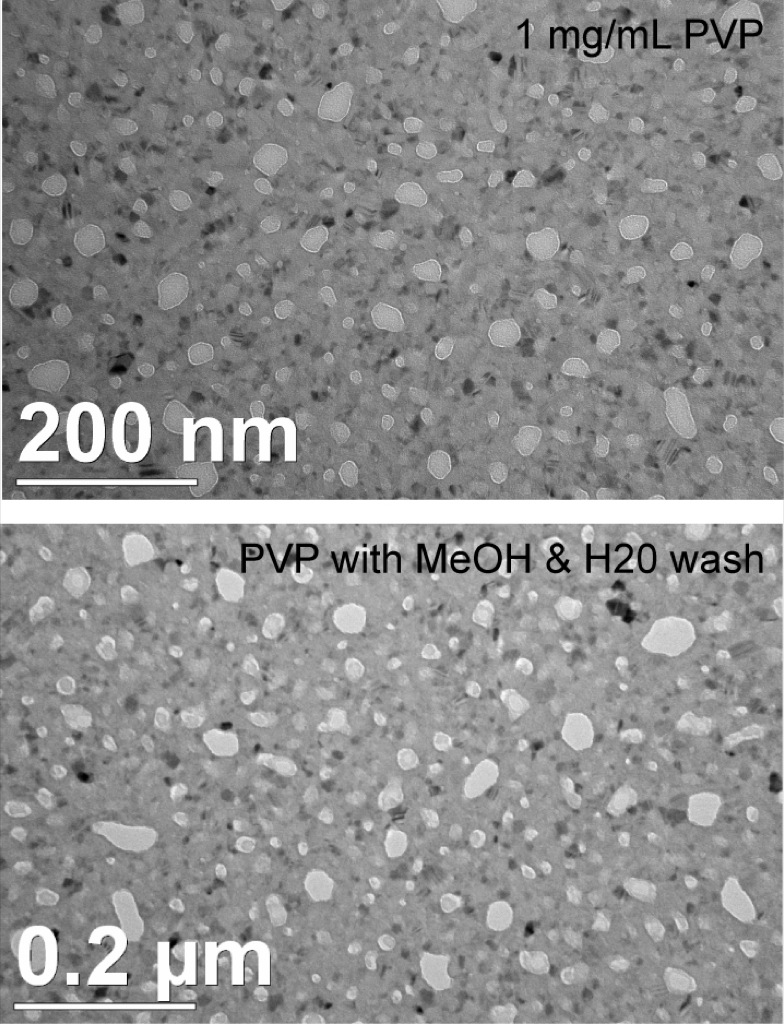
The brightness of the image may even be significant. Was the beam noticeably dimmer with the thick PVP coating. IF so, the film is very thick.
Anyway, the pores are clearly covered, so the fact that water passes so easily must mean that the film either dissolves or is highly porous. It will be interesting to see if there is an effect on separations.