Similar Posts
SEPCON 1.9?
We’ve been doing a lot of work characterizing SEPCON performance in forward and reverse configuration. One lesson we’ve learned is that a vertical orientation might be best for high particle concentrations. I discussed this with Greg and he graciously came up with first prototype design. Greg will put is 3D printing experience to work on…
Rat Dialysis Device Animations
Here’s a few sketchup animations I made for Dean’s device, based on his PPG presentation last week:
SEM of Nanoparticles and NPN
Below are various SEMs of NPN membranes. (All samples were coated with metal by using the Denton Ag sputterer for 120 s) These were used samples that have been sitting out in the lab for weeks. I don’t remember the exact details of the processing. I believe they were filters we used to test the possibility…
Desalting: Continued Work
In continuation of the desalting work, I ran three additional controls: a SepCon with no slits (negative control) and direct addition of 4M NaCl producing final dilutions of 1:400 and 1:600 (these are the experimental final dilutions I have been working with). The results are shown below. I also calculated the flux for each condition….
RTP Time Variation for Cell Culture
In an attempt to improve membrane life in cell culture, different RTP times were tried on a single wafer. Samples from W514 were RTPed in Ar at 800C for 1, 5, and 10 minutes, respectively. Cells were then seeded at confluence on membranes, with membrane stability monitored for breakage. Discoloration was monitored on samples without…
Initial Nanofluidic Transistor Zetapotentials Seem Unresponsive to Applied Gate Voltage
I’ve been taking lots of zetapotential measurements with my current setup. Serendipitously, it appears that the more I use the electrodes, the more stable my zetapotential measurements become. Because the system seems well behaved now, I decided to move on to a more difficult problem. Sarah and I made some nanofluidic transistors a few weeks back,…
One Comment
Comments are closed.

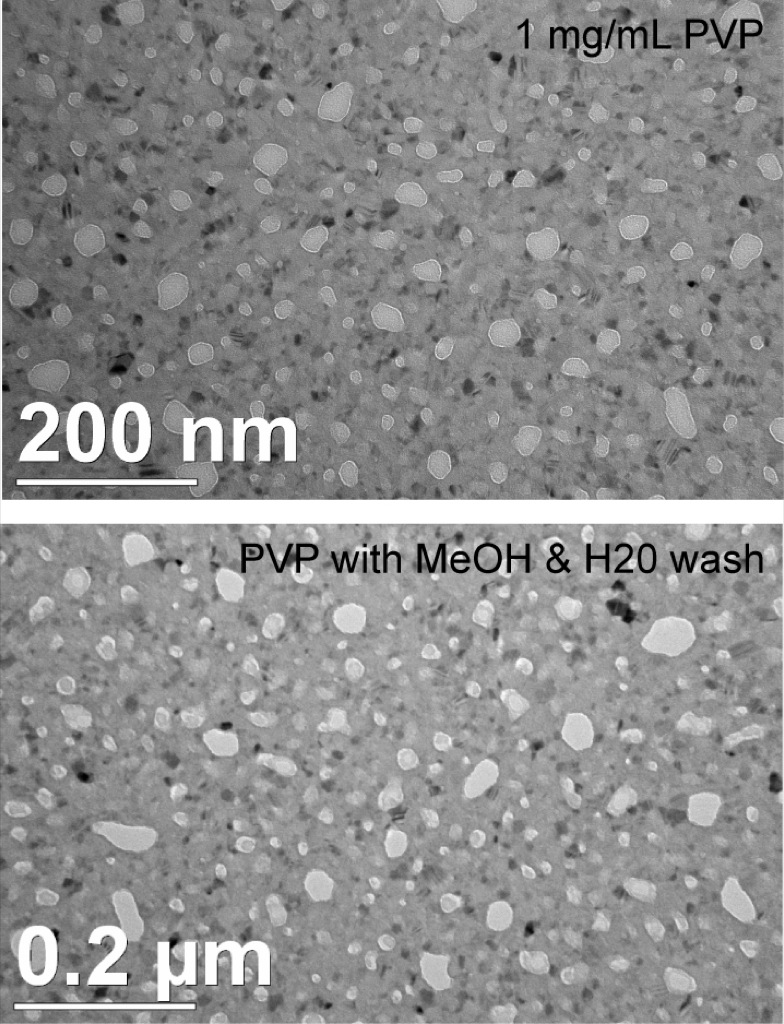
The brightness of the image may even be significant. Was the beam noticeably dimmer with the thick PVP coating. IF so, the film is very thick.
Anyway, the pores are clearly covered, so the fact that water passes so easily must mean that the film either dissolves or is highly porous. It will be interesting to see if there is an effect on separations.