Theoretical Underpinnings of Small Molecule Permeability Measurements in the µSiM (Part 4: Sampling)**
Introduction
In addition to in situ measurements of small molecule permeability (Parts 1, 2 and 3), we wish to enable an assessment of permeability by sampling from the abluminal chamber of the µSiM in a manner similar to what is done with Transwells®-style devices. To begin this, we need to review the methods used with transwells which originate with physiology papers dating back to the 1980’s. I am unsure if this paper from Asrar Malik’s group at Albany Medical College is the seminal work on the topic, but it is written that way, citing only in vivo studies (and theory) concerned with molecular transport across blood vessels as precedent.
That the roots of this analysis traces back to physiology helps explain the awkward way molecular flux is disguised as a quantity called ‘clearance.’ But first the geometry …
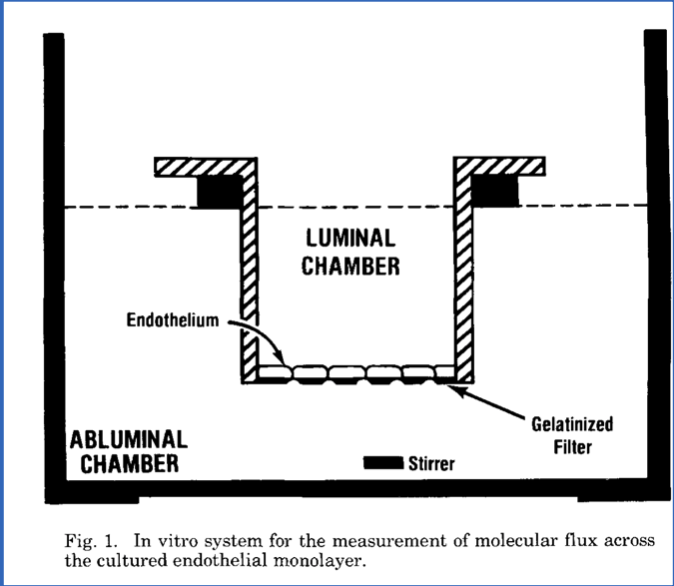
Note the addition of a ‘stirrer.’ This allows the theory to assume the abluminal chamber is well-mixed so that the concentration is the same everywhere.
Picking up from equation (3) in the Malik paper …
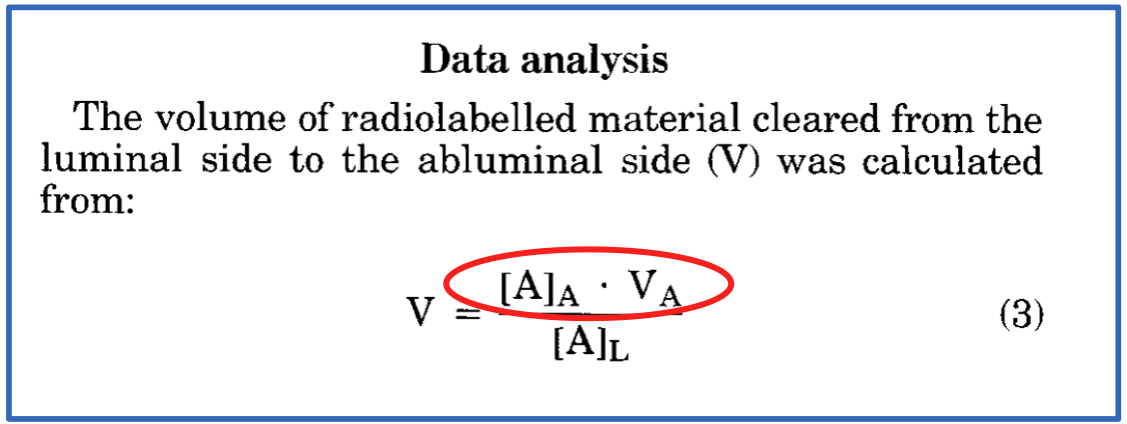
The quantity circled in red is clearly a mass transfer from the luminal to abluminal compartments, with [A] A the abluminal concentration of the species of interest and VA the abluminal volume. Dividing by the luminal concentration [A]L of the species, which is assumed to be in such great excess of the the abluminal concentration that the loss by transfer to the luminal compartment does not change the value over time, converts this into a volume that is ‘cleared.’

Where now the numerator is the ‘clearance rate’ in units of volume per unit time. Given that V is actually a mass transfer that has been normalized to the luminal concentration, we appreciate that the numerator of this equation is actually a mass transfer rate in disguise. Dividing by the surface area between the two compartments (the membrane area) w produces a flux, only again it is in disguise because of the previous normalization with a concentration. So we see that the permeability P is really a flux through a surface normalized to the concentration of the luminal compartment.
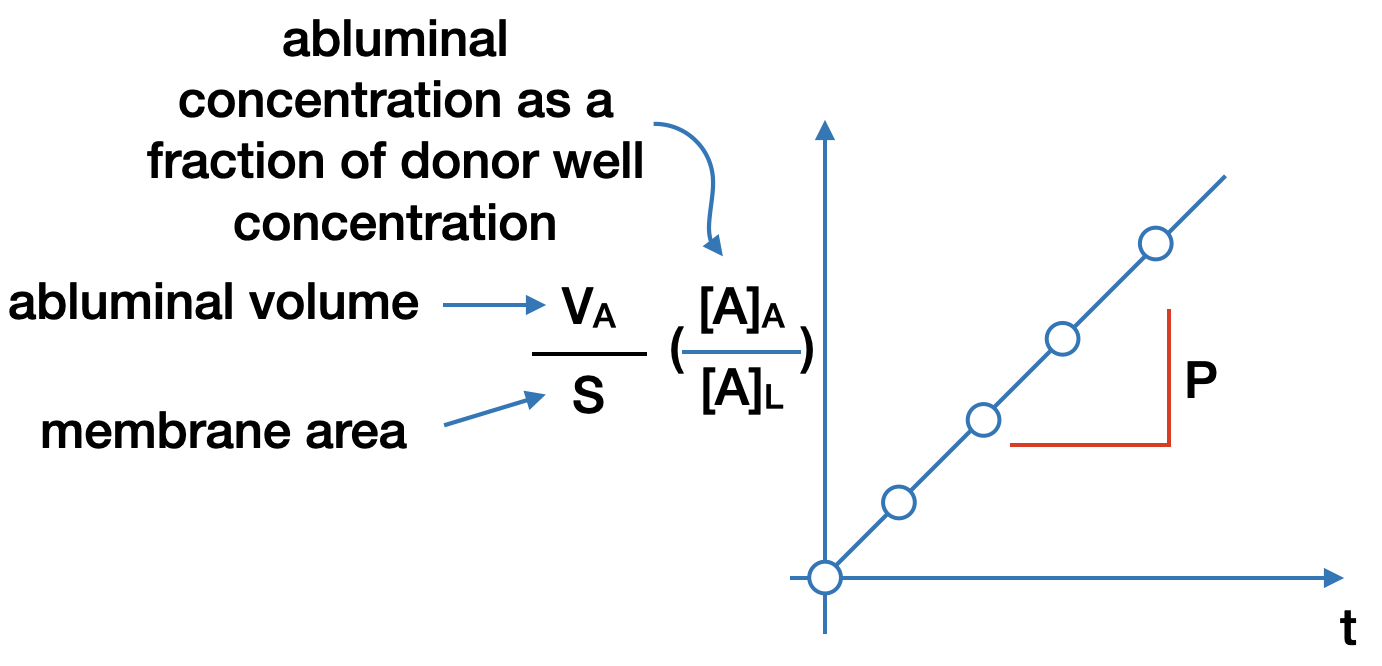
If we substitute equation 3 into equation 4 and assume the clearance rate (i.e. the flux) is constant, we get a formula that implies the following experiment …

Rearranging to more directly get P from the slope …
Or more simply …
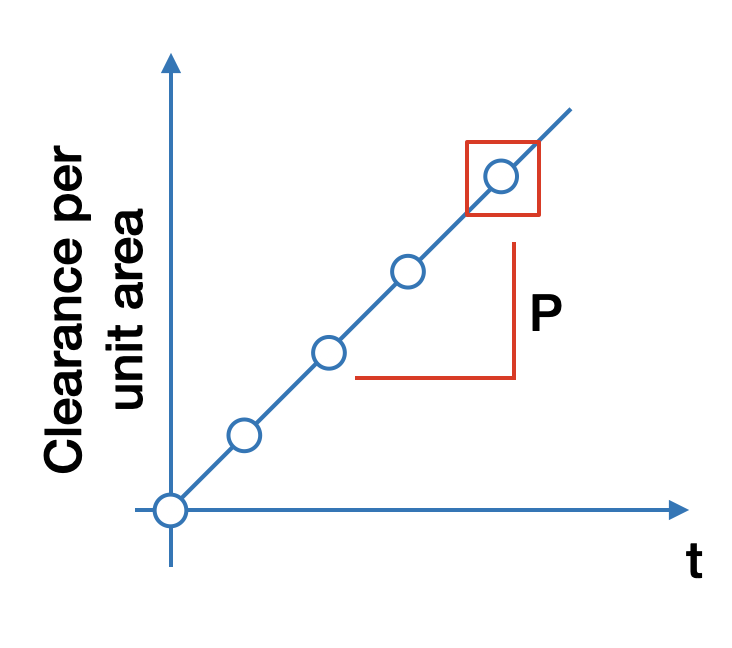
Now in the µSiM we can’t mix continuously and so we harvest the entire abluminal sample in an end-point assay. This means we are determining the slope (and thus permeability) from a single point rather than a line fit. It may be possible to resample without changing the answer, but this will take a careful study of its own. So for now, the plan for sampling is an end-point assay. We do need to ensure that we are harvesting the vast majority of the backside volume to make sure this precious data point is accurate. Molly has studied this well enough to establish a protocol on the sampling method. Her protocol page includes a video that summarizes the concept most succinctly. We’ve made considerable progress in this series on the theoretical underpinnings of our µSiM permeability measurements, but we are not quite done …
Next up: Subtracting background permeability for both the in situ and sampling methods.