Simple Sieving Model
In an effort to better understand and check Karl’s model of sieving, I’ve built a significantly simpler version. The goal is to investigate the potential benefits of thinner membranes in dead-end filtration and separations.
In my model 1 ml of water is displaced from the top bucket to an originally empty bottom bucket with a known flow rate Qo. The starting flow rate is 10 ul/min but the build up of material above the membrane can slow the flow down (more later). One major simplification is the assumption of uniform concentrations in the top (Ct) and bottom (Cb) chambers. So the model is a better representation of a stirred-cell separation than it is a centrifuge based separation. The cross sectional area A, is chosen to be 1 cm^2 and the starting concentration is chosen to be 1 mg/ml. The porosity P is set at 15%. These parameter values are convenient numbers that put the model in the right ball park for our experiments. The membrane thickness is L.
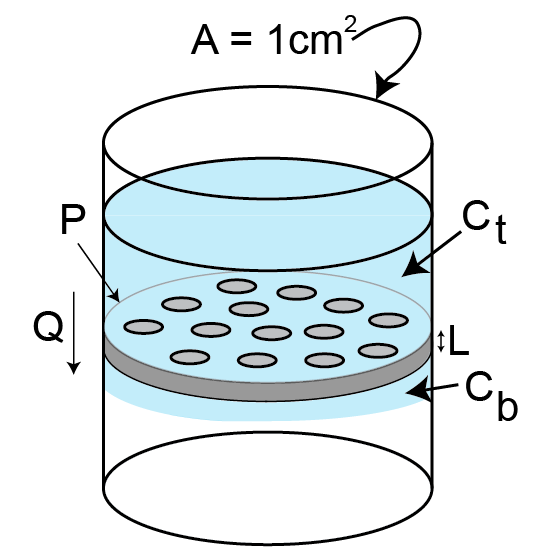 The key equation describes the transport process across the membrane …

where  and
and  are the diffusion coefficient and velocity for solute molecules in the membrane pores. is hindered relative to the bulk diffusion and is hindered relative to the solute velocity. These hindrances have been described by Renkin (diffusion), Deen (diffusion and convection), and others. The most complete treatment we are aware of is this review by Deen. Deen uses the values H and W to describe the hindrances for diffusion and convection respectively.


From the following table (found in Deen) I used the Anderson and Quinn relationships for H and the Brenner and Gaydos relationship for W.
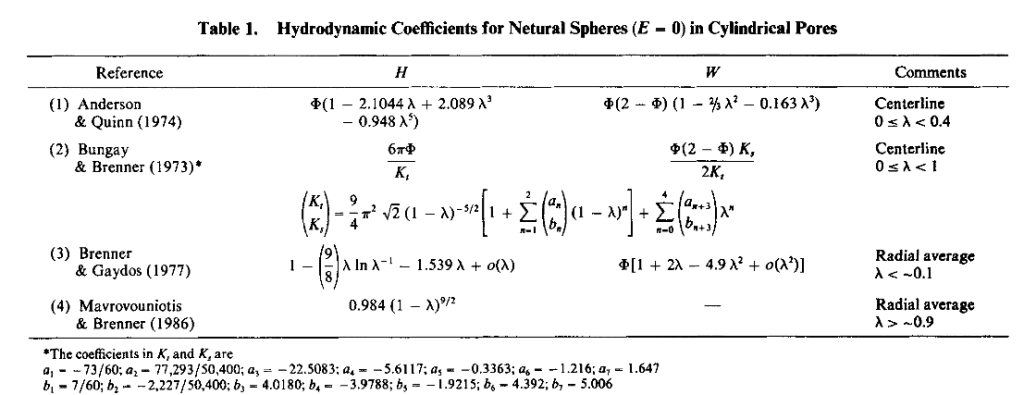
Note that λ is the ratio of the solute size to pore size and Φ describes the steric (or geometric) hindrance. While I broke the rules for λ noted in the comment section of the table, I found these functions to be well behave d over 0< λ <0.8. Comparing the behavior of the two hindrances over this range gives …
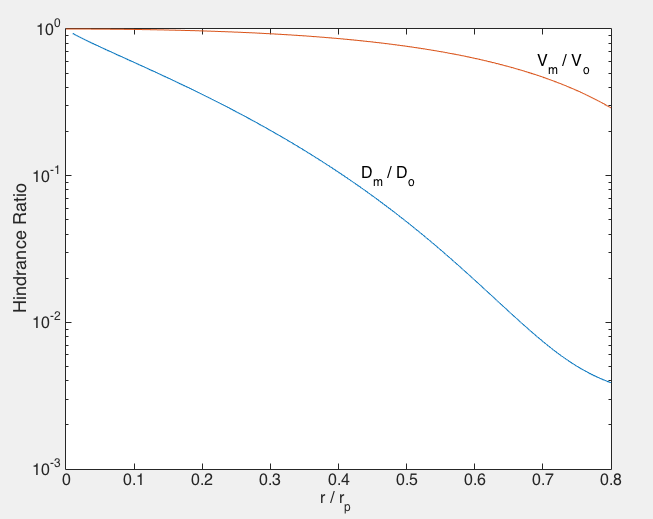
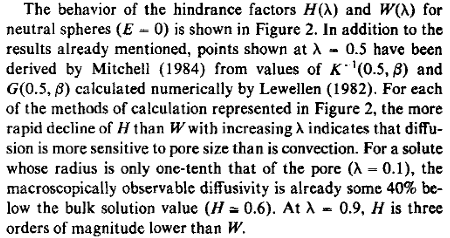
These functions imply that increasing the particle radius relative to the pore size has a higher impact on diffusion than on convection. This observation is also made in the Deen paper …
Obviously the key to high resolution separations is a sudden drop in the transmission of species based on size. Since transport by diffusion is more sensitive to size than convective transport, it follows that membranes thin enough to enable diffusion along with convection (Pe ~ 1) should have better size selectivity than thicker membranes. This is the central hypothesis that Karl’s model is designed to test.
In addition to sieving characteristics we are interested in understanding how membrane thinness impacts the rate at which flow reduces with time due to cake formation. Since cake formation is largely a surface phenomenon, one might not expect an important role for membrane thickness. However our hypothesis is that diffusion enabled by thin membranes helps delay the onset of concentration polarization and cake formation. For this I needed a phenomenological description (Karl is working on a mechanistic one) of how flow decreased with increased solute concentration above the membrane, so I made this up …
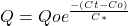
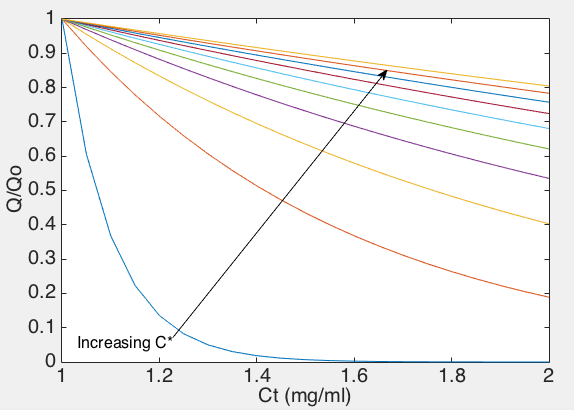
where Co is the starting concentration and C* is a concentration that scales the decay process. Using Co = 1 mg/ml (thinking protein here) and running C* from 0.1 -> 5 mg/ml, the impact of concentration on flow looks like this …
With these tools in hand I simply integrated forward numerically. Calculating at each time step the transport from top to bottom, then the new flow rate, then the new transport, etc.
Results will be posted in a follow up …
Is this post complete?
Not even close. I hit publish on accident. I’m updating as I can.
Now its complete
I think this simple model will ultimately be a very useful part of our analysis of filtration behavior. That said, I believe that the fact that concentration polarization is not incorporated (the stirred cell case) will cause it to lose a great deal of predictive power.
I approached the stirred cell case that this model deals with from a numerical perspective in two blog posts:
https://trace-bmps.org/blog/theory/2014/05/12/incorporating-concentration-polarization-into-our-convective-sieving-model
https://trace-bmps.org/blog/theory/2014/03/18/electrostatic-effects-on-convective-flux-of-nanoparticles-a-mathematica-implementation-of-w-m-deens-model
I haven’t used that mathematica code in some time, but I would wager that it would closely approximate any results that are derived analytically from this post’s treatment of the math. What I found was that I would get very broad cutoffs (https://trace-bmps.org/wp-content/uploads/2014/05/relevant-graph.png) and I think that this model will predict similar cutoffs.
The problem (I think, and the fact that I don’t have good evidence to back this up yet is another reason this analytical model is important) is that the concentration jump between the two compartments is too small for diffusion to be important. When we’re convecting solute up to the membrane and allowing it to build up, there can be a 4 order of magnitude difference in the concentrations on either side of the membrane, but otherwise the difference is given by the sieving coefficient. If the sieving coefficient of the separation is really really low (say 0.001), such that we would expect diffusion to help, the particles won’t go through the membrane anyways. If the sieving coefficient is high (0.9), the separation doesn’t need the help of diffusion. If we have a goldilocks sieving coefficient (0.5), our diffusive “driving force” (I hear Jim grimace at the use of the word “force” but bear with me) is only a concentration jump of 2:1 – and over reasonable timescales my intuition tells me we won’t see significant fluxes. Things might get interesting at S = 0.1 or S = 0.2, but that’s the case where the particle is nearly as large as the pore and we know from Jess’s model that diffusive resistance starts to get high there.
This analytical model does include a concentration buildup in the description of how flux decays over time. Would it be possible to use that concentration when calculating diffusive and convective fluxes?