Spinning transwells
In my previous transport post here, I showed O-ring placement data which was motivated by my thinking about the unstirred water layer (UWL). I think it’s helpful to think about the total resistance to transport through transwell membranes as a number of resistors in series. There is an UWL in the donor well, then the cell monolayer (which can be divided into paracellular, transcellular, active transport, etc. resistances), then the filter and finally the UWL in the receiver well. Without cells, we only worry about the UWL and the filter resistances.
Our assumptions and data say that the permeability of pnc-Si membranes is a few orders of magnitude greater than that of transwells. Since pnc-Si resistances are so much lower than transwells, it is possible that UWL resistances dominate the total transport resistance in pnc-Si transwells but not PET transwells.
In this experiment, I measured Na-F transport through Costar PET transwells and pnc-Si SC065 transwells at 0 rpm and then at 100 rpm (on the VWR tabletop orbital shaker). These membranes had no pinholes, and I subtracted the blocked transwell fluorescence for both devices. The pnc-Si transwells were from the same chip, but different transwells – I didn’t re-use the transwell. Also, O-rings were on the bottom of the Sepcon housing.
Experimental details: Vd = 100uL, Vr = 1000uL, Cd = 0.00075%, Cr0 = 0, gain = 0.000125%, 10×10 circle, 1000um border
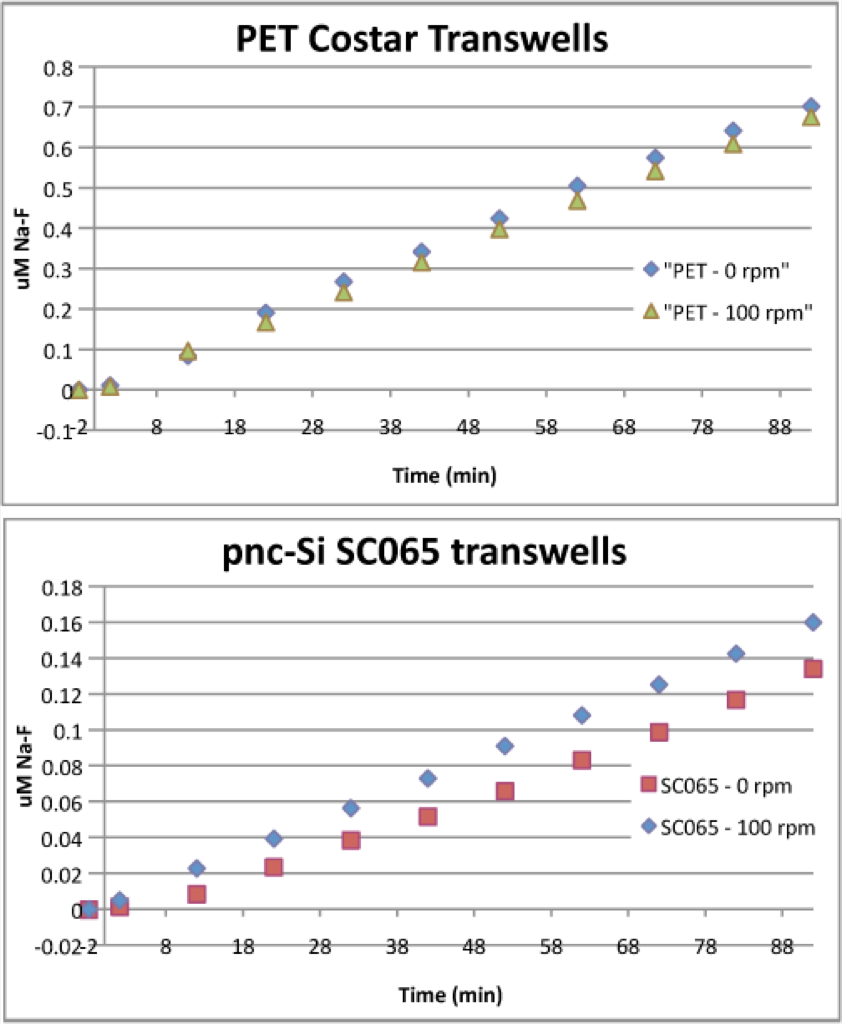
There appears to be no increased transport by shaking the commercial PET transwells. By contrast, there is an increase in transport in pnc-Si transwells due to mild shaking. This data suggests (only n=1 so far) that the UWL resistance is greater than pnc-Si membrane resistance but lower or approximately equal to PET resistance. This is big news – I’m also looking into different rpm values.