Standard Curves For Protein Assays
I have been working with Barrett to test two different assays with BSA. One is a standard procedure for microtiter plates and the other is a microassay procedure for microtiter plates.
Here is a brief summary of each procedure:
Standard Procedure for Microtiter Plates– linear range is 0.05 mg/ml to 0.5 mg/ml
- Prepare a diluted dye reagent that is 1 part Dye Reagent Concentrate to 4 parts DDI water.
- Prepare dilutions of a protein standard. I used BSA and did eight dilutions from a stock BSA solution of 2 mg/ml, ending with a concentration of 1/128 mg/ml.
- Pipet 10 μl of each standard and a buffer control into separate microtiter plate wells. I used a 96 well plate.
- Add 200 μl of diluted dye reagent to each well.
- Mix on a microplate mixer for at least 5 minutes.
- Measure absorbance at 595 nm. I used the TECAN.
Microassay Procedure for Microtiter Plates– linear range is 8.0 μg/ml to 80 μg/ml
- Prepare dilutions of a protein standard. I used BSA and did eight dilutions from a stock BSA solution of 2 mg/ml, ending with a concentration of 1/128 mg/ml.
- Pipet 160 μl of each standard and a buffer control into separate microtiter plate wells. I used a 96 well plate.
- Add 40 μl of dye reagent concentrate to each well.
- Mix on a microplate mixer for at least 5 minutes.
- Measure absorbance at 595 nm. I used the TECAN.
I tested each assay five times, in triplicate.
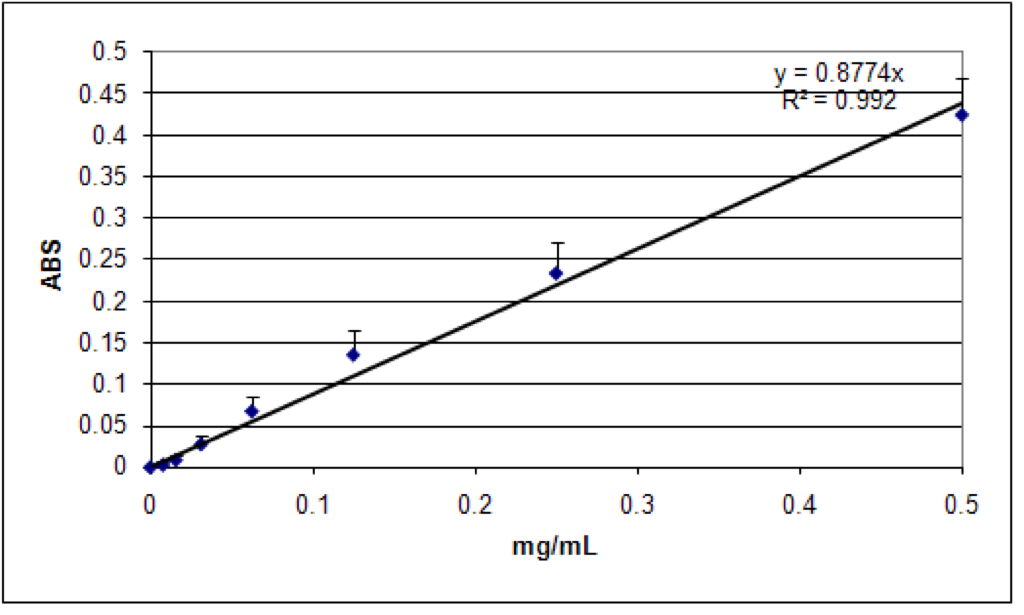
To obtain workable results, I averaged the three rows to obtain an average for each experiment. I zeroed out the buffer by subtracting the buffer’s absorbance reading from each absorbance reading. Then, I averaged the five experiments together to obtain a single curve. I limited the final graphs to the linear range of each assay and did a best fit line, with the positive standard deviations shown.
Results:
Standard Procedure for Microtiter Plates
Microassay Procedure for Microtiter Plates
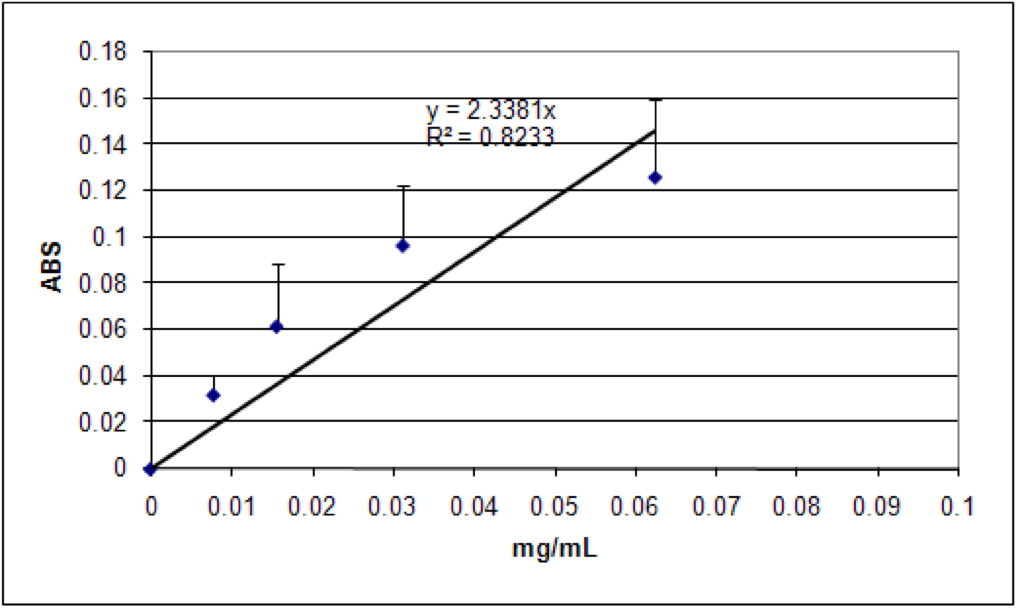
The standard procedure gives a much more linear curve, so Barrett and I think we will go with that one for future protein experiments.