Diffusion to equilibrium dependent on geometry
In order to further test the model, I’ve set up additional rhodamine diffusion assays. In each case, the setup is similar to the nanoparticle/protein/dna separations – 20 uL of .5 mM rhodamine on the top of a SepCon and 20 uL .1 M KCl on the bottom. Two different membrane geometries were used so far – 1x 200×200 um squares and 3x 200×200 um squares. SC 169 was used for these experiments.
Results:
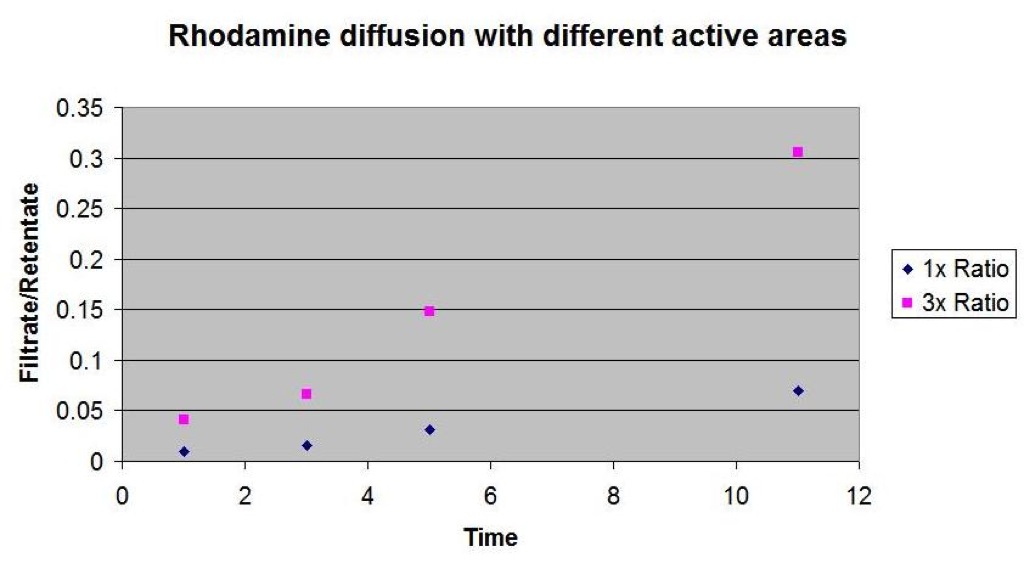
3x squares approaches equilibrium quicker, but still not on the time scale predicted by the model. At 11 hours, the filtrate/retentate ratio is .3 (equilibrium = 1). (Note: The previous rhodamine separations were with SC 073, and one SC 073 was used in this setup to confirm the slower time to diffusion).
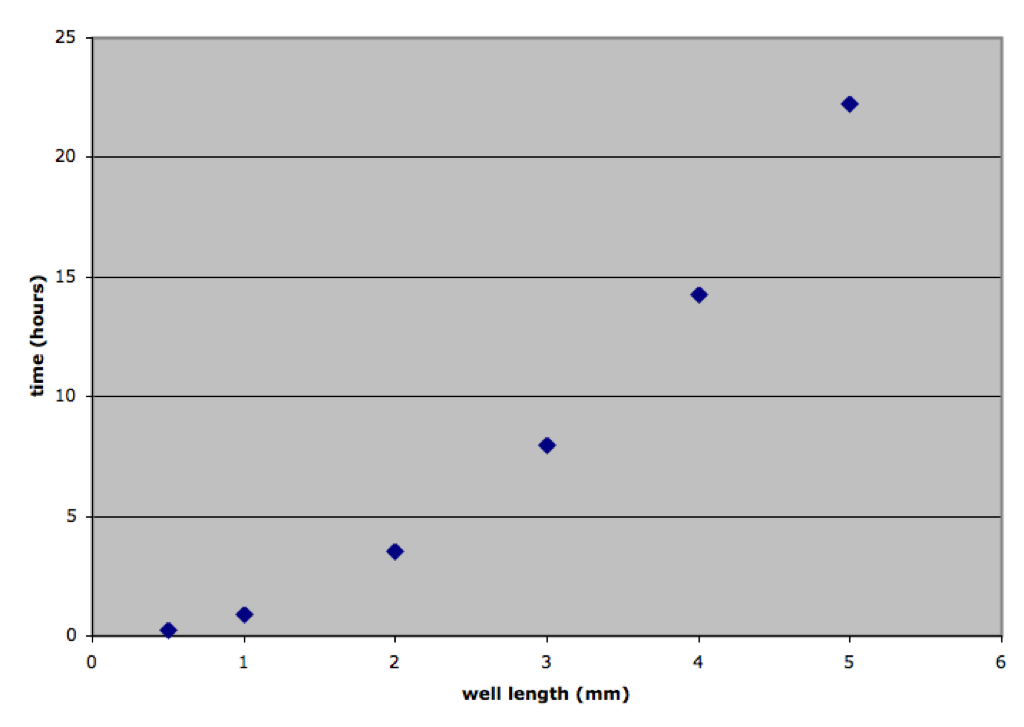
The time to equilibrium is highly affected by the length of the wells (see above figure). We may only need to better understand the geometry of our system to get the model on the same time scale. Of course, a 3D representation may be better than the current 1D version as well.
I will update this post with additional geometries/time points.