Palladium membrane hydrogen purifier
I have been talking with JP about getting some pnc-Si membranes coated with ~10-20 nm layers of Pd (or Pd-Ag) to do preliminary tests on hydrogen permeation devices. Tom and I are thinking of submitting a proposal. This kind of technology has been used industrially and follows the general principle shown below:
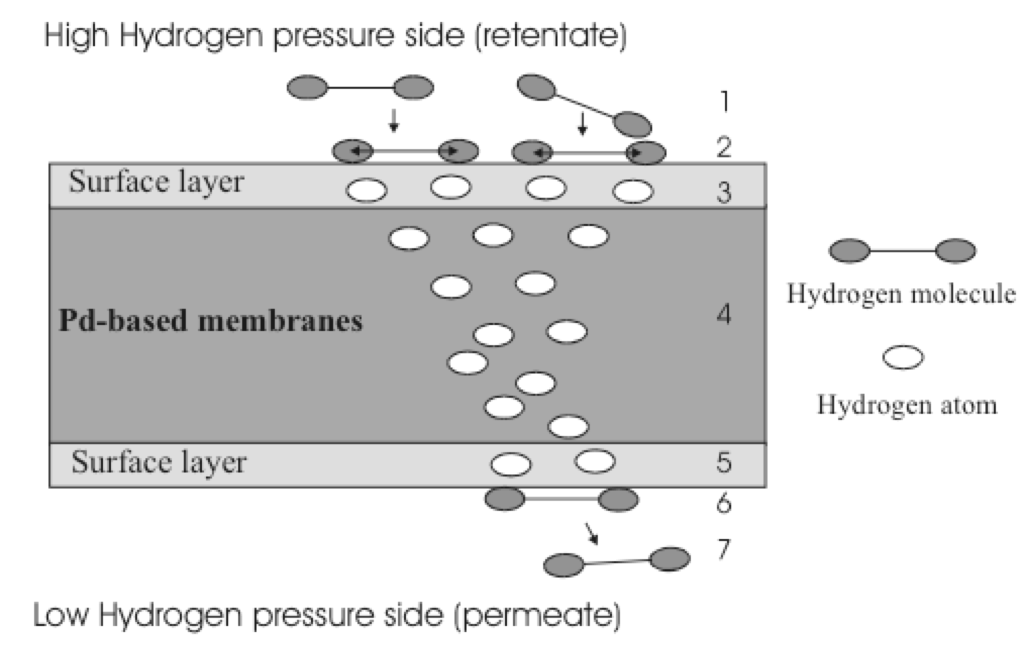
These operate at 300 to 500 C and 1 to 5 atm. The membranes are typically 1 to 10 microns thick, and some have worked at various MEMS-related approaches to getting this down to as low as 50 nm. Generally, the Pd is alloyed with Ag or Cu (77% Pd/23% Ag) to improve the stability of the membrane with temperature cycling.
I think the pnc-Si membrane offers some unique advantages because of the length scale of the pores, the smoothness of the surface, and the relative simplicity of fabrication (compared with FIB-processing a membrane to create sub-micron scale pores).
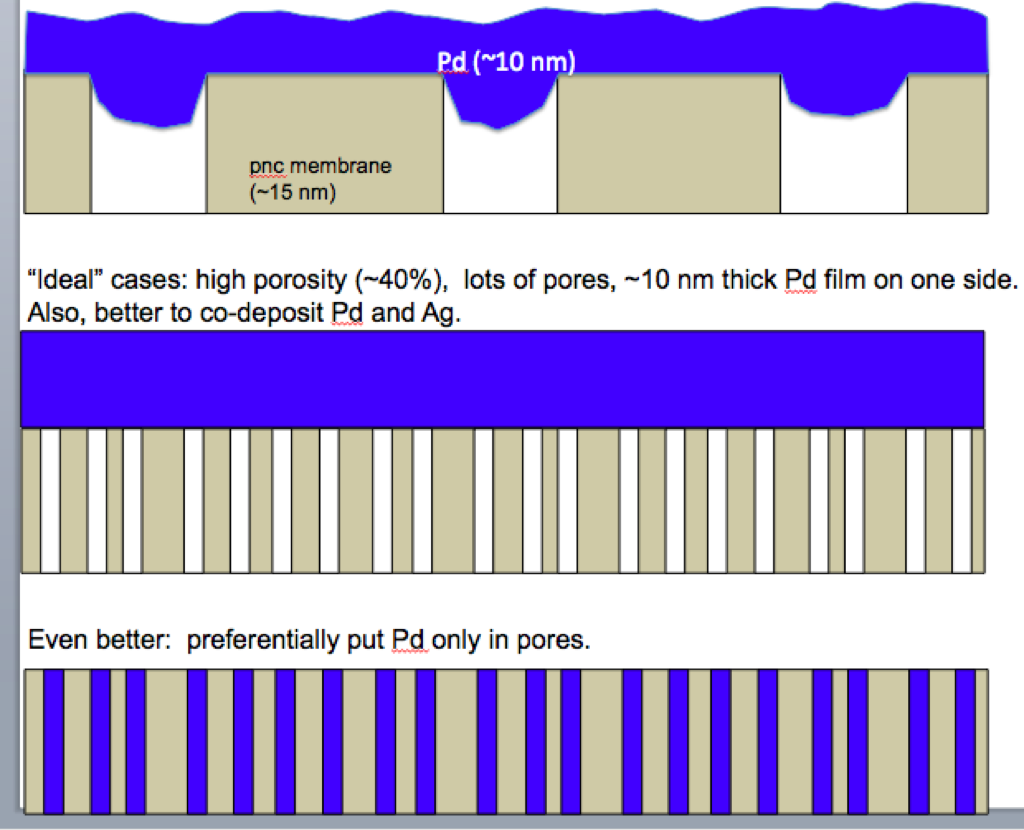
I am wanting to create as thin a Pd/Ag film as possible using the pnc-Si membrane as a scaffold. Sort of like the top cartoon below. I’m also showing a couple ideas of what I think would be a better geometry.
A couple of belated questions on this (possibly repeating our NRG discussion)
1) Are the current Pd membranes freely suspended over large areas? Are they supported by another material? If so what is that material?
2) Thinner would be better why again? Our membranes couldn’t operate at the higher pressures, but they could generate high H flux at lower pressures. Is this the goal?
Q1: Current membranes are typically supported on porous alumina frit that is 100’s to 1000’s of microns thick. Roughness of such supports are easily a couple orders of magnitude greater than the pnc-Si, so getting Pd film that is much less than about 1 micron w/o getting lots of holes is not feasible. Some folks have explored Pd membranes on microfabricated substrates and even nano-fabricated ones using FIB to create the nm-scale holes and channels through the support). Using these approaches, people have gotten to as low as about 200 nm thick Pd membranes and demonstrated correspondingly better H2 fluxes.
Q2: Permeation of H2 is directly dependent on the thickness of the Pd membrane and the cost of the device is also. Ideally, we’d have a thicker pnc-Si (or SiN, SiOx, etc.) w/ lots of very small pores (at least at one surface) so that we could seal the pores w/ a relatively thin layer of Pd. This would give higher H2 flux (thin Pd film, lots of available area for flux) while providing reasonable strength.