Why TEER Values are Multiplied by Membrane Area (DC Version)
Transendothelial electrical resistance measurements are expressed in the units  . Where the measured resistance is multiplied by the area of the membrane to enable a comparison between measurements in different systems. We have often wondered why, but the reasoning for this normalization is straightforward. Consider the simplified ‘transwell’ geometry where a membrane separates two compartments all with the same cross-sectional area, A. The distance between ‘chopstick’ electrodes is d and the media (including the membrane) is characterized by a single conductivity σ.
 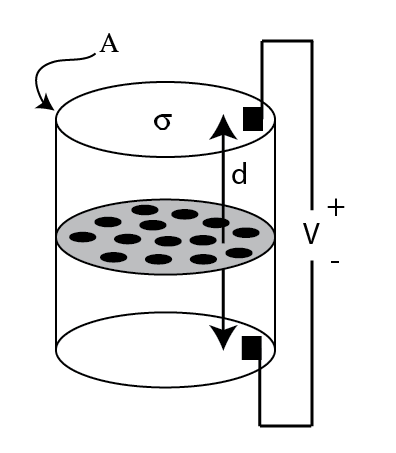 We start with these four familiar equations …
- Ohm’s Law: (1)

- The continuous form of Ohm’s law (2)

- J is the current flux and is thus related to the current by (3)

- Finally is the definition of the electric field (4)

Substituting eqs. 4 and 3 into 2 we get
(5) 
Rearranging for the resistance (eq. 1)
(6) 
Multiplying by the ‘normalization’ factor A, clearly makes this independent of the transwell used so long as the electrodes are the same distance d apart and the media σ is the same.
(7) 
The reasoning above explains to a first approximation, why the ‘normalization’ with an area has become the convention for these measurements. However the assumption that the electrode distance is fixed between the many systems reporting resistance values is a sketchy one. This is especially true when one moves to microfluidic systems (which is addressed in this LOC paper) but also true with chopstick systems used on different transwell geometries.