Analysis of hydraulic permeability calculated from centrifuge experiments
The current method of testing water permeability through SepCons is to place a volume of water inside a SepCon and spin it inside a centrifuge. After a set period of time, the volume passed is collected. The “approximate” permeability can be calculated as: volume passed/(pressure*area*time of experiment) in units of uL/PSI/cm^2/min.

The reason this is an approximation is because as the SepCon passes water, the fluid height decreases and thus reduces the effective driving pressure (P = ρ*g*h, where ρ is the density of water, g is the amount of g force exerted by the centrifuge, and h is the water height). With some help from Jim and Tom, we derived the following equation that takes into account this continuous decrease and can write the true permeability as:
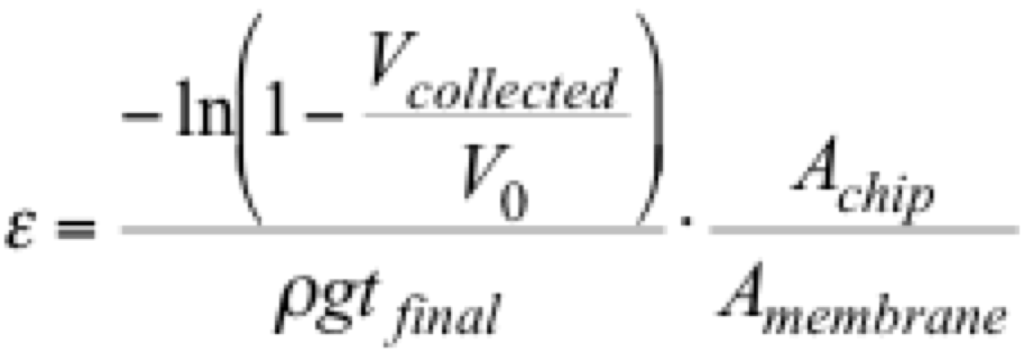
Where Vcollected is the volume passed, V0 is the starting fluid volume, tfinal is the spin duration, Achip is the area of the SepCon, and Amembrane is the active area of the membrane.
For our current geometry, a 5-slit square SepCon:

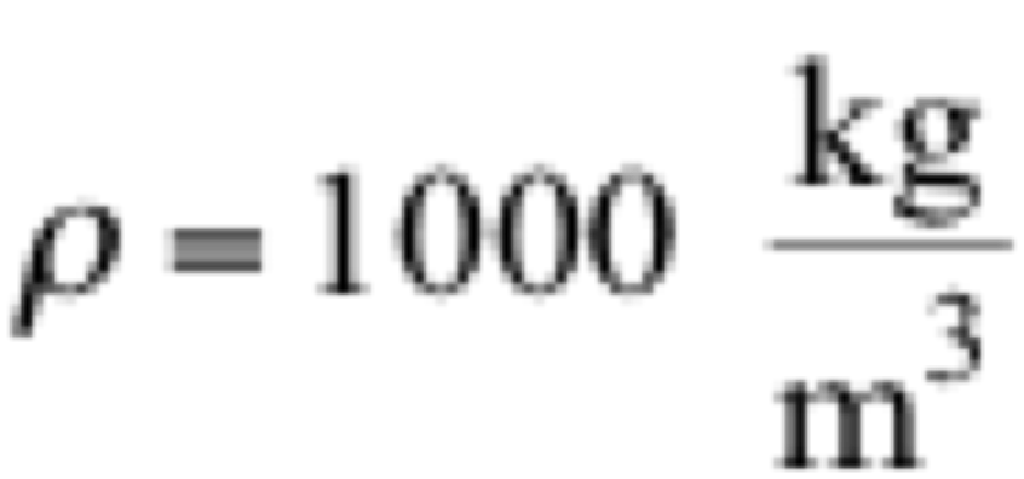
The density of water is:
The initial volume was:

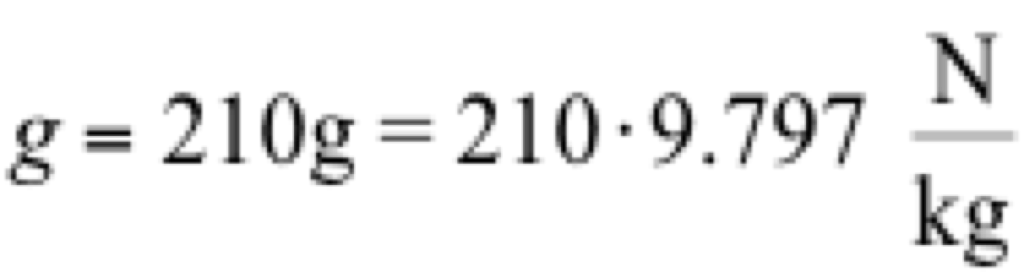
At 2000 RPM in the swinging bucket centrifuge, the g-force is:
Here is a graph showing the approximate permeability and the adjusted permeability over a range of volumes passed.
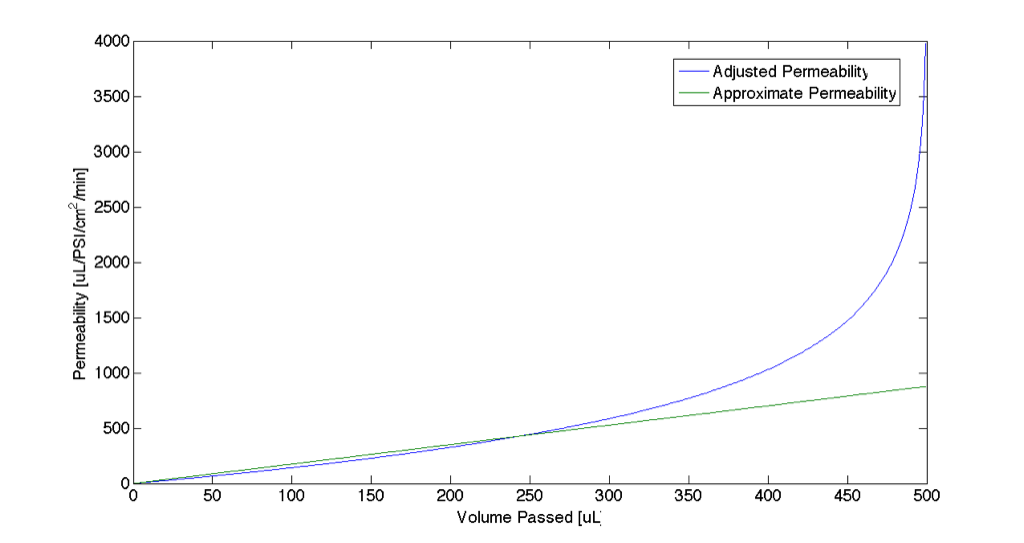
It appears that when less than 240 uL passes, the approximate solution over-estimates the permeability. Volumes greater than 240 uL are grossly underestimated.
Due to the added complexity that is introduced by using the centrifuge configuration, I will be working on creating a simple pressure cell that will be able to apply a constant driving force.
Don’t we already have the pressure cell?
I’m commenting so that I can find this easily