Diffusion boosts sieving coefficients in dead-end filtration through pnc-Si
One of the features of the gold nanoparticle separations in SepCons that was under-appreciated by the reviewers at Science was the fact that we could get very high sieving coefficients in the neighborhood of the cut-off. For 5nm gold the sieving coefficient was 0.8 (i.e. the filtrate was 80% as concentrated as the stock solution) despite the fact that 10nm gold did not pass through this membrane. In rewriting the manuscript I wanted to emphasize this performance and argue that is a direct result of the extreme membrane thinness. Unfortunately, I couldn’t explain the result theoretically and so my writing came to a screeching halt. Lately, I’ve been digging through old papers for help. I’m getting closer to understanding why thinner really is better when it comes to sieving coefficients for normal flow through membranes. I’ve discovered that diffusion through the membrane helps keep sieiving coefficients high relative to convective transport alone. Pnc-Si is the only ultrafiltration membrane where diffusion can outpace convective transport even in normalized flow.
We can appreciate the result from a pretty complex looking equation found in Mochizuki(Zydney) JM S93

The hindrance factors are a function of the ratio of the molecule size to pore size. For diffusion this factor is essentially given by the Renkin equation you’ve seen Jess talk about. There is a similar expression for convection. The derivation of this equation and all its parts can only be appreciated by studying the Zydney paper and several others I’ve uploaded to this page on the journal club. I estimate the velocities through our pores are around 0.2 cm/s when there is no particles or protein present. The presence of gold seemed to slow filtration rates by another factor of 4 or so. Using the formula above, here is a rough diagram for the expectations for 5nm gold through 25 nm pores in 15nm membranes vs. 500 nm membranes (typical ultrafiltration skin thickness).

So our results are pretty close to expectation. This doesn’t explain all of our data, but it does make the case that we should see higher sieving coefficients than thicker membranes. The reason for the enhancement is that diffusion is at work in our membranes. The quantity appearing in the above equation …
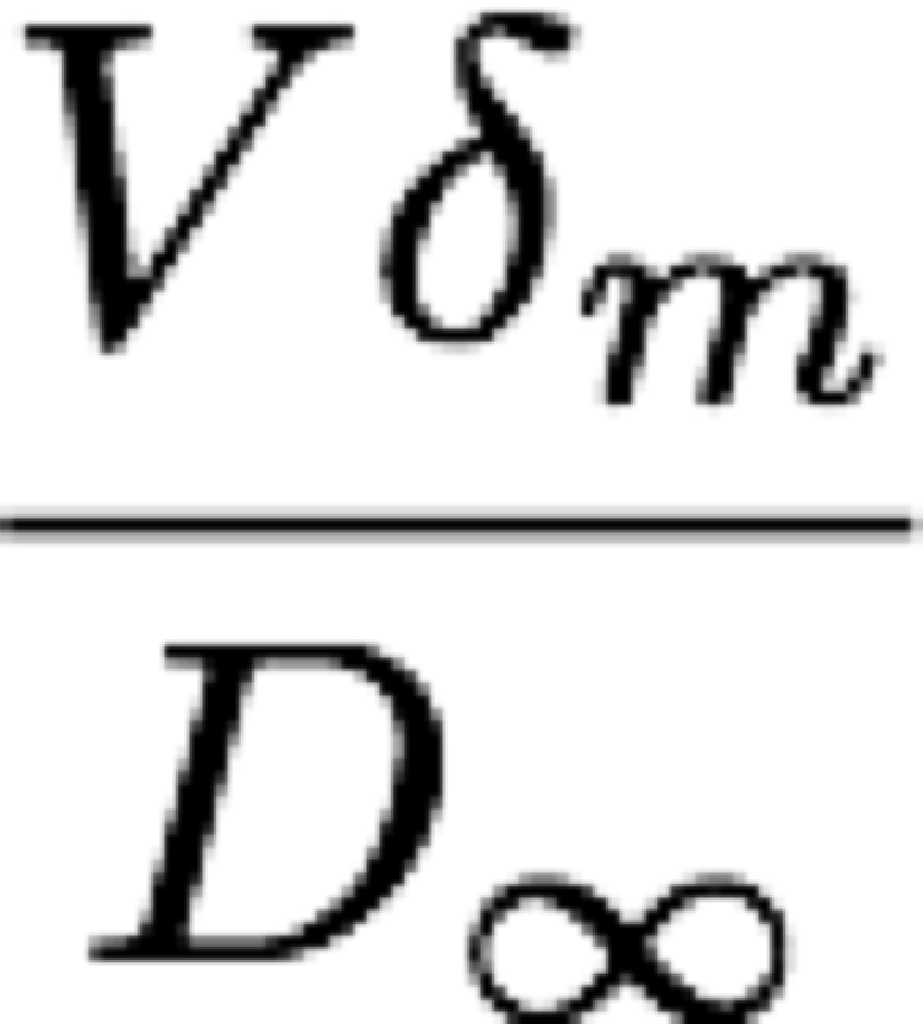
is known as the Peclet number. The Peclet number is the ratio of convective transport to diffusive transport. For our membranes the Peclet number <<1 whereas for commercial membranes it is typically >> 1. A mechanistic explanation of how these transport mechanisms affect sieving is still to come, but based on Zydney’s equation, we can appreciate why pnc-Si should provide higher sieving coefficients with normal flow.
I really like this treatment. Thus far, I think we have not been very rigorous on the theory of sieving in convective modes. I think Jess has developed a good model for pure diffusion, but we really need a generalized model that incorporates both diffusive and convective effects that we can use to support our experimental results. I/We have commented that diffusion can potentially compete with convection in our ultrathin membrane, but have no solid theory to support it.
I’m looking forward to the rest of the story…