Woods Hole Workshop on Microplastics in the Oceans
Summary: Dan and I went to Woods Hole Oceanographic Institute to learn about the current state of microplastics research. There were a number of things that we learned that we did not know. The common sentiment among researchers agreed climate change was a much bigger threat to humans than microplastics, but the reality and immediacy of microplastics in the environment was much easier to communicate. A multi-stakeholder model among industry, academia, volunteer groups, and policy makers was recommended to keep trash out of the ocean. There were still some arguments over terminology. Detecting nanoplastics in the environment is seen as a difficult technical challenge. The level of microplastic contamination in the environment estimated currently is anywhere between 10-1000x less concentrated than commonly studied in the laboratory. There were many calls for making sample standards via cryogrinding from NIST for labs to compare methods. Lots of basic science to be done yet!
Tuesday, October 15, 2019
Lillie Auditorium, 7 MBL Street, Woods Hole
Observations: The large Adventure Science Microplastics study showed the impact of microplastics on wildlife (think birds with stomachs full of undigested plastic), but it is difficult to extrapolate any of the toxicity effects seen in the labs due to large dose sizes. Major Questions: How much plastic entered the ocean? What routes? What are the debris characteristics? How are they transformed? Are we at risk. Knowledge is not hindering solutions to microplastic pollution, attitude and habit are. If the plastics industry is 1.5% of the world economy, growing at 3% yearly, what level of resources should we devote to reducing microplastics in the oceans, and how do these costs change?
One particularly shocking thing to me was the fact that the lifetime of plastics degradation has not been peer reviewed anywhere, the estimates from 1-1000 year lifetimes have come from a few different institutes. A lot more work needs to happen based on the photodegradation and weathering mechanisms of these heterogeneous polymers.
| 6:30pm | Open Public Event: Microplastics in the Ocean: Emergency or Exaggeration? This will be a public forum with keynote speaker Dr. Kara Lavender-Law (Sea Education Association) followed by a panel discussion of the global significance of microplastics with Chelsea Rochman, Hauke Kite-Powell, Gunnar Gerdts, Shige Takada and Colin Ward, all experts and global leaders in microplastic research. The panel discussion with the audience participation will be moderated by U.S. National Public Radio science reporter Dr. Heather Goldstone. |
| 8:00pm | Reception and Icebreaker (Tent next to Redfield Building) |
Wednesday, October 16 – Redfield Auditorium, Woods Hole
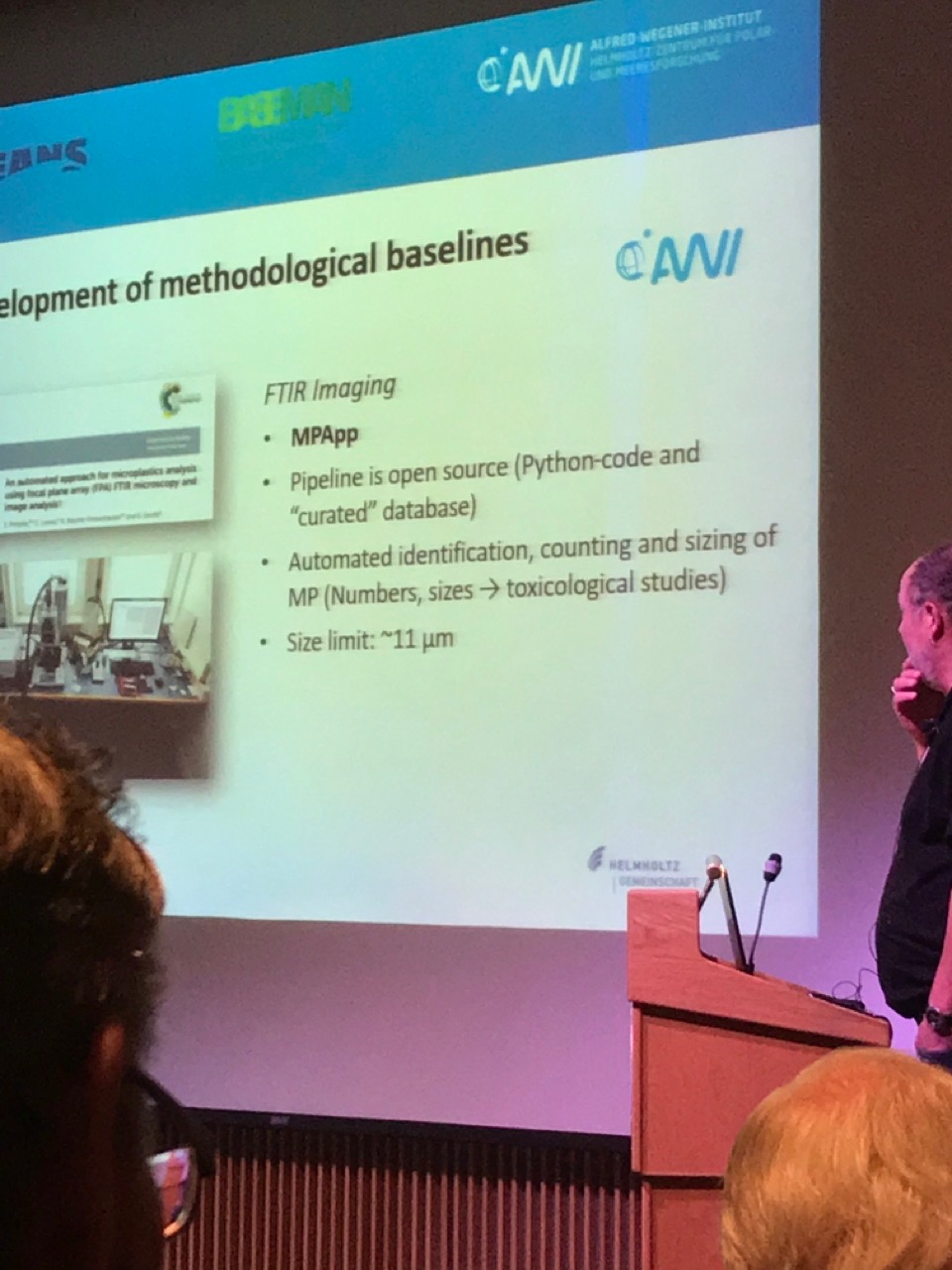
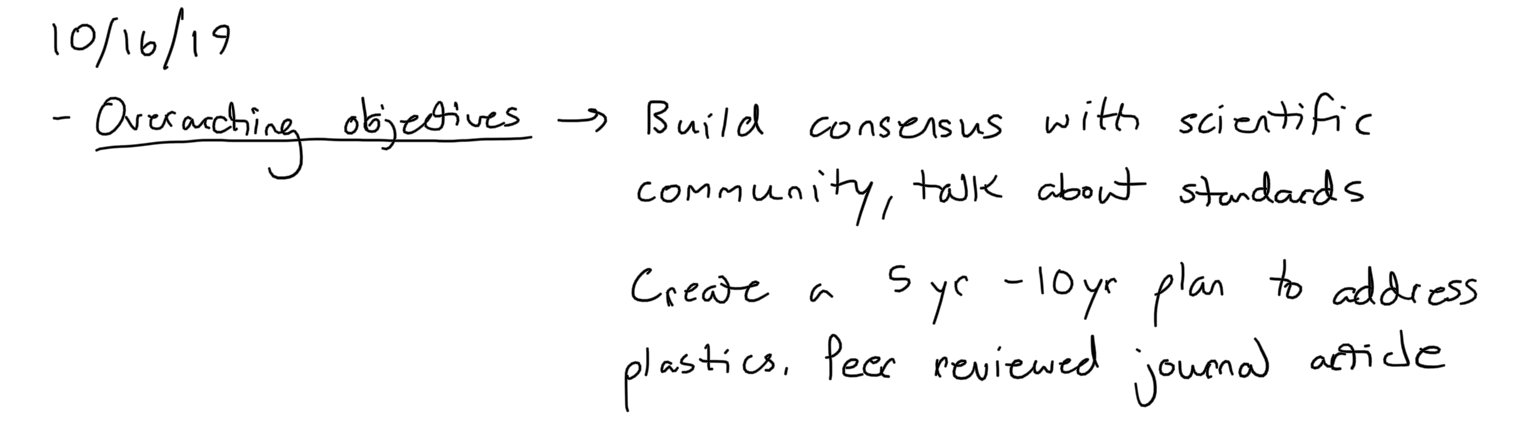
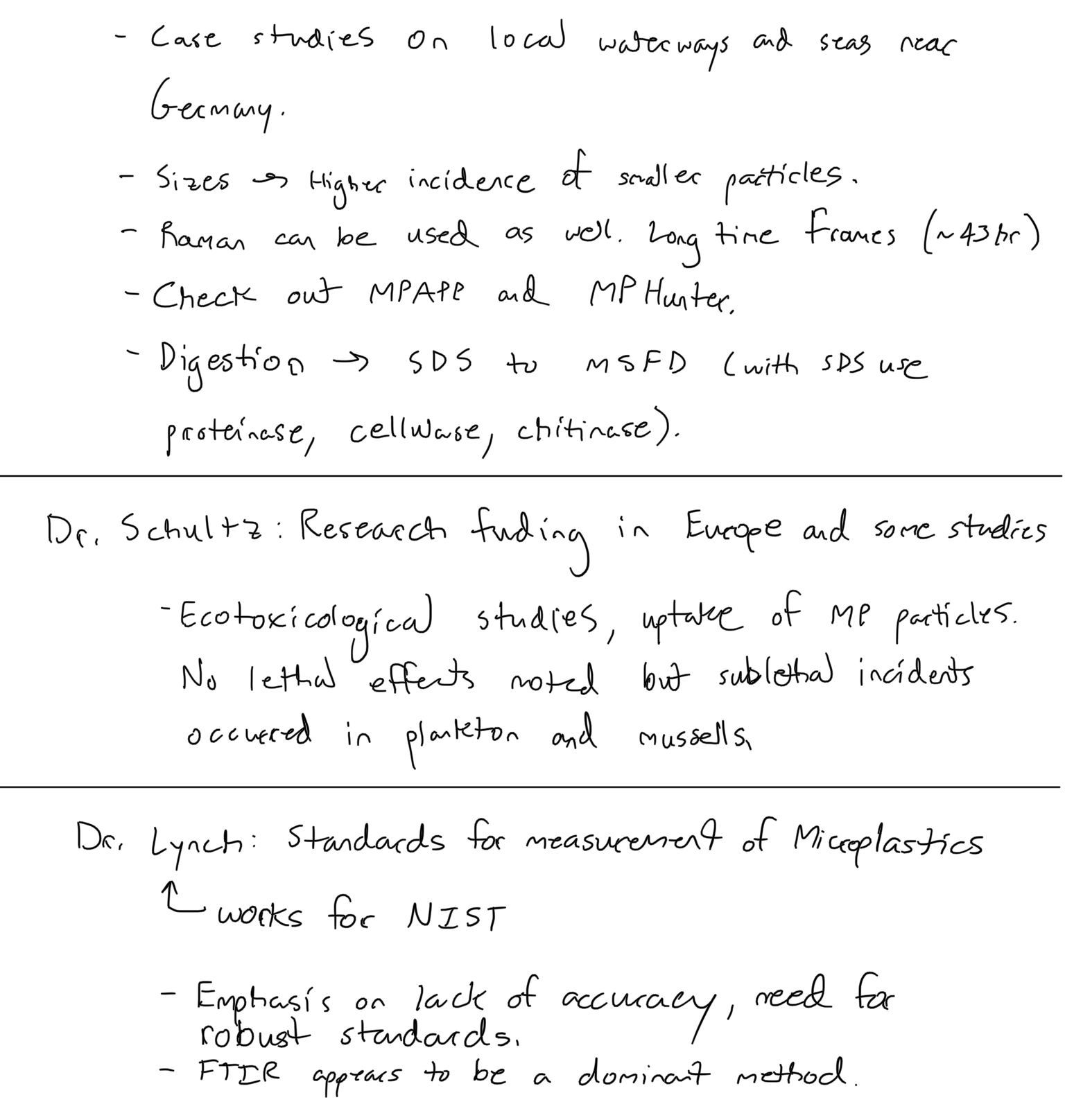
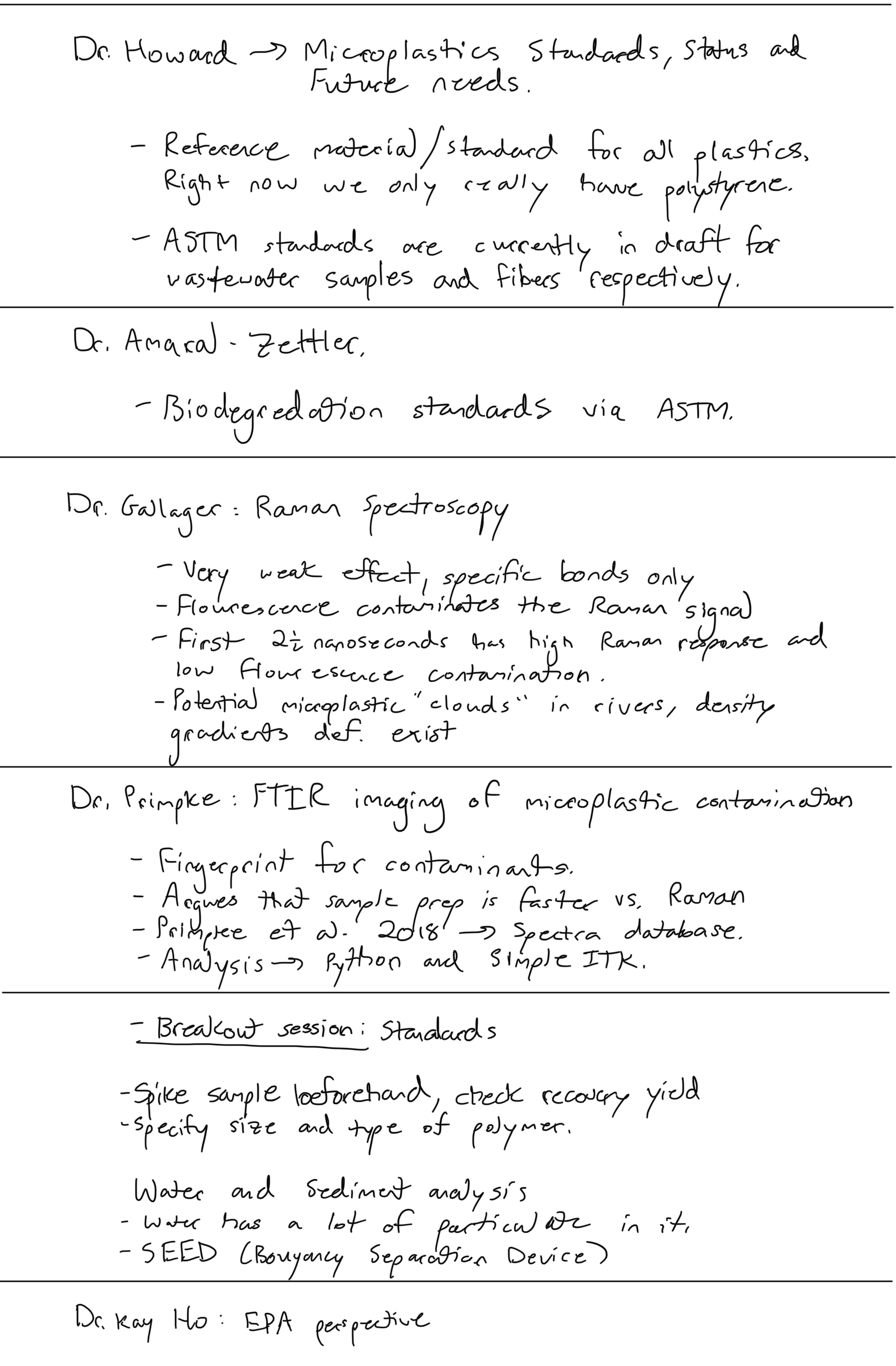
Observations: Building consensus with the scientific community is of immediate importance. Any standards that are created are going to be specific for certain kinds of information gathering. Some work needs to be done on standards that can be scaled up and automated. FTIR seems to be a favored technique, though Raman is in second place. There are libraries for common plastic signatures in FTIR and Raman, freely available for download (MP Hunter).

| 8:00am | Morning refreshments |
| 8:30am | Welcome and Introductory Remarks (Scott Gallager, WHOI, and Rick Murray, Deputy Director and Vice President for Research, WHOI) |
| 8:45am | Report out on Summary of Critical questions from questioner survey |
| Summaries of Recent Major Workshops (Moderator: Scott Gallager) |
|
| 9:00am | Richard Thompson (University of Plymouth, UK)(remote presentation), Marine Litter are there solutions to this global environmental problem? |
| 9:30am | Bart Koelmans (Wageningen University & Research, Netherlands), Microplastic in Nature and Society: Science Advice for Policy by European Academies (SAPEA) |
| 10:00am | Break |
| Summaries of major academic programs (Moderator: Scott Gallager) | |
| 10:15am | Gunnar Gerdts (Alfred Wegener Institute), Defining the Baselines and Standards for Microplastics Analyses in European Waters (BASEMAN), lessons learned |
| 10:45am | Isabelle Schultz (JPI – Oceans Program), Ecological aspects of microplastics: JPI Oceans aligns research across 16 countries |
| The Need for Standards and Best-Practices in Sampling and Reporting Methods (Moderator: Scott Gallager) |
|
| 11:15am | Jennifer Lynch (National Institute of Standards and Technology, Hawaii Pacific University, Center for Marine Debris Research), Standards for Measurement Science of Microplastic Pollution |
| 11:35am | Brett Howard (American Chemistry Council), Why Standards are Necessary |
| 11:55am | Linda Amaral-Zettler (NIOZ Royal Netherlands Institute for Sea Research) (remote presentation), Next-Generation Science for Microbial Biodegradation Standards for Biobased Plastics |
| 12:15pm | Lunch |
| Current State-of-the-Art in Polymer Classification from Lab and Field Samples (Moderator: Anna Michel, WHOI) |
|
| 1:00pm | Claire Gwinnett (Staffordshire University), The use of Forensic Fibre Examinations for Microplastic Studies |
| 1:20pm | Scott Gallager (Woods Hole Oceanographic Institution), Microplastic Particle Analysis of Hudson River Surface Water Using Novel Flow-Through Imaging Raman Spectroscopy |
| 1:40pm | Sebastian Primpke (Alfred Wegener Institute), Harmonized Analysis of Microplastics by FTIR Spectroscopy and Imaging |
| 2:00pm | Ashok Deshpande (NOAA Fisheries), Plastic Polymer Quest Using Pyrolysis GC-MS |
| 2:20pm | Break |
| 2:30pm | Plenary: Introduction to Breakout Groups |
| Groups 1-4: Sampling, processing, and reporting standards (water column, sediment, biota, standards for interlab calibration) | |
| Groups 5-8: Sensing and detecting MPs in the environment. What new technologies are needed to develop a global MP budget? | |
| 3:40pm | Breakout Groups Switch Topics |
| 4:40pm | Plenary report-out |
| 5:45pm | Shuttle to Clark Lab |
| 6:00pm | Poster session and Reception – Clark Lab 507, Quissett Campus |
Thursday, October 17 – Redfield Auditorium, Woods Hole
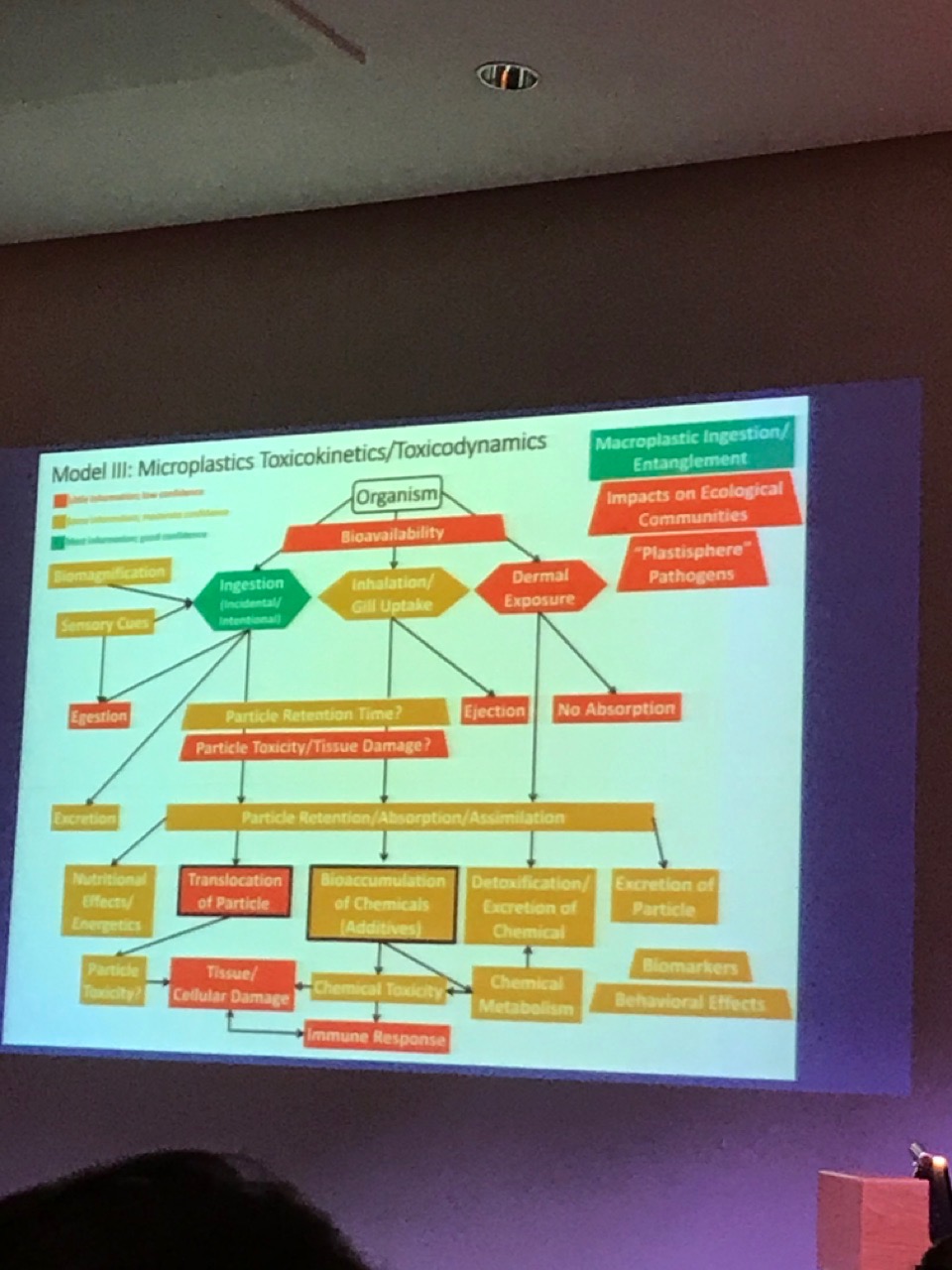
Observations: Ephimare is a program to test persistent pollutants and microplastics as a vector for delivery. Additives are probably more toxic than the plastic itself. Plastox showed the accumulation of microspheres in fish larvae/juveniles. Particles bigger than 20 microns were readily excreted.
Anthony Andrady: Weathering of plastics in seawater did not occur on the surface, but, oxidation seemed to occur (validated with XPS). Hydroxyl groups weather long polymer chains because they are more mobile. Plastics on land turn into microplastics much better due to the oxidation AND the weathering.
Colin Ward: Partial oxidation is important to the fate of most polystyrenes. Lifetimes for degradation are on the decade to century timescales based on this mechanism. Additives may increase the degradation rate by absorbing visible light. No models with comprehensive fate pathways exist at the moment.
Matt Macleod: Are plastic polymers themselves the source of chemical contaminants that pose risk to the environment. Acute Toxicity requires high concentration, chronic exposure hasn’t been studied yet. Oxygen diffusion into the plastic seems to be important. Photochemical reciprocity is tough (hot and short will produce different products than long and slow).
Won Jon Shim – Need 3 things to photodegrade: High temp, oxygen, and sunlight. 500 million nanoplastics vs 10 million microplastics produced from weathered polystyrene. EDS used to confirm the plastics.
Eric Zettler – Microbes alone will not cause microparticles to sink. Surface area to volume ratio is high for sheets and films; if enough microbes bind to the film, they may sink.
| 8:00am | Morning refreshments |
| Summaries of Government and NGO program overviews (Moderator: Carlie Herring, NOAA) |
|
| 8:30am | Carlie Herring (NOAA Marine Debris Program), Summary of the NOAA Marine Debris Program and Research Priorities |
| 8:50am | Kay Ho (U.S. Environmental Protection Agency), Microplastic Research and Preventative Measures at the US Environmental Protection Agency |
| 9:10am | Kim Warner (Chief Scientist for Oceana.org), Marine Plastic Pollution- An NGO perspective |
| 9:30am | Rachael Miller (Rozalia Project for a Clean Ocean), Microplastic field science, supporting innovations and developing curriculum |
| Assessing the Fate of Plastics- Mechanisms of Fragmentation and Colonization (Moderator: Collin Ward, WHOI) |
|
| 9:50am | Anthony Andrady (North Carolina State University), Degradation and Fragmentation of LDPE in Sea Water |
| 10:10am | Collin Ward (Woods Hole Oceanographic Institution), How long does plastic last in the environment? |
| 10:30am | Coffee Break |
| 10:45am | Matthew MacLeod (Stockholm University), Chemical and toxicological characterization of chemicals released from plastic polymers under ultraviolet light |
| 11:05am | Won Joon Shim (Korea Institute of Ocean Science and Technology), Producing secondary nano- and microplastics by photooxidation and (or) mechanical abrasion |
| 11:25am | Erik Zettler (Royal Netherlands Institute for Sea Research), Assessing the Fate of Plastics: Colonization and density changes |
| 11:45am | Lunch |
| Impacts on Ocean Ecosystems (Moderator: Mark Hahn, WHOI) |
|
| 12:30pm | Evan Ward (University of Connecticut), Examining the use of marine bivalves as indicators of microplastic pollution in the environment |
| 12:50pm | Chelsea Rochman (University of Toronto), What is known and unknown about the effects of plastic pollution on wildlife |
| 1:10pm | Bart Koelmans (Wageningen University), Thought experiments to understand the impacts of microplastic on the (marine) environment |
| 1:30pm | Tracy Mincer (Florida Atlantic University), Microplastics in the Ocean’s Interior |
| 1:50pm | Dror Angel (University of Haifa, Israel), Microplastics in the Levant – a snapshot from an ocean desert |
| 2:10pm | Hideshige Takada (Tokyo University of Agriculture and Technology), Hazardous chemicals in marine plastics and their threat to marine organisms |
| 2:30pm | Break |
| 2:40pm | Plenary |
| 2:45pm | Breakout Groups |
| Groups 1-4: Degradation pathways of particles, fibers, and nanoplastics | |
| Groups 5-8: Impacts on organisms in the water column, epifauna and infauna | |
| 3:45pm | Breakout Groups Switch Topics |
| 4:45pm | Plenary report-out |
| 5:45pm | Walk to Swope Building |
| 6:00pm | Poster Session, Reception and Workshop Dinner – Swope Building, Woods HoleGuest Speaker: Rachel Meidl (Rice University, Baker Institute for Public Policy), Plastics, sustainability, and the circular economy |
Friday, October 18 – Redfield Auditorium, Woods Hole
Michalea Meyns: Nanoplastics from basics to analysis. Most particles are smaller than 200 microns, in arctic sea ice 10^6 particles/m^3 vs in snow 10^3 particles/m^3. Primary nanoplastics come from microplastic production, medicines, additives in cements. Developing silicon nanomembranes in ordered array to capture nanoplastics (almost ready). They use AFM and FTIR to ID individual nanoparticles.
Tanja Kogel: Microplastic and nanoplastic quantification and effect studies don’t match (review paper submitted). Nanoplastics have some effects observed, but the dose is extraordinarily high. PVC dominates nanoplastics, but PE dominate microplastics
Jellyfish mucus is good for collecting nanoparticles!
| 8:00am | Morning refreshments |
| Industry and Foundation Overviews The role of industry in research, technology development and clean-up (Moderator: Brett Howard, ACC) |
|
| 8:30am | Brett Howard (American Chemical Council), The American Chemistry Council and industry efforts to understand microplastics |
| 8:50am | Ron Abbott (Chevron Phillips), An Industrial View of the Global Plastics Problem |
| 9:10am | Todd Gouin (Researcher and Consultant ), Towards the development and application of an environmental risk assessment framework for microplastic particles |
| The Roles Modeling Can Play to Describe Distribution and fate of MP (Moderator: Jake Gebbie, WHOI) |
|
| 9:30am | Jake Gebbie, and Carol Anne Clayson (Woods Hole Oceanographic Institution), The search for the missing microplastics: how and where do microplastics get transported below the sea surface? |
| 9:50am | Mikael Kaandorp, (Utrecht University, Netherlands), How can we use Lagrangian models to explore microplastic particle behavior and properties? |
| 10:10am | Kara Lavender Law (Sea Education Association), Plastics as tracers to understand physical ocean processes |
| 10:30am | Coffee Break |
| Nanoplastics as a Particular Threat in the Food Chain and in Human Health (Moderator: Mark Hahn, WHOI) |
|
| 10:45am | Michaela Meyns (Alfred Wegener Institute), Nanoplastics – from basics to analysis |
| 11:05am | Tanja Kogel (Institute of Marine Research, Norway), Reviewing physiological effects of micro- and nanoplastic particles on water biota, the lack of quantitative data on them, and our efforts to provide them |
| 11:25am | Dror Angel (University of Haifa, Israel), Micro and Nanoplastics – can we reduce their flux into the environment? |
| 11:45am | Stephanie Wright (King’s College London), Microplastics as a novel air pollutant: challenges, implications and the future |
| 12:05pm | Lunch |
| 12:45pm | Breakout Groups |
| Groups 1-4: How can industry help, what should we be doing? | |
| What drives the perception of microplastic impacts with the public, policymakers and scientists? | |
| Groups 5-8: The fast track to modeling fate and transport | |
| Understanding mechanisms of NP impacts–Do they exist? | |
| 2:00pm | Plenary report out |
| 2:30pm | Final Plenary Wrap-up |
| What have we learned and where do we go from here? What is the 5-10 year plan? | |
| Develop major sections of the workshop report for manuscript | |
| 3:30 pm | Workshop closes |