Connecting electroosmosis and streaming potential
All electrokinetic phenomena are connected by a form of the Helmholtz-Smoluchowski equation. In the case of electroosmosis, the equation can be written as follows:

where v is the velocity (in m/s) of water flow through the pores, epsilon the permittivity, E the electric field, zeta the zeta potential, and eta the viscosity. Since we do not directly know the field, in order to find zeta potential from electroosmosis experiments we need to rearrange this equation. First if we multiply both sides by the area we get the following:
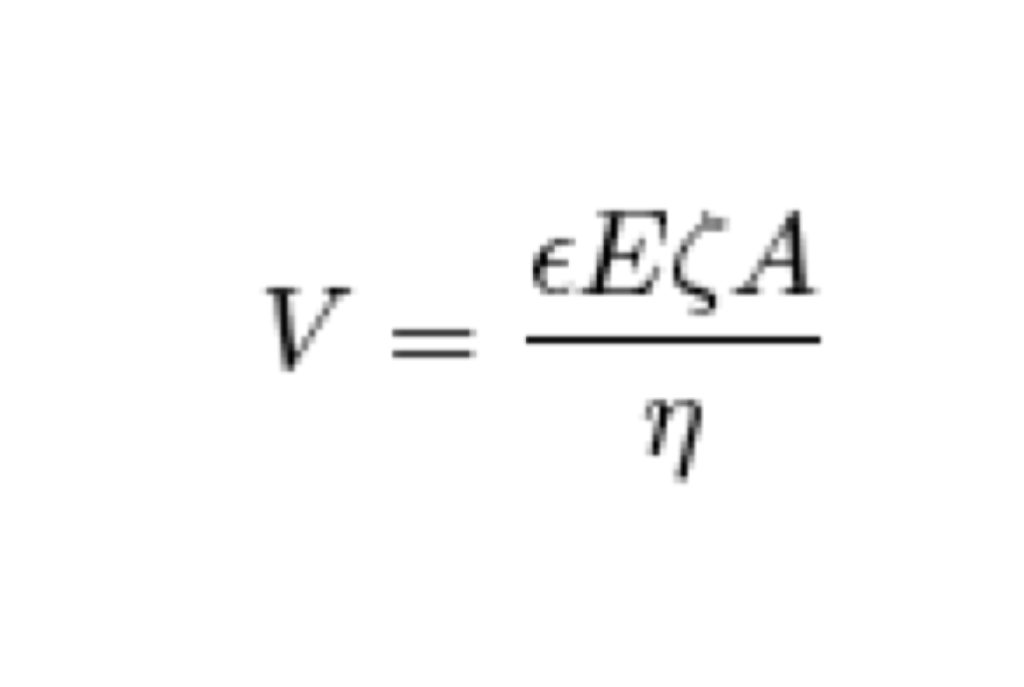
where V is the volumetric flow rate (m^3/s). We can use Ohm’s law (V=IR, also written as E=I/A*1/k) to further rearrange this equation:
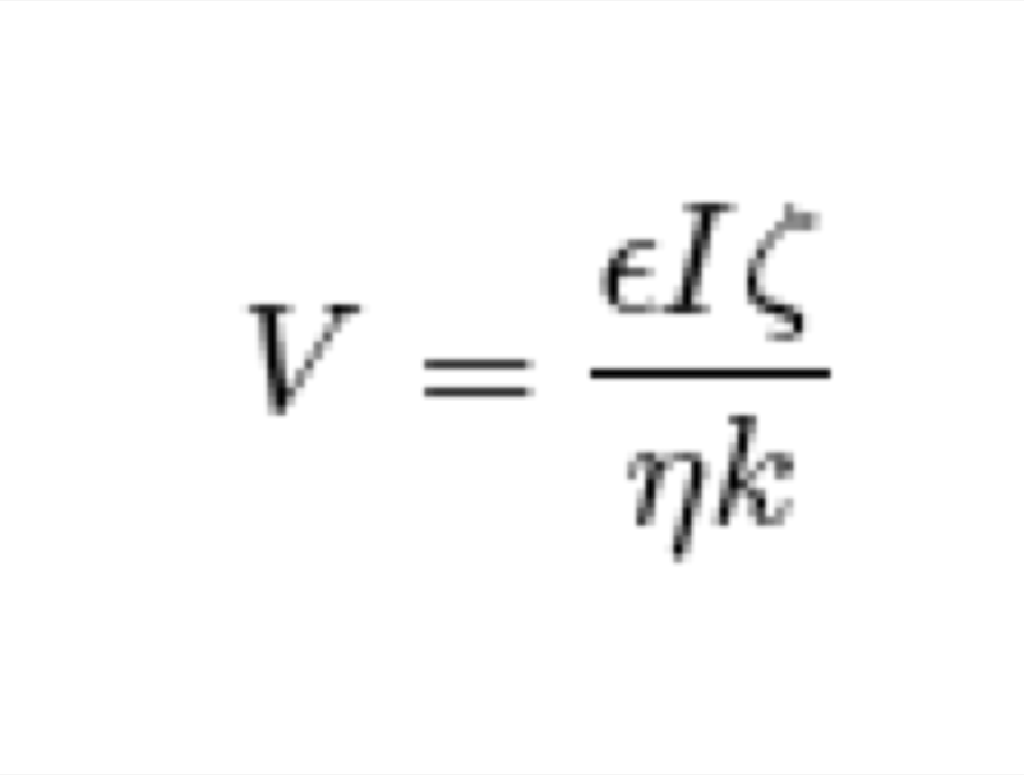
where I is the current in the system and k the conductivity.
I have measured volume flow of 100 mM KCl through PES in the following chart:

By using the flow rate from this chart and using knowledge about viscosity, permittivity, and conductivity I’ve calculated a zeta potential of -17.9 mV.
I’ve run a streaming potential experiment of this material in 100 mM KCl in order to calculate a zeta potential with the following form of the Helmholtz-Smoluchowski equation (which makes use of Onsanger’s recipricosity):

where delta E is the change in potential and delta P the change in pressure. From the streaming potential experiments I’ve calculated a zeta potential of -11.0.
In general, the literature shows some disagreement between electroosmosis and streaming potential calculations of zeta potential, usually with the electroosmosis presenting the larger value. There are a few things that could contribute to this difference, but I wonder if the electrolysis is changing the solutions enough over time thus changing the zeta potential. If the flow rate is taken at very early times, we can get the following chart:

For early times the flow rate is lower, resulting in a calculated zeta potential of -11.0. It’s surprising that this gives the exact same answer as the streaming potential, as there is still a lot of error in these processes, but I think we’re in the right area. The next step is to check pnc-Si zeta potentials via electroosmosis.