New sputtering system
The new sputtering system is scheduled for delivery at the end of June. It will bring several advantages over our current system; which translates (hopefully) into stronger and more consistent material. 75 days…
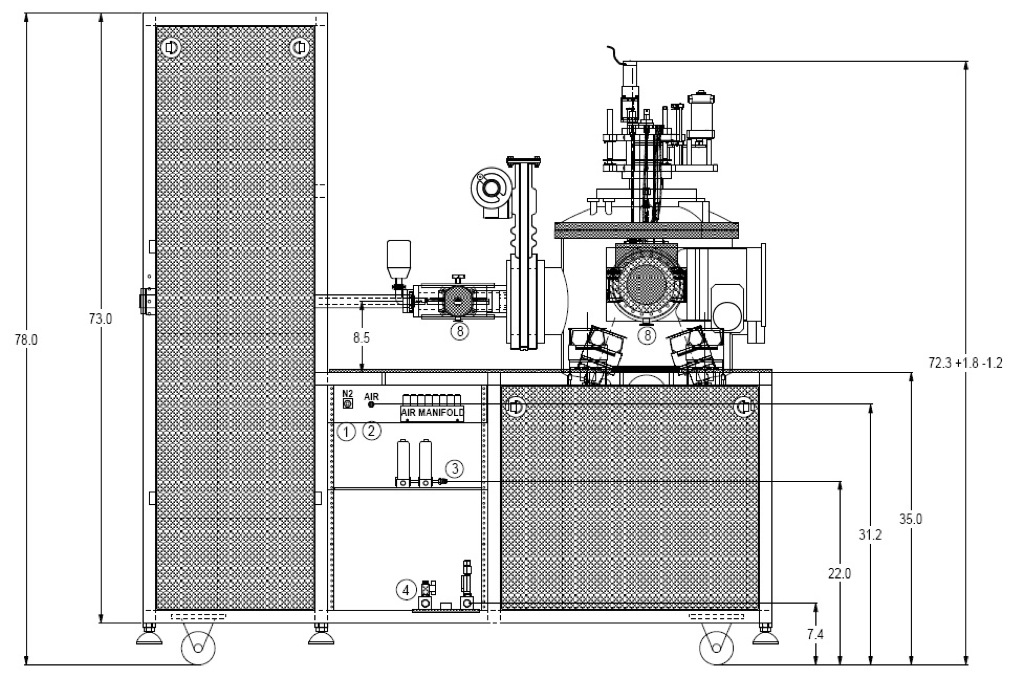

The new sputtering system is scheduled for delivery at the end of June. It will bring several advantages over our current system; which translates (hopefully) into stronger and more consistent material. 75 days…
As a quick update on the ECM masking with Parylene membrane, we made changes to the device designs. Instead of relying on the peel-off process, we used a simplified design, with the membrane serving as the roof of the channels. Here is the latest design: For these experiments we continued to use relatively low…
For last 1.5 years, I have been working on developing a COMSOL model to understand how the geometry of pncSi chips affects the TEER values when cells are growing on them. I addressed this issues in some of my previous blog posts. What was lacking in the previous post (which I thought was the concluding…
In previous experiments where the affinity based capture of EVs in ALine devices was tested, issues were encountered. It was noticed that when capturing EVs on the ALine, the non-biotinylated slit membranes had captured a higher quantity of EVs compared to biotinylated membranes. This conclusion led us to question if the flow through the ALine…
This was mentioned in the meeting today, and I’ll try to describe what’s going on here. We start out with a system with a smaller volume on the top of the membrane: If we start out with 10 mg/mL in the retentate, and assume perfect equilibrium of the protein/particle: The concentrations in each compartment would…
I’ve been going to considerable lengths to try and get reproducible zetapotential measurements from my streaming potential device. Zetapotential measurements are the closest we can experimentally get to measuring the surface charge of a membrane, and are important for three reasons. First, I need accurate surface charge data for the membranes if my electrostatic model is…
To supplement our upcoming manuscript, we decided that we needed to provide a visual of how thin our ultrathin SiO2 membranes actually are. To demonstrate the thinness of the SiO2 membranes, in comparison to the commercially available Track-Etched hanging membrane inserts, we performed a co-culture using 0.5µm high porosity SiO2 membranes (thickness ~0.1-0.3µm) and 0.5µm…