1st HUVEC TEER data
I recently completed some experiments with the Endohm system, which measures transendothelial electrical resistance (TEER). I seeded either 16.25k or 32.5k HUVECs (P5) on commercial polycarbonate (PC) or polyester (PE) transwells and on pnc-Si in the transwell format. I then tracked the TEER for 7 days. This data is normalized to the day 0 TEER reading (before cell seeding) so 100% indicates no change of resistance.
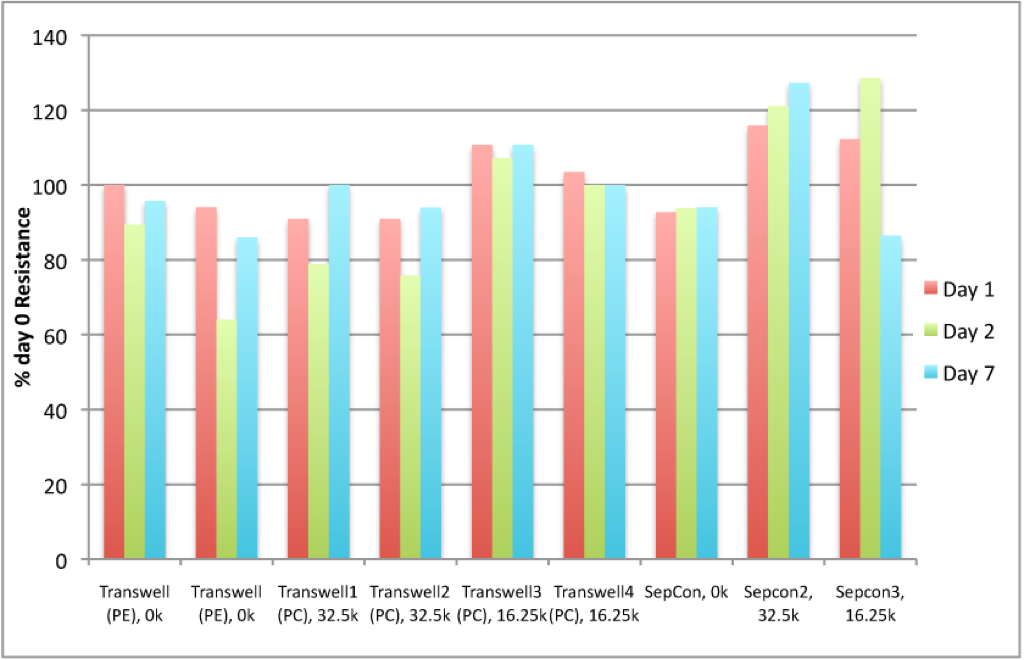
The commercial transwell data is all over the place. Transwells without cells showed a decrease in resistance over time. There was no trend with the transwells which contained cells at either density. I have a feeling that the HUVECs are not adhering very well to untreated commercial transwell membranes, and I’m starting to get some data to support this. The Sepcons performed really well! There was ~20-30% increase in TEER over 1 week for the Sepcons. The day 7 TEER fell on the last sample because the membranes broke after I measured the TEER on day 2. This is the first data to suggest that pnc-Si Sepcon transwells are more sensitive to cellular changes than commerical transwell devices.
This looks great for us, but if the commercial devices are this unreliable, why would anyone use them? Is all data normalized to the day zero TEER reading for PE? That is the only 100 value.
All data is normalized to its own day0 data. All of the transwells (except for the 1st PE) showed a decrease in TEER after a day. The changes aren’t really all that big. I think a big part of the problem is that I didn’t coat the transwells before seeding the cells, so adhesion was poor.