Surfactants tested to reduce agglomeration between IgG and 20 nm fluospheres
Mary Lee and I performed a quick test to determine the efficacy of different surfactants at reducing agglomeration between IgG and 20 nm fluospheres.
Each solution is a combination of 50 uL 10 mg/mL IgG (in PBS) + 50 uL 20 nm red Invitrogen fluospheres + 500 uL of surfactant.
We used 1 x PBS only, 1 x PBS and 0.1% PEG, 1 x PBS and 0.1% Triton X 100, 1 x PBS and 0.1% Tween 20, and the Pixy dust surfactant we’ve been using from our collaborators.
Imaged below are all of the variations (except the pixy dust) after 5 min at 5 krpm in the centrifuge. PBS alone resulted in rapid agglomeration and pelleting of the IgG and particles. The 0.1% PEG also had pelleting, but some of materials look to have stayed in solution. The Triton X 100 and Tween 20 performed similar to the pixy dust we have been using successfully in our more recent separation experiments. There are a few small specks of possible pelleted material in all three of the these more successful surfactants.
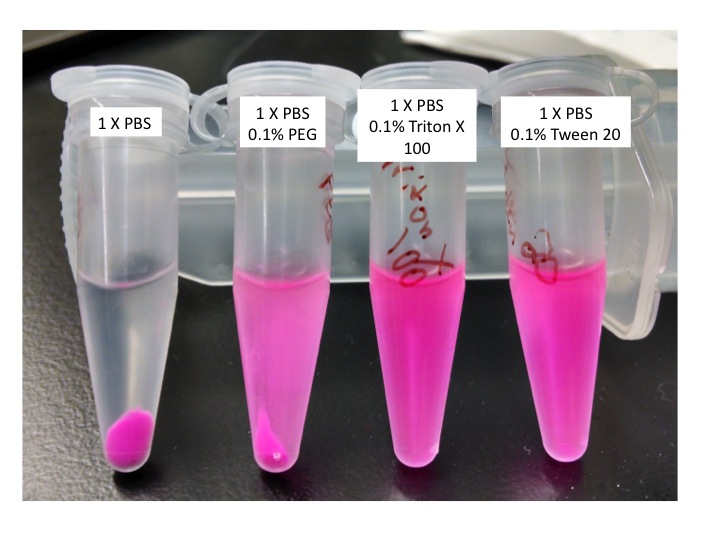
Following up on this relative success, we will try to use Triton X 100 and Tween 20 in the reverse centrifuge tests.
This is great progress, but there is one problem. The detergents would lyse cell membranes.
This is probably why the ‘pixy dust’ is not a detergent. So we need to find a biocompatible surfactant. PEG was a good choice and perhaps higher concentrations or shorter molecules might work? I also heard of this stuff called “pluronics’ you may want to check out.