Adsorption Quantification II
I’ve updated the figure from this post to add new data from oxidized and pre-washed glass samples. We now have possession of teflon material, which I will be testing this week.
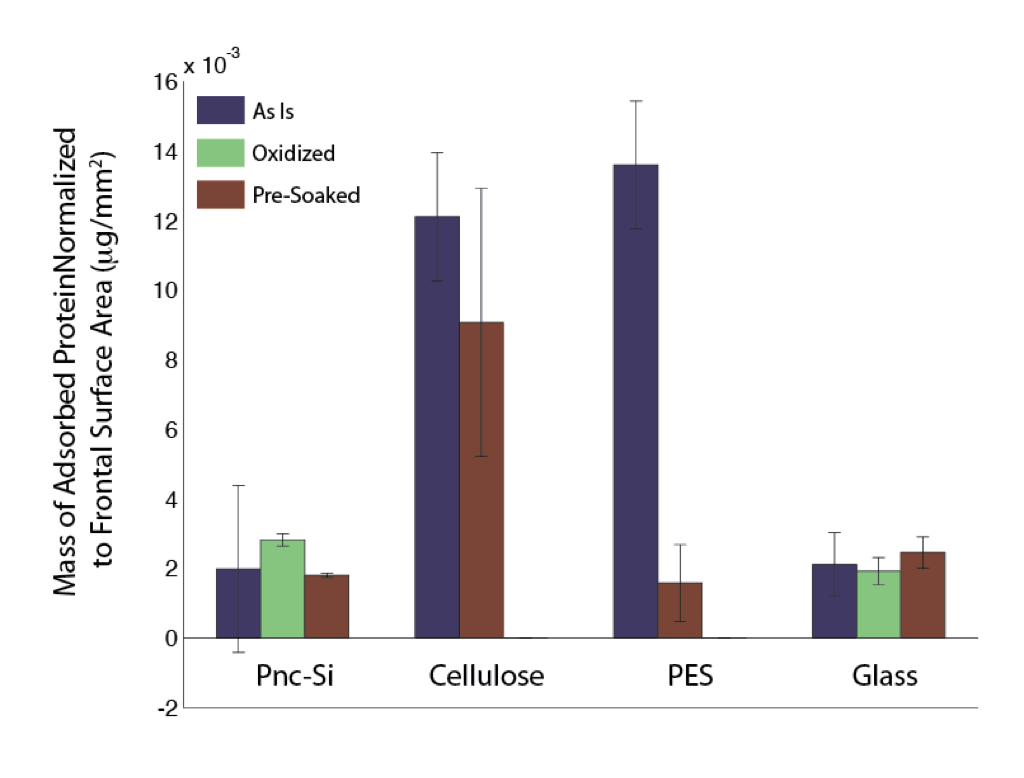
I’ve updated the figure from this post to add new data from oxidized and pre-washed glass samples. We now have possession of teflon material, which I will be testing this week.
Bob and I are trying to determine which wet etch would be appropriate to use to remove the native oxide inside the pores before membrane liftoff. The issue is when removing the native oxide, we will remove part of the membrane. So far, we removed native oxide from bare silicon wafers using 50:1 HF. For…
With some of the recent high porosity membranes being produced, I wanted to demonstrate that we can use ALD to create a movable cut-off without sacrificing too much in permeability. I took sc713 and coated it with 5 nm and 10 nm of Al2O3 i.e. I shrank the pore diameter by 5 and 10 nm….
I’ve been trying for some time to make chips that can dynamically change their surface charge. To this end I’ve made the following NFT chips, which have 12 nm of silver coated in 10 nm alumina: Note the Aluminum foil coating the insides of the gel box. The silver layer is either photoactive or…
Summary Since our last attempt, Greg and I have been attempting to refine our tenting experiments with the goal of demonstrating that we’re able to hydrate the volume underneath a nanoporous tent. This latest experiment is very similar to our previous experiment in theory, but we made some key changes which are discussed herein. Most…
The new bottle of PVP (polyvinylpyrrolidone) sitting on the shelf was calling my name this morning. I apologize that this post is long, but its pretty exciting – I think we have half-solved the wettability problem. According to MSDS sheets, PVP is soluble in water and alcohols. Since drying water on the membrane is a…
Purpose: Study the hemocompatibility of different substrates using platelet activation as the indicator. Extraction of platelet rich plasma (PRP): PRP were prepared from whole blood following the standard protocol outlined by Abcam (http://www.abcam.com/protocols/isolation-of-human-platelets-from-whole-blood). To describe briefly, 9 mL whole blood was centrifuged at 200g for 20 minutes in a 15 mL Falcon tube to obtain…