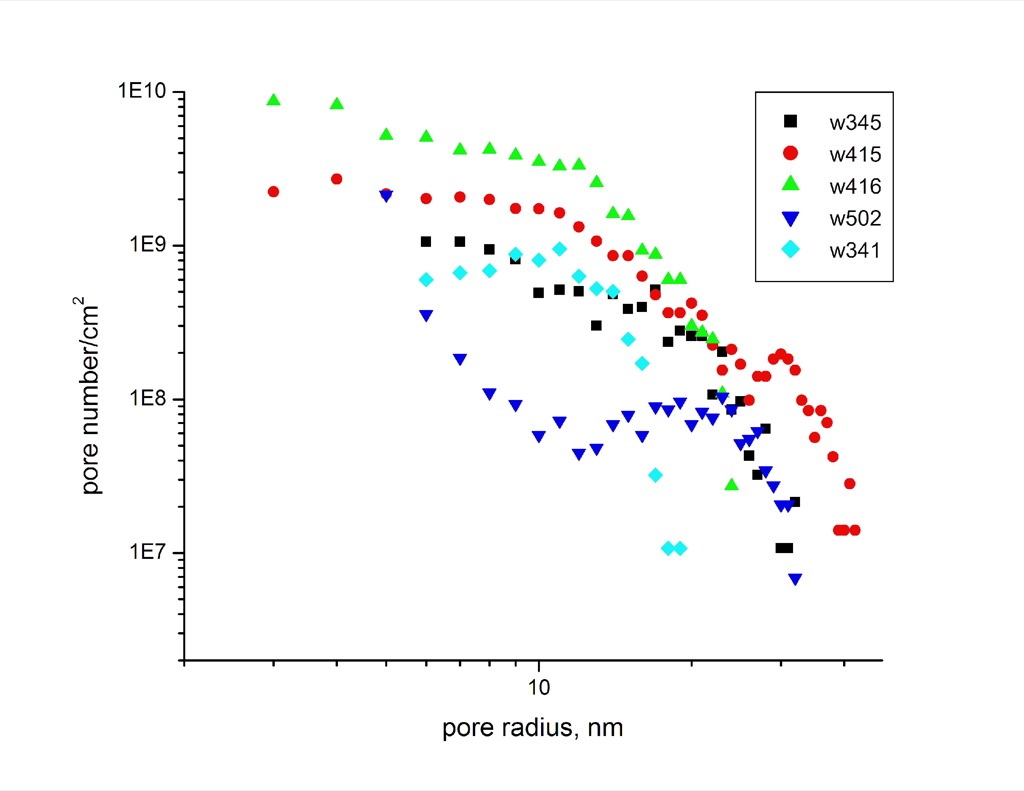
-2 Power law for density vs. pore size
Josh Miller and Elizabeth Hirschman (RIT co-op student working on STTR lift-off project) obtained preliminary successful results lifting off ~1 in2 sections of NPN membrane where the nanopores were only transferred into the nitride layer in a microporous pattern (ø3 µm pores, hex-close-packed on 6 µm pitch). Details of process are given below. Bruce…
First off – OK now on to the science. Wafer 747 has a huge amount of pinholes, and in this study I wanted to see how these pinholes would effect electroosmosis. I will show results here from two experiments with these holey membranes. These membranes have a lower rate of electroosmosis than previous tested membranes. …
In the wake of the apparent loss of all of the phosphatase in a sample that was placed into a CytoVu well, left for 24 hours, and then checked for phosphatase activity, it’s become clear that the adsorptive qualities of the CytoVu assemblies needs further characterization. I showed in an earlier post that there was some loss…
Yesterday I posted my results from a BSA diffusion experiment using “treated” and “untreated” SC269 samples. To ensure that the pores in SC269 are indeed open I took a step backwards and set up a diffusion experiment using small dye molecues; rhodamine and fluoroscein. Using Jess’ diffusion cell I set up a matrix to test…
We have previously observed some interesting transfer characteristics of our nanomembranes, using water vapor (breath) to delaminate and adhere them to glass and silicon nitride surfaces. Some membrane transfers do not appear to be stable (fragments or floats away when submerged and exposed to shear stress), while others can withstand shear stress at high rates…
I hope to bring this question to our group meeting. As we discussed before, we know that Cl- can be absorbed at the gold surface to screen the applied positive charge. We are using R6G as the filtration species, which is positively charged. So we must either use DI water as the buffer solution (we…