Recently, Jim has purchased a Makerbot 2x printer for our group. I’ve spent the last few weeks printing and debugging. It has the capability to print many different types of material, along with 2 separate nozzles. I have been able to get many fine prints done with ABS plastic, and I’ve put together a basic guide that will allow people to run the machine (n = Tejas), printing out previously designed builds. I am currently working on other parts of the guide that will describe how to design and slice up models for printing, how to finish parts, and how to weld printed pieces together.
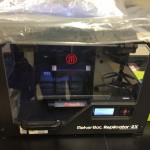
Our Shiny new machine,…missing its lid. I’m told that it is on the way by Top Men. Top Men.
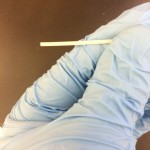
The neatly trimmed ABS plastic, ready for insertion into the extruder. It’s not transparent, unlike PLA.
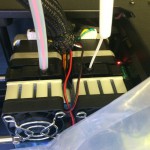
Replicator 2x has 2 extruders! We can print in multiple colors/materials. Dissolvable scaffolds, 2 tone prints are both possible!
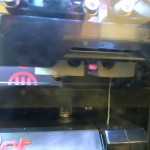
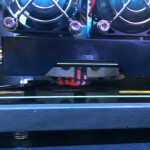
Nozzle extruding a thin line of plastic.
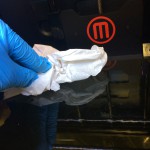
It’s really important to wipe down the build plate with Acetone (ABS dissolves in acetone) to make sure the prints stick. Otherwise, you may have wasted 3 hours for nothing.
Beginning a print. The nozzle purges it’s initial volume of ABS in a line on the front of the build plate..
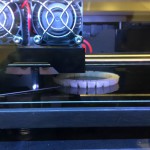
And we are printing (in this case a bracelet)
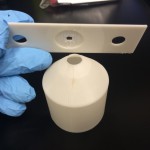
Other larger pieces can be printed simultaneously. Here is a spin cup designed by Meghan.
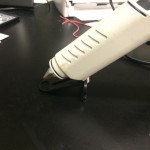
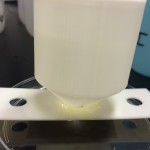
Joining pieces together can be done using a hot glue gun (akin to resin) or ABS slurry (akin to welding). Each have their pros and cons.
Joined with hot glue. It’s water tight!.
We will be able to print PLA and dissolvable filaments in this printer as well, but I haven’t determined the best settings for these yet.
Using the remaining 10nm EA-treated chips (all of the 15nm EA-treated and all of the PEG-lyated chips had either been used or broken) I was able to pass cytochrome C through Sepcons. As usual, yields were low (~8-12uL) but the curves were of high quality. The passage of Cytochrome C is not surprising because we…
Last week, Barrett and I made up the three buffers needed to perform this test: Dissociating buffer: 0.1 M glycine-HCl, pH 3.5 1 M Tris Binding buffer: 0.1 M sodium phosphate, 0.15 M NaCl, pH 7.5 In addition, I made a solution of protein A beads that consists of 0.0166 g of beads in 50…
I performed a test study to see the effect of microbial media’s : LB and BHI Broth on the membrane to check for discoloration. LB Broth : Lysogeny broth,Luria broth or Luria-Bertani broth. Obtained from Sigma and made by dissolving 20g in 1 l of D.H2O and autoclaving at 121C for 15 mins. LB is…
I’ve been going to considerable lengths to try and get reproducible zetapotential measurements from my streaming potential device. Zetapotential measurements are the closest we can experimentally get to measuring the surface charge of a membrane, and are important for three reasons. First, I need accurate surface charge data for the membranes if my electrostatic model is…
On Friday, Henry was kind enough to ship 15 tested Sepcons to the Barcikowski group in Essen, Germany. With luck they will arrive in time for Christmas. I wrote up some documentation and an illustration for wetting and using the Sepcons and figured I would share it with the group. Unfortunately, wordpress won’t let me…