Relationship Between Single Pass and Multipass Clearance Values
The relationship between the inlet and exit concentrations in a single pass over a membranes can be derived assuming first order loss to the membrane …
(1) 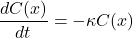
where  is the local bulk concentration above the membrane and
  is the ‘elimination rate constant,’ a concept also used in drug delivery.
this integrates across the membrane to …
(2) 
where  is the analyte concentration at the exit,
  is the concentration at the inlet of the dialyzer and
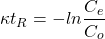
  is the resident time of fluid in the dialyzer. This simple model only makes the reasonable assumption that the rate of loss from the sample channel is proportional to the bulk concentration above the membrane, but the rate constant will depend on the details of the dialyzer and its operation (membrane permeability, channel height, boundary layer structure, etc.).
Solving for 
(3) 
The residency time can be rewritten in terms of the dialyzer volume  and flow rate Q as
(4) 
equation 3 becomes …
(5) 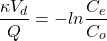
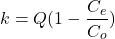
Note that both the numerator and denominator have dimensions of flow rate. The term can be interpreted as the fraction of the total flow rate Q that is cleared of the analyte. The product  is what we’ve been calling the ‘single pass clearance value’ k. To appreciate this, recall that for arguments close to one the natural logarithm can be approximated according to …
(6) 
we have fractional loss of < 20% in our single pass studies (i.e.  > 80%). The error associated with using only the first term under these conditions is less than 10%.
Thus …
(7) 
or
(8) 
where  is what we’ve been calling the fractional loss.
In a closed loop dialyzer only a fraction of the sample is in the dialyzer experiencing clearance. Lets call the ratio of the volume in the dialyzer to the total volume of the circuit  the duty ratio, r. Since the volumetric flow rate Q applies everywhere, r is also the ration of time in the dialyzer t_R to total circuit time t_c. This bolus of fluid then spends the rest of its time traveling without dialysis. The elimination constant during this part of the circuit is zero. Thus the average elimination constant for a multipass experiment is …
(9) 
Thus in a multipass system equation 5 must be modified to account for the duty ratio.
(10) 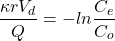
Or in terms of the single pass clearance k
(11) 
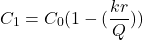
Where we’ve replaced with  to begin counting loops through the dialyzer. Using the approximations for ln … the entrance concentration on the second pass into the dialyzer is
(12) 
and
(13) 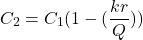
which in terms of the starting concentration is …
(14) ![\begin{equation*} {C_2} = C_o({ 1- (\frac{k r}{Q})}) [({ 1- (\frac{k r}{Q})}) ] \end{equation*}](https://staging.nanomembranes.org/wp-content/ql-cache/quicklatex.com-eb9784263af6c5c490f853f5b34a7789_l3.png "Rendered by QuickLaTeX.com")
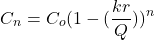
So after n cycles the concentration is given by …
(15) 
We can replace the cycle number with total dialysis time t by recognizing that the n is just the ratio of total elapsed time of dialysis to the time for a single cycle  …
…
(16) 
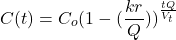
so that …
(17) 
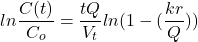
Taking the log of both sides and rearranging …
(18) 
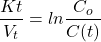
Recalling the classic equation for hemodialysis treatments
(19) 
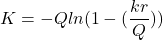
We can appreciate that the multipass ‘clearance’ K is related to the single pass clearance factor through
(20) 
or
(21) 
using our definition of the fractional loss.
Given a low fractional loss <20% and the fact that the duty ratio is always < 1, we can again use equation 6 to derive the very simple relationship between the single pass and multipass clearance values …
(22) 
What have we accomplished … We can now replace long term closed-loop dialysis experiments with data from quick single pass experiments and predict the K value or ‘clearance’ understood by clinicians and dialysis machine designers. We’ve made suprisingly few assumptions in establishing this relationship …
- The fractional loss during one pass across the dialyzer should be low. A value less than 20% only introduces 10% error. This actually argues for using small membranes in single pass experiments – which is what we do.
- The rate of analyte loss from the dialyzer can be described as a first order rate reaction.
This second assumption seems safe from Fick’s first law assuming the concentration in the dialysate is ~ 0 and the concentration and the fractional loss is small. Under these conditions …
(23) 
Where  is the membrane area and the flux through the membrane is due to a gradient in the y direction. By comparing equation 23 to equation 1, we see how the elimination coefficient is related to more fundamental parameters
  .
.
Equations 10 and 11 do not make sense to me. They say that changing the size of the external fluidic circuit affects the clearance at the dialyzer. The larger the circuit, the lower the clearance. Clearance is just a flow rate of completely cleared fluid, e.g. 1 mL/min flows in, 20% of the urea is removed. k = 0.2 mL/min. It will take more time to clear a larger fluid volume of 20% of its urea, but the clearance is the same. 0.2 mL/min.
K for a typical HD session is 268 mL/min (for Qb=300 mL/min, Qd=500 mL/min). With a dialyzer volume of ~50 mL. Tolal water volume is ~40 L, r=.00125 If K = 268 mL/min and k = K/r then k = 214 L/min.
k is a steady state value (i.e. time independent) and K is dependent on time, I’m not sure how you convert between the two without the time dimension.