Long term discoloration II
There have been differences between the previous long term discoloration studies carried out by myself and Barrett. Couple of reasons speculated for the differences were:
1) Wafer variation (w683 vs w704); w683: has no visible pores, is more amorphous in character, and has many pinholes; w704: 200um series.
2) Silanization treatment (UVO chamber PDMS contamination; or other procedural differences)
Following is the discoloration chart of samples from w704. I carried out this experiment using DMEM with high (3.7 mg/ml) and low (1.5 mg/ml) sodium bicarbonate concentrations.
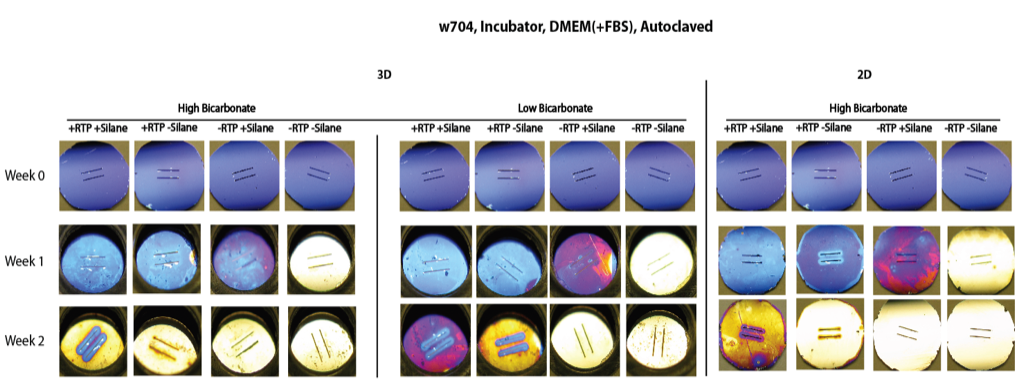
The results are similar to what Barrett saw in his experiment here. Plus, the higher bicarbonate speeds up the discoloration, as expected. So there are two possibilities emerging out of this: either the UVO chamber was not decontaminated completely leading to improper silanization, or there is actual (major) difference between the material used here (w704) and before (w683); old material vs AJA material?
Following is an updated discoloration chart from long going on study of w683 samples. (Here only high sodium bicarbonate DMEM was used)
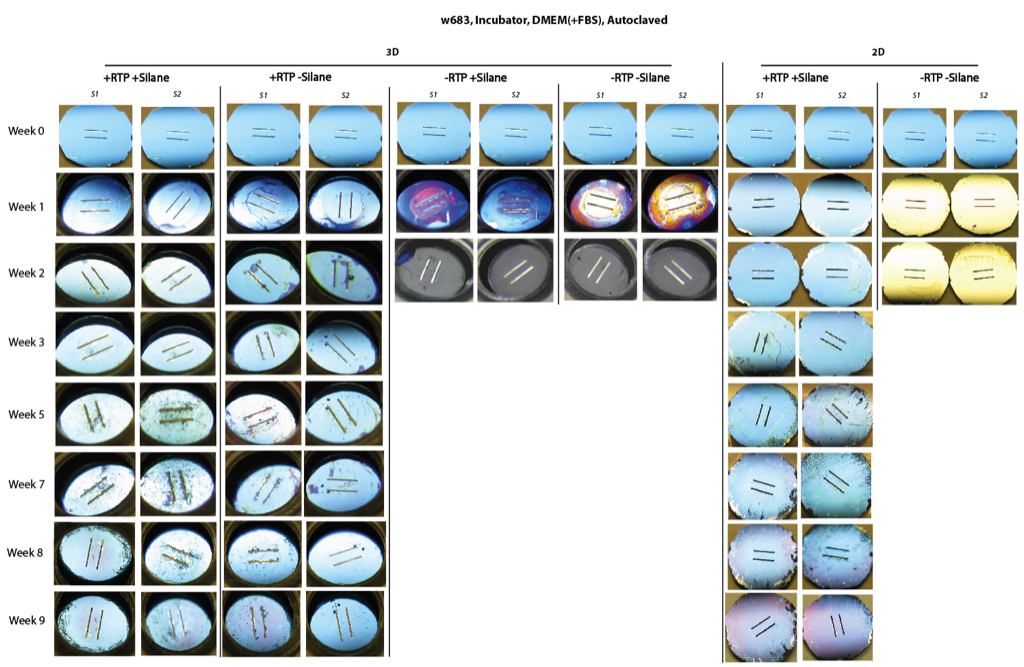
As seen above, the discoloration is still not significantly evident after over 9 weeks!!
I tried to clean the chip surface properly to get rid of any ‘gunk’ present that could have delayed the discoloration process (but this doesn’t seem to be the case as the chips looked fairly clean).
Finally, we should look deeper into this material to figure out what could have led to such a long ‘non-discolored’ life of these samples.
It will be interesting to see how new w683 samples fair after the new silanization process (after decontaminating the UVO chamber). Because it could be possible that, long back when above samples were silanized, the chamber was heavily contaminated and a thicker PDMS coating was formed which prevented the discoloration to much greater extent (more than silanization does?).
Or we should just wait for the new YES silanization system to arrive.
PS: Media is changed 2-3 times a week for all the samples.
In case of w683, both ‘RTP’ and ‘RTP+APTES’ samples in 3D format look the same after over 10 weeks! So there is nothing exceptionally different about carrying out silanization on these samples (till this time point). It has to do something with this particular material.