Metallized Membranes
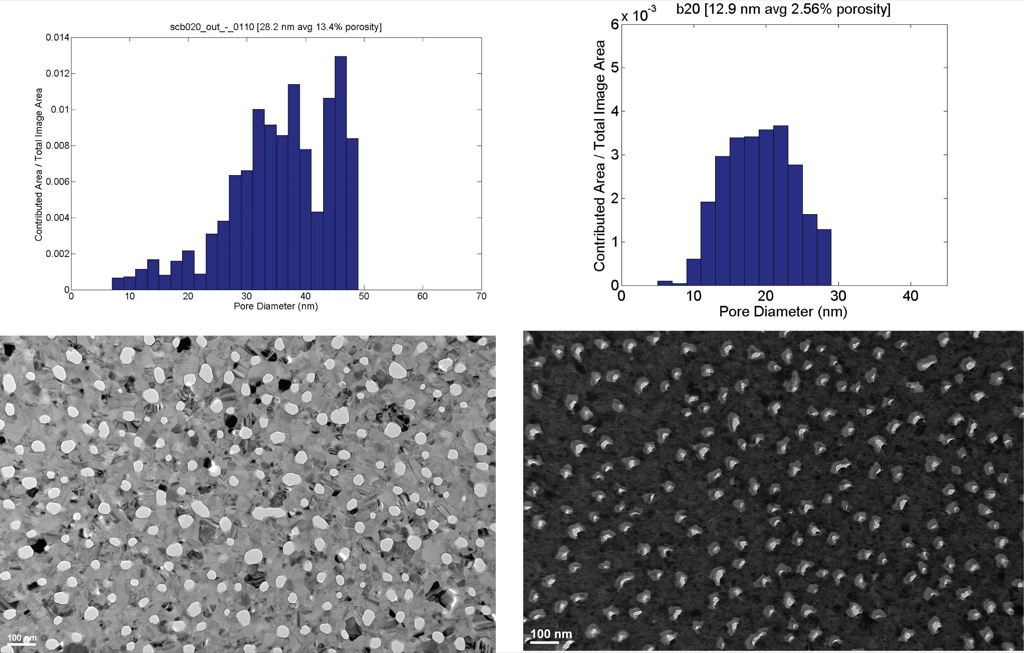
The deposited metal thickness is 20nm, consisting of 10nm titanium and10nm gold. Post not finished.
sc b020 – 25nm
sc b011

sc b01

The deposited metal thickness is 20nm, consisting of 10nm titanium and10nm gold. Post not finished.
sc b020 – 25nm
sc b011
sc b01
Summary: Dan and I went to Woods Hole Oceanographic Institute to learn about the current state of microplastics research. There were a number of things that we learned that we did not know. The common sentiment among researchers agreed climate change was a much bigger threat to humans than microplastics, but the reality and immediacy…
See my previous post for background information. It has been established that diffusion of small particles (diameter < roughly 1/3 pore diameter) across ultrathin membranes is mediated almost entirely by the ability of the particle to discover a pore, rather than by its ability to diffuse through a pore once one has been found. In…
(Meghan Kazanski actually did all the work, but she didn’t have a login when this post was started.) The calculated porosity is 16.4 % with an average pore diameter of 417 nm. SepCon assembly was performed with chips from wafer 4409. Assembly was performed systematically – SepCons were boxed following assembly for later control…
Last week I ran a series of membranes through the carbonization process at four different temperatures (600, 700, 750 and 800 C) at a fixed acetylene concentration (1 LPM). As expected, the growth of the carbon ring around our pores is temperature dependent. Note: image processing was done on 100 kx micrographs with the exception…
This post is an accumulation of the results obtained from my research thus far. To recap, my intent (for my masters thesis) is to provide context for critical flux optimization in NPN microfluidic devices, particle capture, and compare critical flux in NPN to traditional track etched (TE) devices. Note that “critical flux” is the flux…
This post explains that electroosmosis in our material is higher than we expected. Jim suggested that maybe we don’t have fully developed flow in our thin material. Here I attempt to find the entrance length, or distance until fully developed flow, in our material. One needs to keep in mind that this is a continuum…