Superficial analysis of charge effects
A paper by Munch (from Kodak), Zestar, and Anderson in J Mem Sci (1979) writes that charge has a big effect on albumin separations in track etched membranes. They show in their paper that they can make the theoretical sieving match the results better if they simply add the Debye length to the molecular radius and subtract it from the pore radius. Basically, Debye length is used as an approximation of the “fuzzyness.”
If I take my model and try this approximation, here are the results:
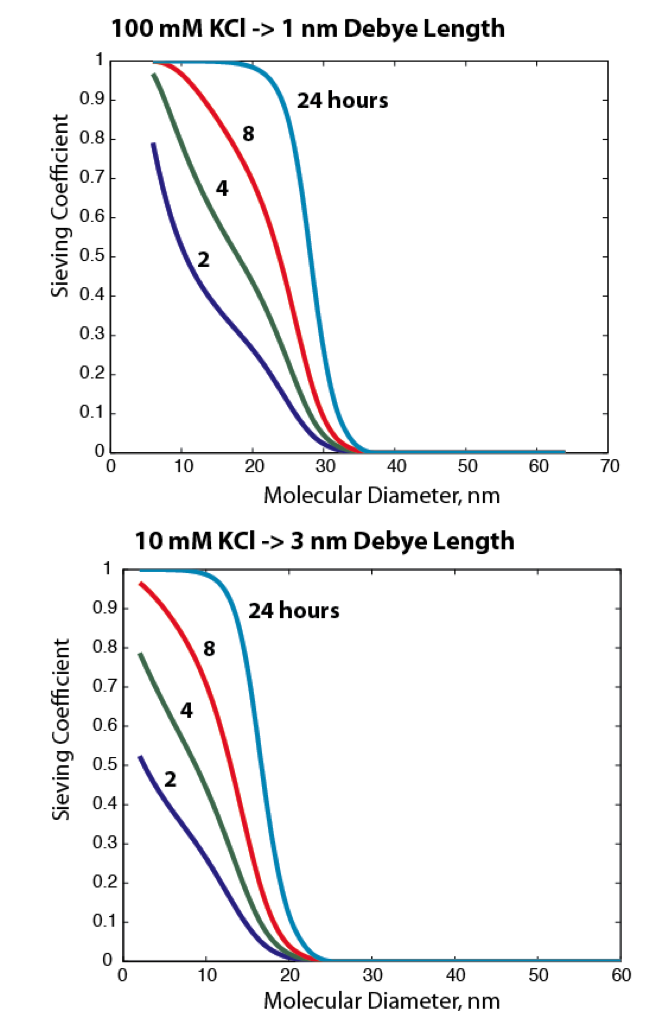
The first chart shows the sieving coefficient curves up to 24 hours for a 100 mM salt solution. There is an expected Debye length of 1 nm in this solution, and there is very little change between this and the previous sieving curves (not shown because the scales were different – I’m working on another plot of the original). If we switch to 10 mM KCl, the Debye length is 3 nm. There’s a big shift between these two. The cutoff drops from ~30 nm to ~20 nm.
These cutoffs are still higher than what we’re seeing for protein and even for C-dots. In 100mM KCl, this indicates that 22 nm C-dots should probably go through, and we do not see them appreciably in the filtrate. While protein may have additional pore shrinking due to adsorption, C-dots should not have this problem.
This method is superficial because the Debye length is not really a length; it is the position of a 1/e drop off of the potential. THis doesn’t indicate that the potential has a specific value at this specific position, and it might take more like 2 or 3 Debye lengths before a molecule can pass through the pores.