Detergent Micelle Sizing and Zeta Potential
This is the first post I have made with respect to the project proposed by Mark Dumont of the department of Biochemistry and Biophysics. As a reminder of the scope of the project Mark has shown an interest in using our pnc-Si membranes to separate detergent from trans-membrane proteins during the process of preparing samples for crystallization. Solubilization of membrane proteins involves the addition of detergents whose structures are similar to that of lipids. These detergent molecules insert into the cellular membrane and cause the spontaneous formation of micelles when the detergent concentration reaches the critical micelle concentration (CMC). The solubilization process results in three distinct products: (1) lipid/detergent micelles, (2) detergent micelles, and (3) protein/lipid/detergent complexes.

Assuming that the detergent micelles and the protein/detergent complexes differ in size and charge then our pnc-Si membranes should be able to allow for the detergent micelles to pass through while holding back the protein/detergent complexes.
I first wanted to determine relative sizes associated with some detergents of interest. To start off Professor Dumont suggested working with the maltoside family of detergents, specifically dodecyl-maltoside (DDM) and decyl-maltoside (DM). These detergents are non-ionic and are relatively gentle on the proteins during solubilization.
Dodecly-maltoside (DDM): C24H46O11, MW=510.6, CMC=0.17mM
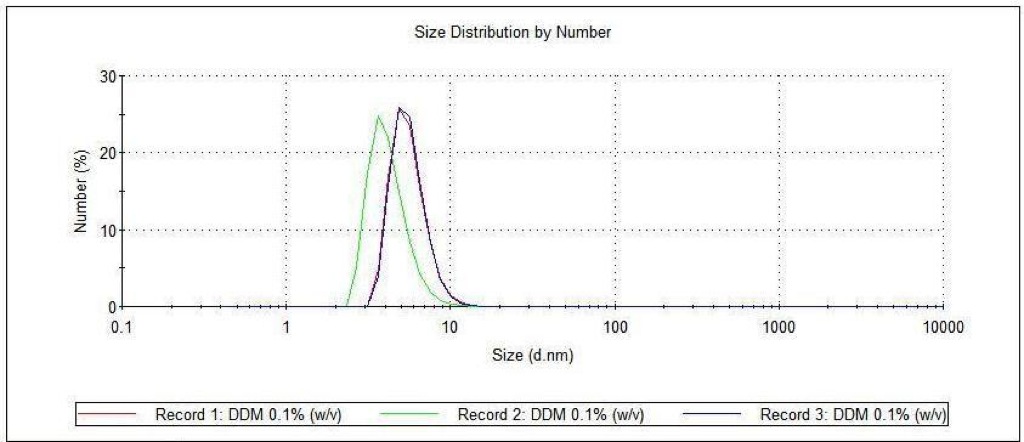
The above figure illustrates a size test run on 0.1% (w/v) DDM in DI-water using the melvern. Based on the values reported the average DDM micelle is approximately 5.2nm in diameter.
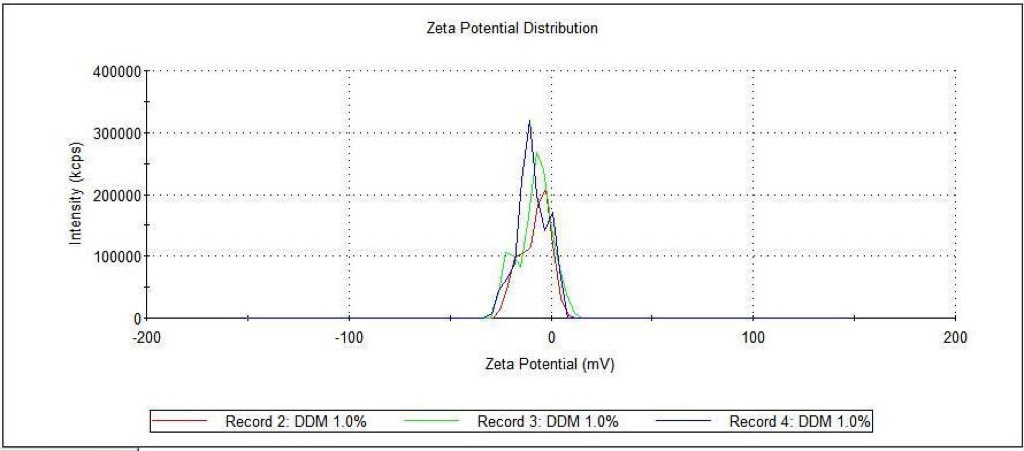
The above figure illustrates a test for zeta potential on 1.0% (w/v) DDM in DI-water. Based on the reported values the average zeta potential for DDM micelles in DI-water is approximately -8.4mV.
Decly-maltoside (DM): C22H42O11, MW=482.6, CMC=0.18mM

The above figure illustrates a size test run on 0.1% (w/v) DM in DI-water using the melvern. Based on the values reported the average DM micelle is approximately 4.5nm in diameter.

The above figure illustrates a test for zeta potential on 1.0% (w/v) DM in DI-water. Based on the reported values the average zeta potential for DM micelles in DI-water is approximately -13.1mV
Knowing that the micelle diameter of both DDM and DM is smaller than our pores one of the next steps to to begin simple diffusion studies to see if we can pass detergent micelles through the membrane. In an additional note, I ran the zeta potential tests in DI-water but depending on the protein we choose to use as a model we may need to shift to a salt solution and I will have to recalculate the zeta potentials. I know that these detergents are considered non-ionic but it is clear they have a “slight” negative charge: could someone shed some light on a possible reason? might it have to do with the DI-water?