More Modeling
Frustration with the lack of agreement with experimental device has led me to check if the diffusion in the wells within the model is physically relavent. To do so I’ve solved a partial differential equation pertaining to a concentration of 1 on the left half of the system and a concentration of 0 on the right half with no membrane to separate the halves. I then compare the time to equilibrium and the development of concentration profiles for the membrane and no membrane cases.
(NOTE: Don’t mind the first wavy lines in these images. This is a fourier series solution with only a limited amount of eigenvalues to save computational time. The first time point is a step function, and this is hard to make with limited eigenvalues.)
Case 1: Ultrathin membrane with a .5 nm radius molecule (e.x. rhodamine).

Each line represents a 100 second interval time point. You can clearly see that the concentration on the left hand side quickly reduces to .5 while the right hand side increases to .5 (units not important, some variation of number/volume). The time points go out to 1 hour, and equilibrium is almost reached within an hour.
Case 2: No membrane with .5 nm radius molecule
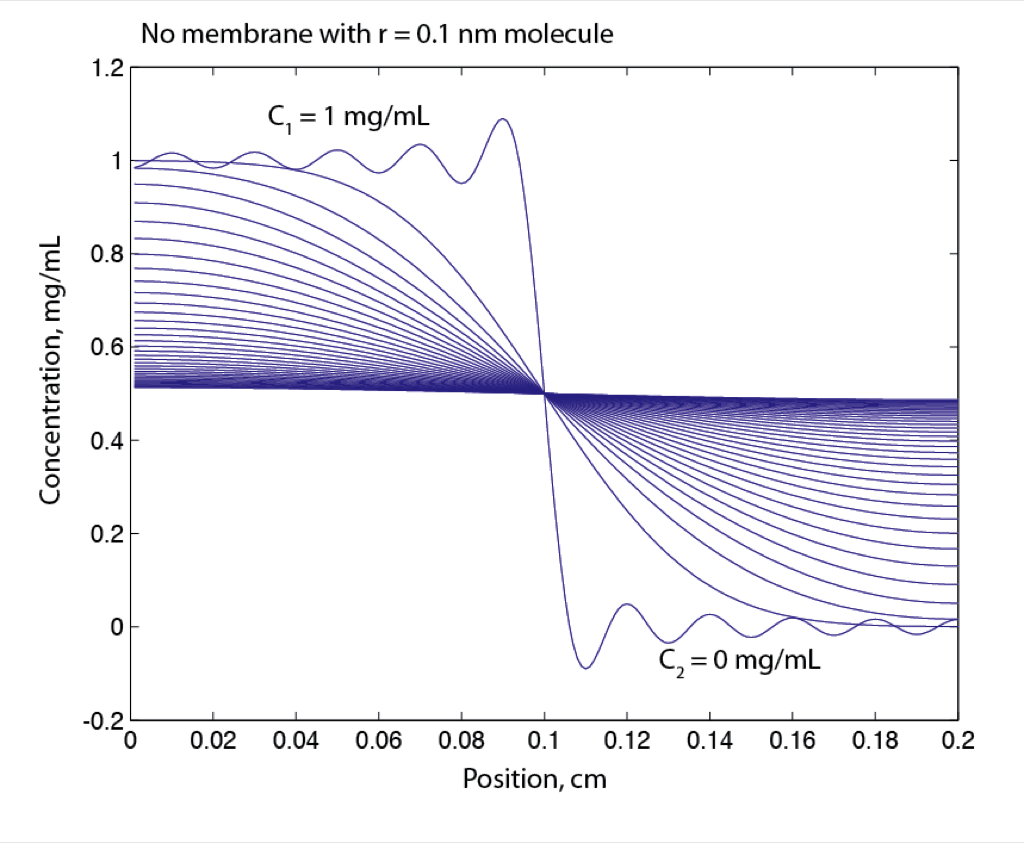
This looks very similar to the membrane case. The diffusion to equilibrium in ~ 1 hour appears to be physically reasonable for this small molecule, and that means the membrane in Case 1 presents little to no resistance to diffusion.
Case 3: Ultrathin membrane with 9 nm radius molecule (e.x. beta-galactosidase)

In the particular membrane selected, the pores are around 20 nm in diameter. This means that the molecule is approaching the pore sizes. The resistance goes up, and this slows diffusion at the interface (the time points still go out to 1 hour). The discontinuity in the highlighted circle is the affect of hindrance by the membrane. Still these molecules do manage to diffuse through the membrane, and equilibrium will be reached in approximately 25 hours. We do not see beta-galactosidase reaching equilibrium within this time, however there is some limited transport in our experimental systems.
Case 4: No membrane with 9 nm radius molecule

The diffusion in this case is still slow. This is due to the much lower diffusion coefficient for this molecule. This system with equilibrate in approximately 20 hours, so not much quicker than the membrane case.
My guess is that the resistances we’re defining is just not high enough for the membranes to achieve separations similar to our experiments. This may be an error in the coding or the analysis, so I’m currently working on that. However, it seems that the model does have very nice results in comparison to the no membrane cases.