Adsorption Quantification II
I’ve updated the figure from this post to add new data from oxidized and pre-washed glass samples. We now have possession of teflon material, which I will be testing this week.
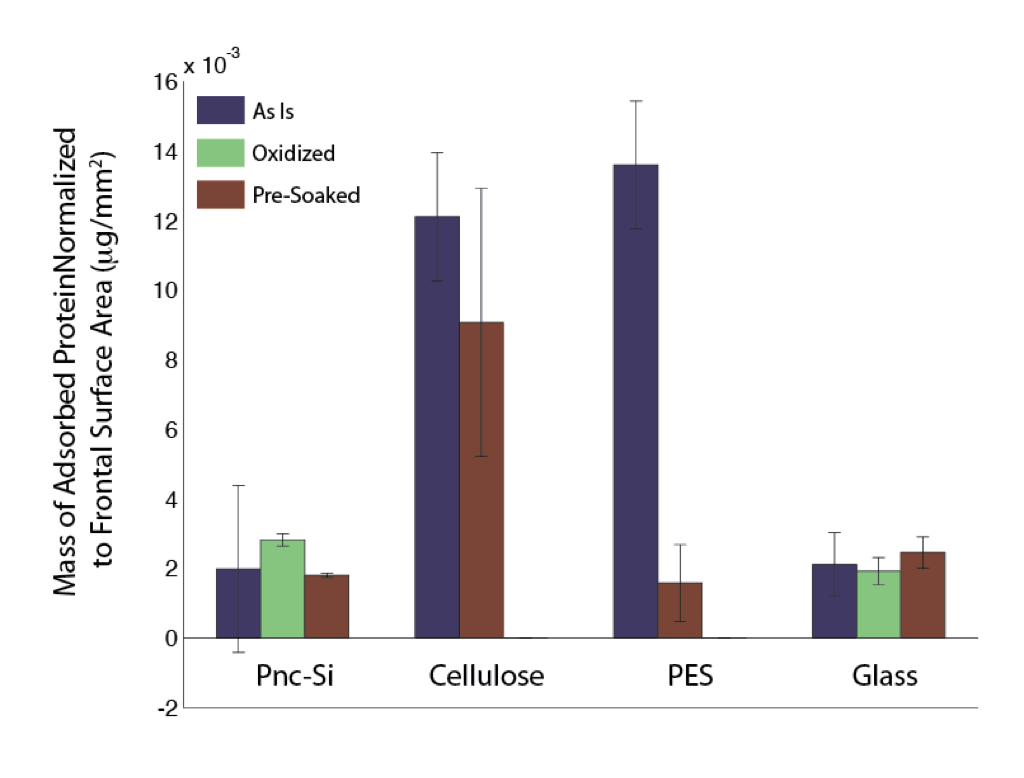
I’ve updated the figure from this post to add new data from oxidized and pre-washed glass samples. We now have possession of teflon material, which I will be testing this week.
As a proof of principal experiment, we wanted to test if Kilean and I could extract RNA from exosomes following their capture on 1298 membranes. As noted in Figure 1, we first used ultrafiltration to capture exosomes on the nanoporous membrane. We then attempted exosome lysis and RNA release by flowing the lysate below the…
A change in open-circuit potential, measured across a pnc-Si membrane, in response to a fluctuation in flow rate of electrolyte solution exhibits a promising flow-sensing capability of the membrane. To demonstrate this correlation, the open-circuit potentials were measured under a variety of pressured-driven flow patterns. In Figure 1, a series of flows under various applied…
This is just a quick comparison of the new types of imaging that we now have available to us. As Bill mentioned previously, we have an Andor Dragonfly confocal system now available to us thanks to Patrick Oakes. We have been testing the system extensively and I have been messing around with it for imaging…
Hello Everyone, So first of all, a quick reminder of what i have been working on: we were able to show the trapping of the beads by TE membranes, although in final step and after releasing of the beads, we could still see beads on the membrane, so we hypothesized that the beads are…
Hi all! Above is an image of the bioreactor made from the square, 5-slit pnc-Si chip and a PDMS structure. Fused-silica capillary tubings were inserted into the bioreactor to form the inlet and the outlet for the transfer of the cells into the lower compartment, which is made entirely out of PDMS. Note that the…
First, a quick publication update. Recently we’ve published a paper on our efforts towards computationally analyzing polymorphonuclear leukocyte (PMN) trafficking on a vascular endothelium via hand-built µSiM flow cell devices. We record videos in phase contrast with a 40x objective and are able to delineate PMN state, speed, and persistence by leveraging ML algorithms and…