Pore morphology is RTP time dependent (part II)
In the last production cycle, there were several wafers annealed for longer than our standard 1 minute RTP soak time. Recall in my earlier post, I observed a significant change in pore morphology in a 30 nm thick silicon membrane annealed at 1050 C for 1 min/5 min.
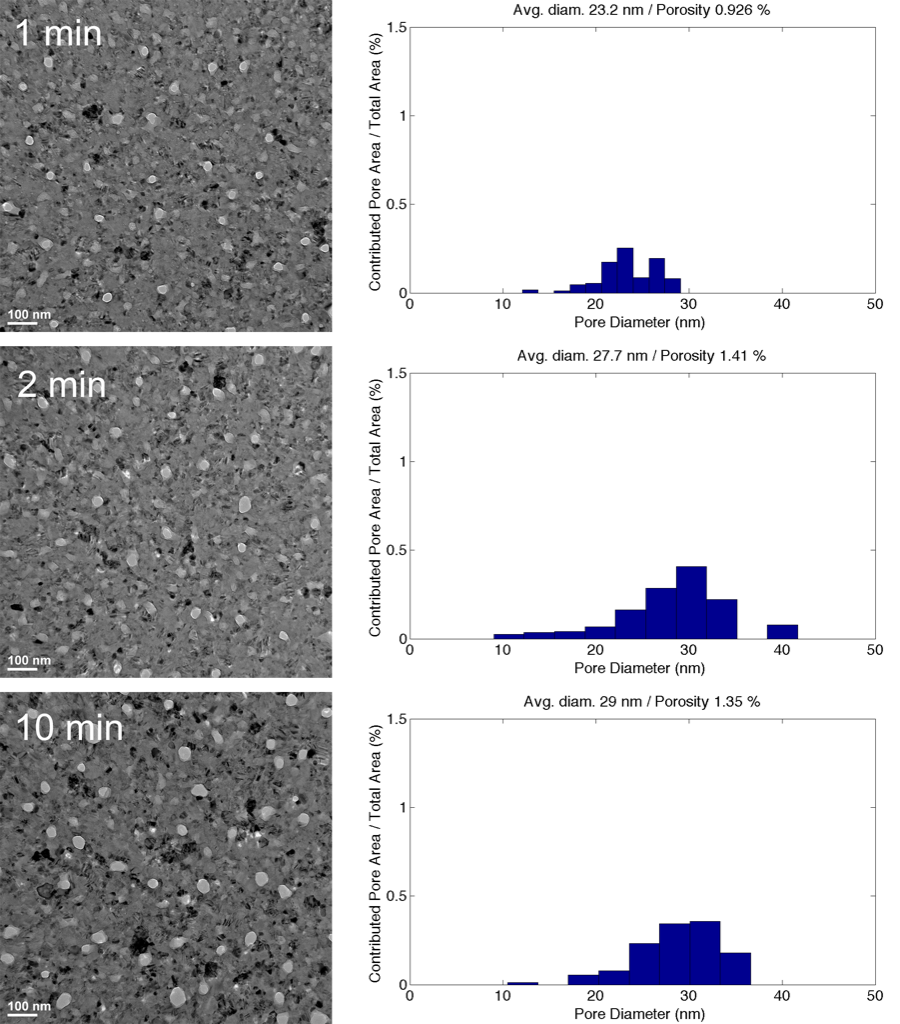
In this series of experiments, we observe an increase in average pore diameter and cut-off for annealing times greater than 1 minute in a 30 nm film annealed at 1000 C, a 15 nm film annealed at 900 C, and a 15 nm film annealed at 1000 C. Below are the TEM micrographs with histograms.
30 nm pnc-Si, 1000 C RTP
15 nm pnc-Si, 900 C RTP

15 nm pnc-Si, 1000 C RTP

From this information, we can conclude that annealing in the susceptor at 50 C/s for one minute does not form material that is in equilibrium. That is, there must still exist atoms in the film that are able to move around and leave void spaces behind. This is yet another parameter space we can further explore.
My next set of experiments will include a larger range of time points at a lower RTP temperature. I would like to find a temperature/time at which the onset of pore formation occurs. By varying the annealing time at this temperature, we should be able to more completely highlight the dependence on soak time.
This post and your previous post are very, very interesting. I hope they will get us closer to a “theory” of pore formation.
Now, if a short annealing time does not allow the film to reach “equilibrium”, then I wonder whether this means we still have a lot of amorphous material left. If the entire film were crystallized, how would further annealing (at the same temp) change things? How could this lead to larger pores? Are the nanocrystals of the same size or are they also increasing in size?
An interesting experiment might be to try to reach ‘equilibrium” at a given temp, then switch to a higher temp for a given amount of time. I wonder whether we would get some pore or nanocrystal distribution similar to that after ‘equilibrium” or to that we would see if we only annealed at the higher temp. And how do we put this together with your previous study about the ramp steepness effect?
Philippe
Looks like we don’t gain much in porosity or pore size from 2 to 10 minutes in the 30 nm film but it seems like they are more and bigger crystals. Maybe you don’t have to do a time series all the way out to 10 based on this?