Separating effects of molecular collisions with pore walls in pnc-Si, carbonized walls effect
The goal here is to see if by using our membrane we can measure and separate different pore wall interaction effects of gas molecules passing through a pore.
First, some theory. The flow through every pore of particular aspect ratio (L/d) is determined by pore’s transmission probability value (W), which is the probability of the incoming molecule to pass the pore without being reflected back by colliding with pore wall. W increases as the aspect ratio drops, and is explained in the equation of transmission probability of a tube of length L and pore radius r (1):
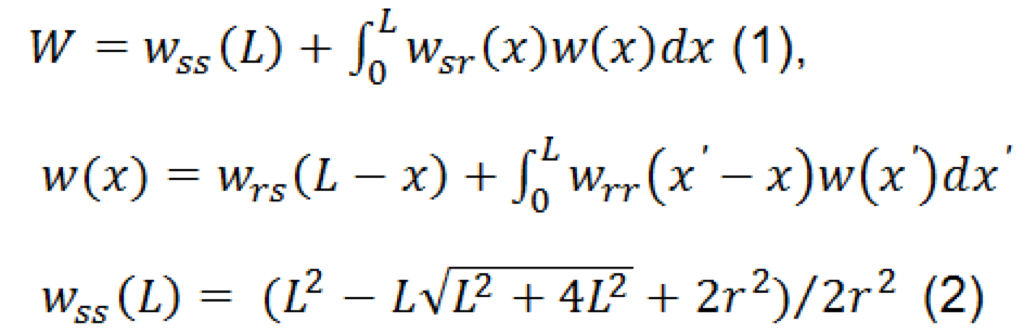
The function Wss(L) (2) is probability that the molecules will pass the tube without colliding with the wall, and Wsr(x), Wrs(L-x), Wrr(x’-x) are probabilities of a molecule to exit the tube after reflecting from different positions x and x’ inside of the tube L. Eq. (1) separates the transmission probability is two components: probability that a molecule will pass the pore without encountering the pore wall Wss (ballistic component), and the probability of transport due to all possible collisions with pore wall Wwall (wall collision component), which correspondingly depend on pore aspect ratio only, and pore internal surface properties and aspect ratio.
1) “collision-free” or “ballistic” component. The image below is based on equation (2) and shows how Wss changes with increase in pore diameters for different thickness of material.
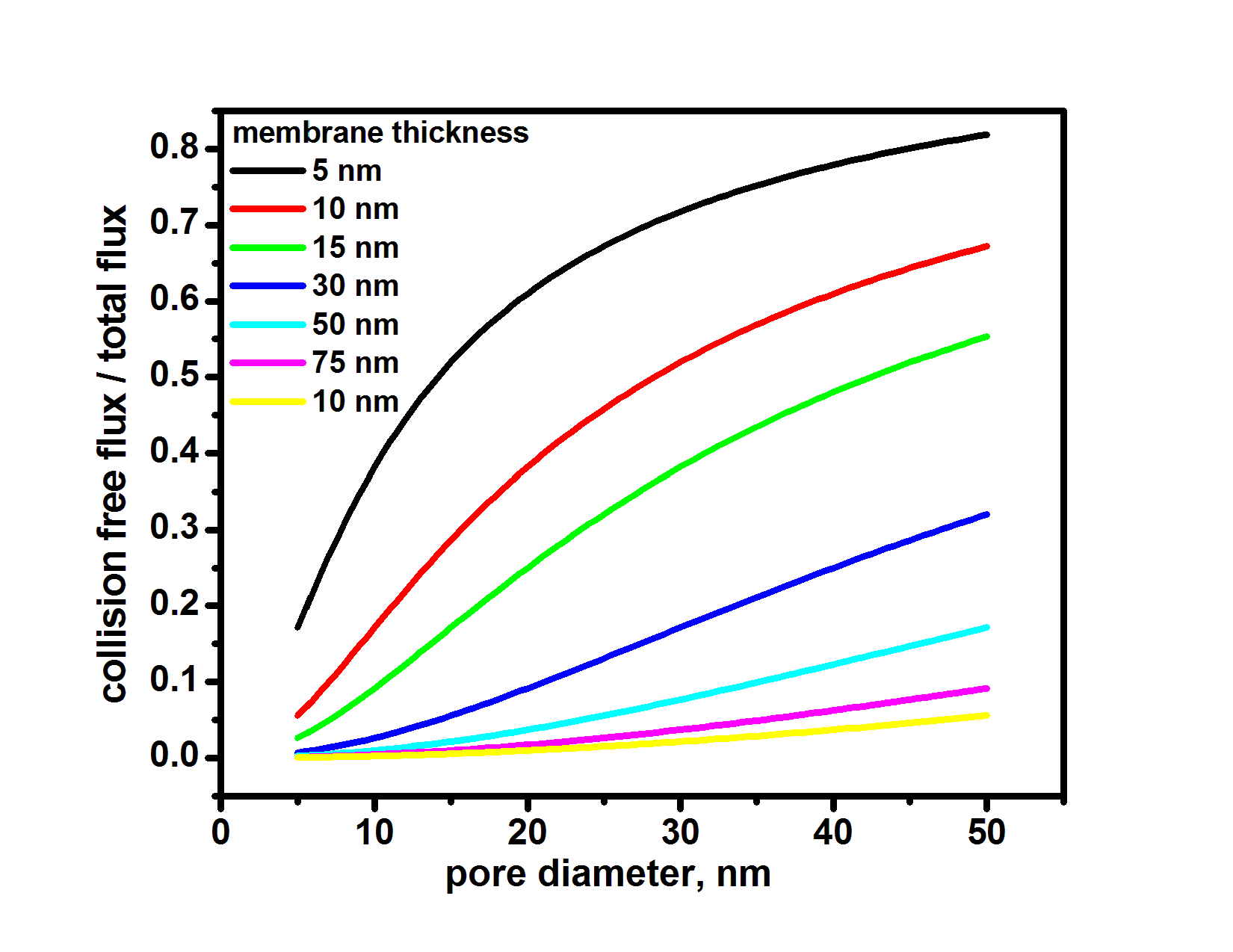
The amount of molecules with ballistic trajectories for 15 nm pnc-Si membrane is approximately 48 % for 40 nm and 9 % for 10 nm diameter pore.
2) “wall collision” component. In Knudsen regime it is assumed that the molecule-wall collisions are diffusive, meaning that the speed and direction of the molecule after colliding with pore wall have no relation to incoming values of the angle of incidence. This assumption of diffusive reflections is not valid for all systems as supported by results MD simulations and experiments which have shown that fast transport through carbon nanotubes arises from the collisions with CNT walls being nearly specular. This means that the molecule is not likely to be reflected back after it entered the pore (this increases Wwall component). Then “wall collision” component of transmission probability can be due to diffusive reflections (as in most porous materials) and due to specular (as in CNT).
So based on all this, I decided to see if these effects can be measured with pnc-Si. First, the “collision-free” component of the flow was separated before and is on the graph below. Now, I tried to see if “wall collision” component can be differentiated into diffusive and specular. Idea for this is to use carbonized membranes, where the pores are carbonized till the point where the carbon coating creates carbon rings, that maybe it will re-create the carbon nanotube wall and will influence the amount of specular reflections through pnc-Si, which should theoretically increase the flow.
Experiment with carbonized pnc-Si: I took 2-3 pinhole free samples from different wafers together with corresponding TEM samples of those wafers, and Dave carbonized them all. Then I took TEM images of all wafers after carbonization and processed them to get mean pore diameters and porosities as we do for non-carbinized pnc-Si. The permeability experiments with carbonized membranes are done in the same way as all other permeability experiments, with blank sample testing for leaks. The permeability values are normalized to porosity so we can technically compare the same porosity membranes. All carbonized results are added to the graph below, where the previously measured “ballistic” component is plotted.
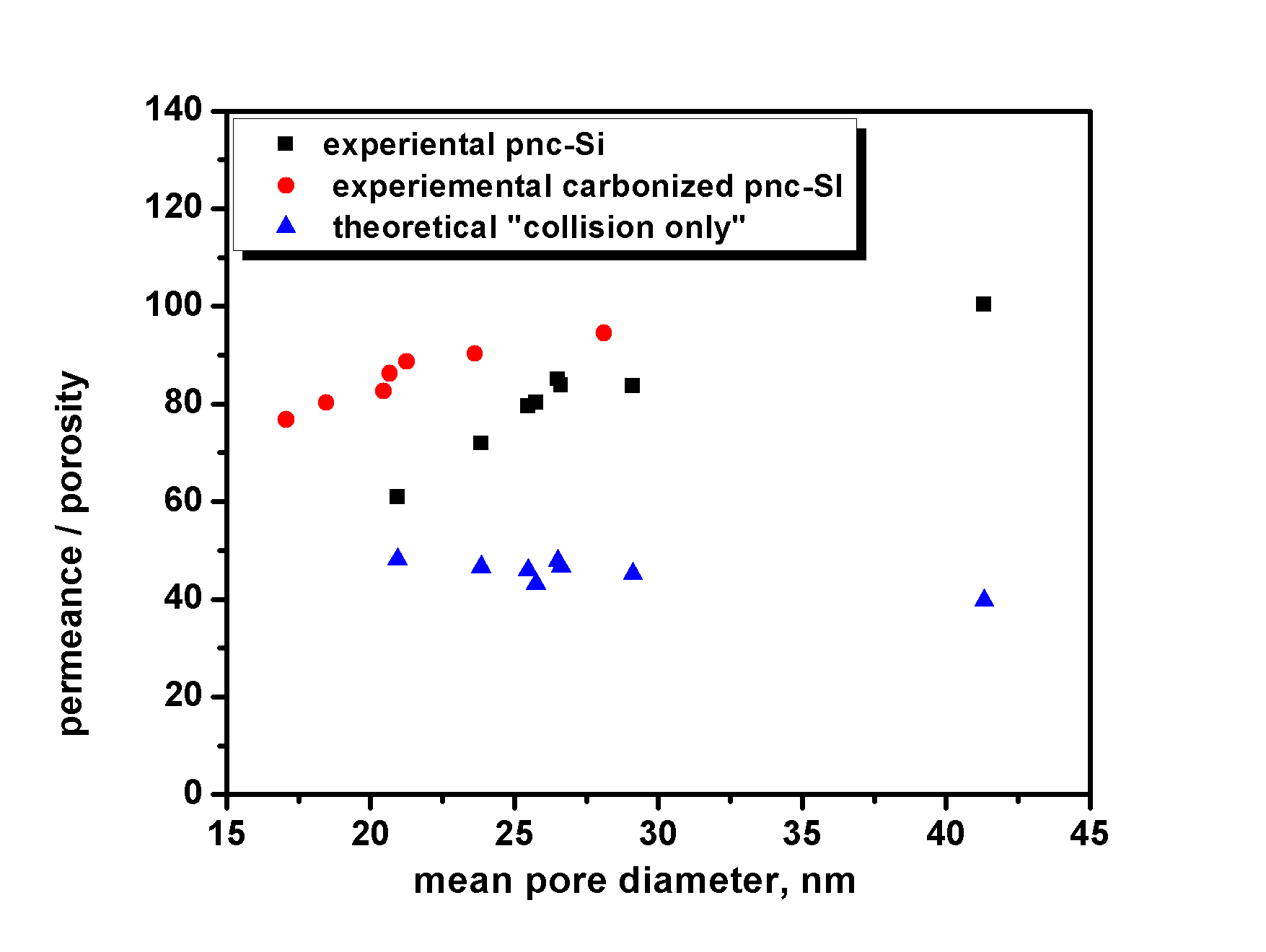
From this experiment it looks like there is an enhancement in the flow influenced by carbonized walls which decreases as the fraction of wall collisions among all collisions drops with diameter. I plotted the theoretical value of flow due only to molecules that collide with walls to show that their fraction decreases with diameter, but the flow doesn’t decrease much because this fraction’s Wwall goes up too. That’s why for big pores it probably won’t matter if the reflection is diffusive or specular, as the small fraction of molecules that see the pore has high W anyways. The theoretical number is calculated by subtracting the “collision free” percent of the flow calculated by using equation (2) from predicted flow value through that membrane (not carbonized).
The measured carbon ring thickness is approximately 2.5 nm which gives additional 5 nm to carbonized membrane thickness. I didn’t normalize the flow to the thickness in the last plot.
Just a quick comment. I think you’ve really increased the significance of the work with the carbonization data. We need to be sure that it makes sense to say that carbonization enhances gas flow but not water flow. The enhancement happens for different reasons in both cases and so I think this is OK, we just need to think it through. That will make for an interesting point in the discussion of this manuscript.
I need to think about your result- to make sure it holds against challenges, because if it does it’s important
The CNT papers that I’ve looked over are organized here
Maryna – Please add any relevant articles to this page.
I’ll add some papers.