Water transport follows theory for alumina coated pnc-Si membranes
Today, I ran a quick experiment to confirm that water transport was not negatively affected by an aluminum oxide coating. I deposited 1.5 nm of Al2O3 onto a pnc-Si membrane which I then treated with an oxygen plasma in the YES system. I was curious to see whether the alumina coating along with O2 treatment would allow for wet/dry water flow. Unfortunately, it did not. I had to wet both sides of the membrane to initiate flow. Here is a video at 4x speed showing water flow through an aluminum oxide coated membrane (double click to start, single click to stop):
I measured the permeability to be 25 mL/cm2/min/bar, which closely matches the theoretical permeability of 26 mL/cm2/min/bar calculated from the TEM micrograph of an untreated membrane with a 1.5 nm pore constriction applied.
Sample size was 1, but I plan on repeating with multiple chips and will then move to separations.
Here is one from the blooper reel. Too much coffee!
Addressing Chris’ comments below:
I used sc 702. It has a cutoff of 32 nm, average diameter of 21 nm, and porosity of 10.6%. The pores look clean, but I think a thicker coating would certainly help. It’s possible that 1.5 nm is not enough to form a continuous coat so there are still areas of exposed Si…
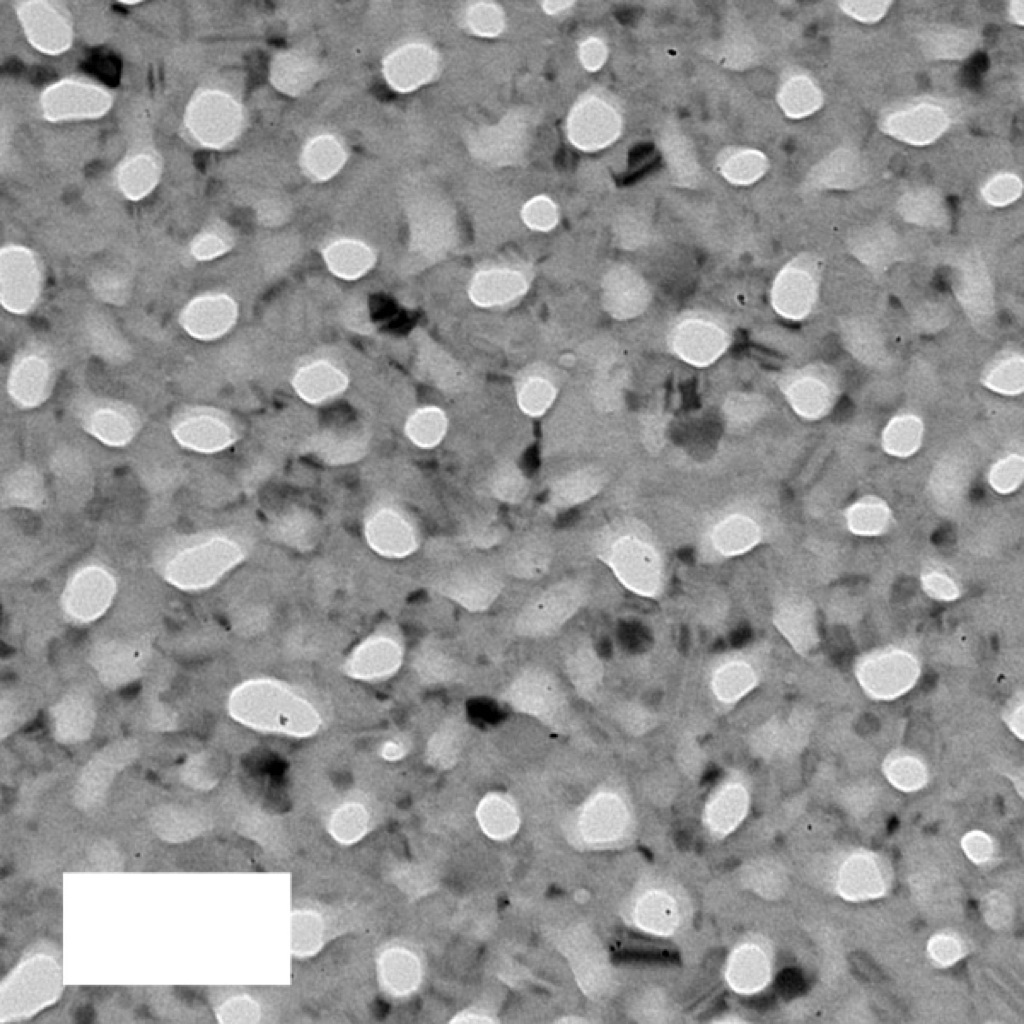
TEM micrograph of sc 702. The scale bar is 100 nm.
This is a nice video. I assume there is little noticeable difference in flow with the alumina, compared to the base membrane?
Which membrane is this? I would think to get wet-dry flow, it would be best to have:
1. High porosity
2. No sharp overhanging or conical features
3. A thicker alumina layer
Since you have confirmed that the material is extremely hydrophilic, this must be a geometric limitation where solution cannot wet across a sharp edge. Do you have any samples with 5-10nm of alumina that retain a reasonable porosity that you could try? There’s got to be a way to get this to work.