MicroEO update
This is an update of the research on the on-chip EO pump.
Due to a mistake in determining the direction of particle flow, it now looks like the particles in this post were moving by electrophoresis rather than electroosmosis. The particles were negatively charged (-40 mV zeta potential) because of a COOH group on the surface. I went back to look at the rest of the particles we had, and a more neutrally charged polystyrene with a PEG-COOH surface group (-2 mV) still predominantly flowed due to electrophoresis.
A major problem with these experiments though is that I can now see swirling/bead aggregation effects even at low voltages. My guess is that these effects are caused by the pH changes at the wires. One solution may be to try Ag/AgCl wires.
The biggest problem though is that flow at the voltages in these experiments is not measurable. If there is flow, it is so slight that I can’t tell it apart from bubbling at the wire. The current in the microEO device at 10 V is only 1 mA, and there may not be enough driving force for the flow. Typical EO flow rate experiments in the large chamber had currents of close to 10 mA. I raised the voltage as far as 70 V (~5 mA) and obtained a measurable flow rate of 1.2 uL/min.
Here is a look at an I-V curve of this material compared to the larger scale system:
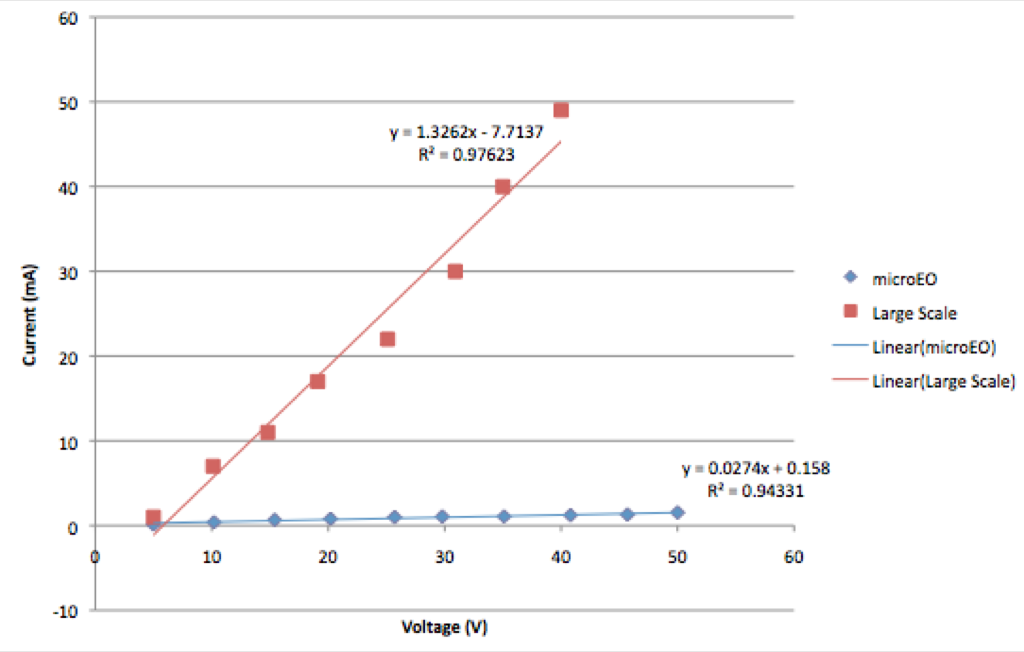
The resistance of the microEO is about 48 times higher than the large scale system. The trick to getting more efficient flow may be to rebuild the chamber or use a different electrode configuration.