Intermediate state morphology investigation
In my previous post of Morphology evolution in pnc-Si membrane (2), see https://trace-bmps.org/datablog/?p=14769&preview=true , I showed that membranes (30SiN-25Si-30SiN) annealed at 700C show us an intermediate morphology in the pnc-Si membrane. I did some further investigation in the past week on this intermediate morphology. Compared with the previous test which membrane was annealed at 700C for 1min then ramp up to 800C following 1min holding time, I varied the holding time when the temperature reached to 700C while keeping other process the same. I did 4 different holding time which was 10s, 60s, 120s and 300s. The following plot is the heat treatment process.

The followings are the TEM images of 4 sample.
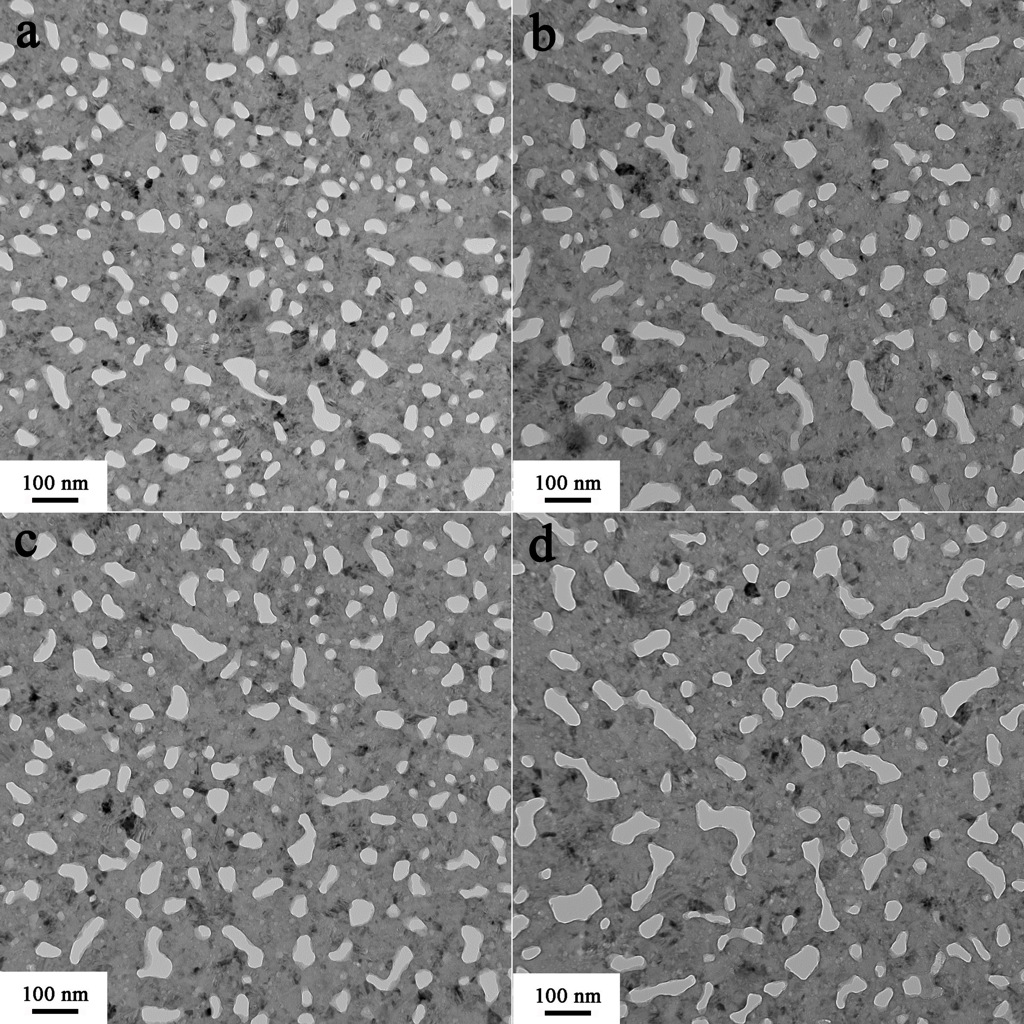
The image (a) to (d) correspondings to the holding time from 10s to 300s. It can be seen that the density of tiny pores decreases with the holding time and more elongated pores are formed with longer holding time. It does make sense because the longer holding time, the higher crystalline fraction in the pnc-membrane. Tiny pores move around to coalesce to formed bigger but irregular pores until they are fixed by adjacent Si crystals during the annealing.
As we already observed that this intermediate morphology is quite different from the morphology which formed directly under 800C (or higher) annealing, it may be interesting to hypothesize that the formation mechanism of this intermediate state is somewhat different from that of the regular circular pore from higher temperature annealing. Here is what I thought.
The dominate formation mechanism for the intermediate state is the pore movement. Since the annealing temperature is below 800C, Si crystals start to form during the crystallization process, however, let’s say with a relative slow speed or not very high fraction. As a result, pores which are also formed during crystallization get more chance to move around and meet with other adjacent pores. That is how the elongated irregular pores form in this scenario. When the annealing temperature is greater than 800C, Si crystallizes either very fast or in high fraction so that pores are more likely fixed by the adjacent Si crystals once they form. As a result, circular pores are more preferred in this scenario. The whole process is more likely the competition between the Si crystallization (speed) and pore formation (speed), which is dominated by the annealing temperature.