Rapid Prototype of Single Channel Dialysis Device
In order to rapidly test the entire setup for dialysis evaluation, including piezoelectric micro motor and recirculating fluid path, a means of quickly evaluating PDMS designs is needed. A mold was created with a multi-print technique in which printer toner is built up to sufficient height by over printing the same transparency. (see Fig. 1)

- Figure 1: Print image for microfluidic access to
dialysis chips for rapid prototype PDMS mold

The transparency was printed four times to build up sufficient toner then adhered to a class slide with double sided tape. This mold was used in the same way as the Si wafer based molds.

- Figure 2: Single Channel Nanoporous Silicon Membrane Chip.


- Figure 3: Bonded Device, Left port shows signs of the PDMS pulling
away from the chip, possibly due to large pump pressure and/or
poor bonding. The right port shows the result of good bonding.
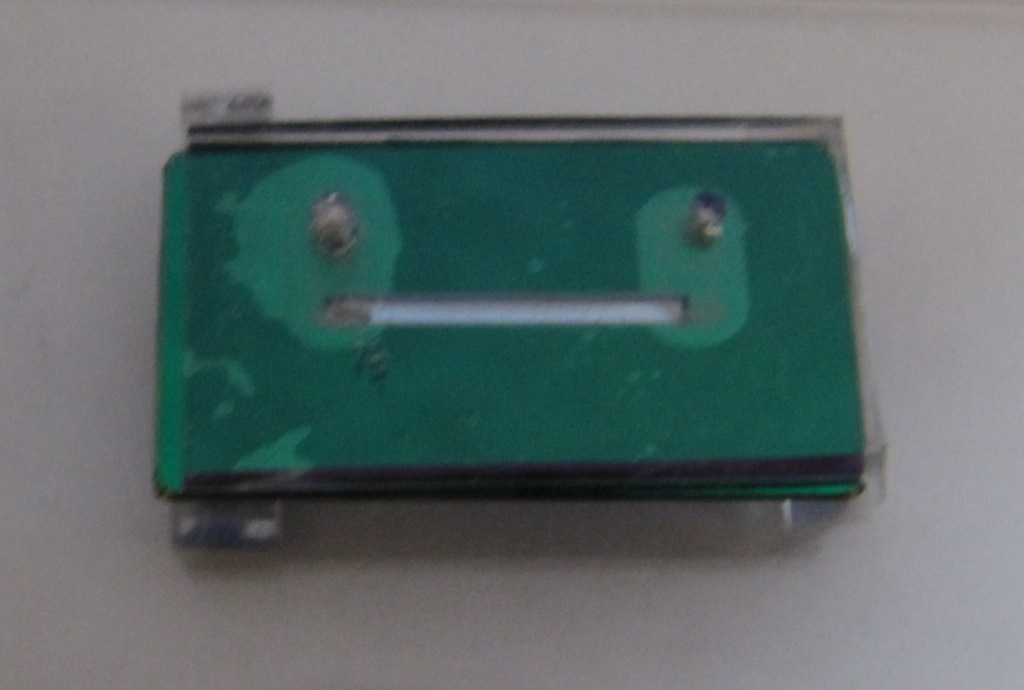

- Figure 4: Prototype PDMS Bonded to single channel
dialysis chip with recirculating pump system.
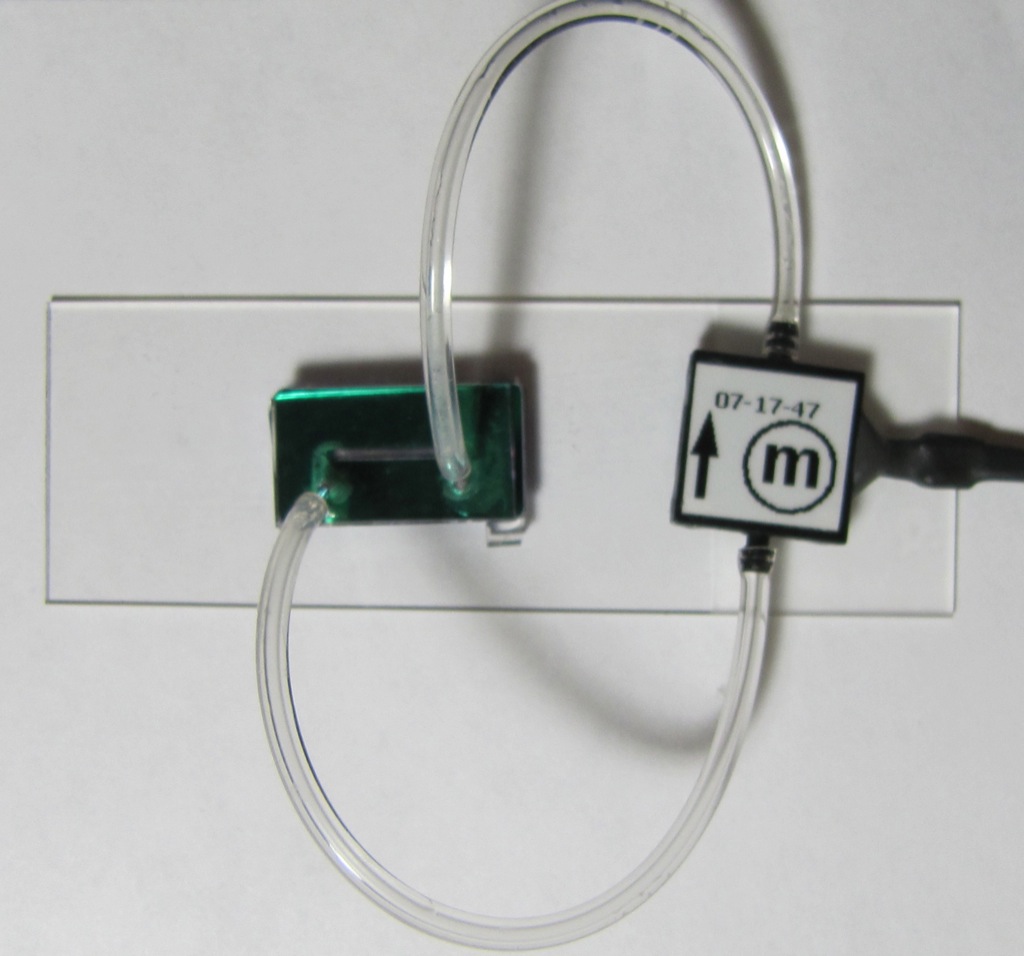

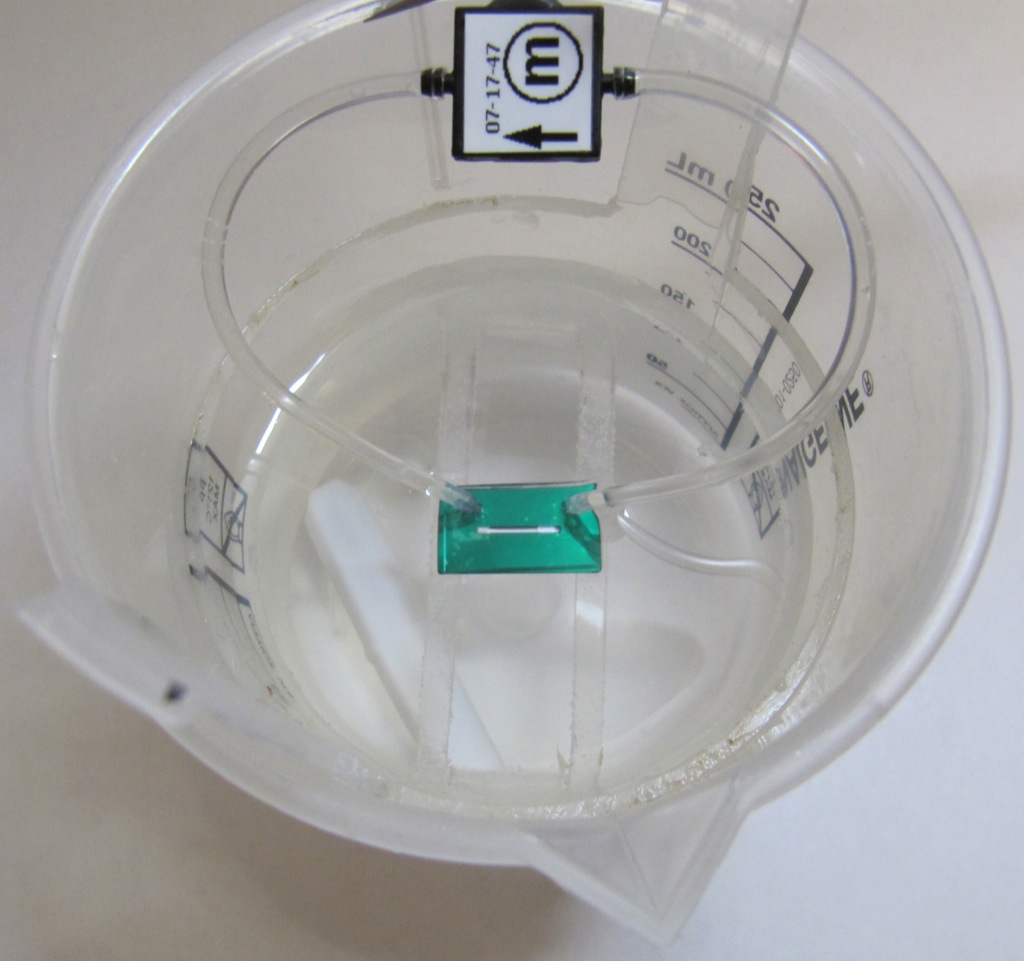
- Figure 5: Complete test set-up
in beaker in closed loop.
The closed loop fluid system contains 75 µL. To acheive a Péclet number of one, a single channel needs a flow rate of 11.76 µL/min. This is easily achievable with the piezo pump by dialing-in the actuation power. At 1 Hz and 160 Vpp gives a rate of ~10.7 µL/min and 170 Vpp gives ~13.6 µL/min. So at 1 Hz, 164 Vpp should give 11.88 µL/min. (within 1% desired value. This is likely less than the measurement error values which are not being reported here). The piezoelectric pump does not allow for fractional frequency of voltage values and repeatability of rates will need to be tested.
Regarding the piezoelectric pump
Sterilization…
The interior of the pump is made of polyphenylene sulphone (PPSU), polyimide (PI), and nitrile butadiene rubber (NBR) all are sterilizable with ethylene oxide (EtO) according to the manufacturer.
Pressure
The stall pressure of the Bartels Mikrotechnik pump is 3.6 psi. It seems that this presure (or less) is enough to rupture the 10 mm x 0.5 mm single channel membranes. While performing a dry run, that is the nitride surface of the chip is dry and the channel side is being pumped with DI water, the membranes did indeed rupture. No pressure information is available for the experiment but the maximum pressure from Bartels data was derived using 250 Vpp while the maximum for this experiment was 195 Vpp with the flow rate linearly proportional to the voltage. No pressure to voltage relationship is published.