Autoclaved BBB Device V2.5
To prepare the BBB devices for cell culture, they must be sterilized. To that end, I wanted to see if there were any adverse effects from autoclaving the device. Recipe 4 on the U of R autoclave is a dry process that we use to sterilize tips, so I used the same recipe. I placed the device on a slide, into a beaker, covered with tinfoil, and used some autoclave tape as an indicator.
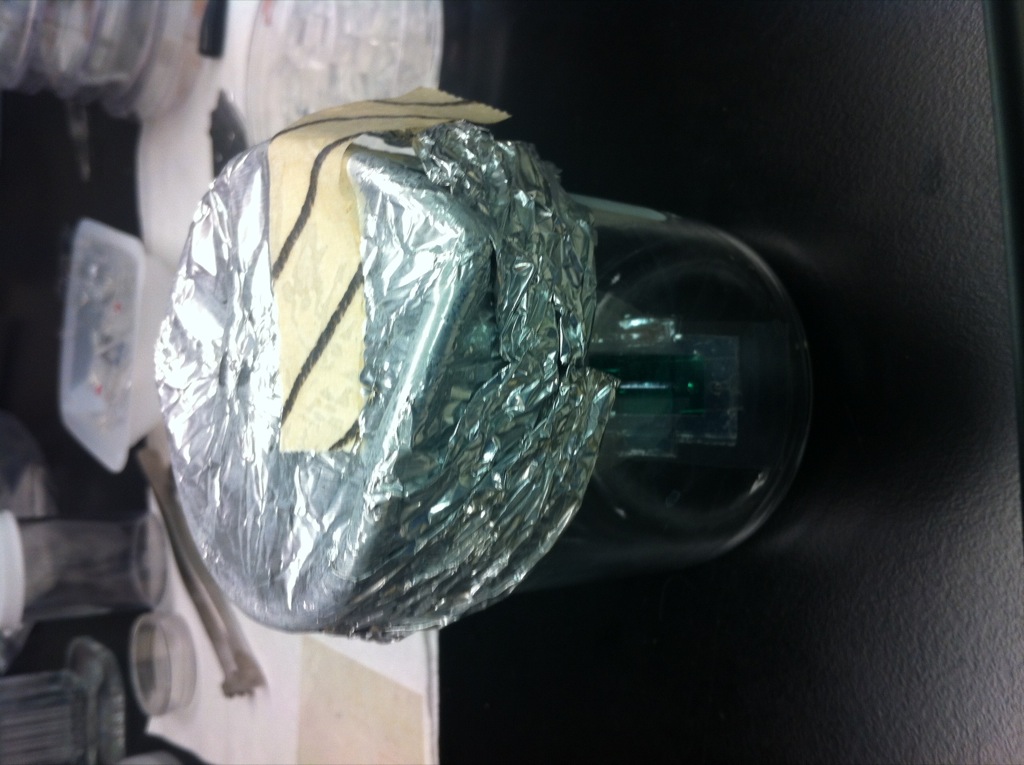
Upon inspection, I didn’t see any tears/breaks/discolorations that you might see with a thermal process. The device hadn’t moved off of its’ slide. I wanted to then assess the leak and electrical performance of the device. I clamped the two bottom ports and began to fill the top port with blue food coloring/ DI H20 (5 uL/minute).
BBB Device 2-5 fluid enters top chamber
BBB Device 2-5 Top Chamber filled with fluid, exits outport
After filling the top chamber successfully, I attempted to fill the bottom chamber with red food coloring/ DI H20. The fluid entered the bottom chamber successfully, but did not migrate across to the outport. Instead, the red fluid started to enter the top chamber through the filter, from the bottom chamber. I determined that the reason for this flow was that the outport for the bottom channel was blocked, thus no fluid was entering that capillary. Wiggling the capillary seemed to unclog the channel, but the electrode snapped in the process, providing a leak point for fluid to get out when the pumping process was resumed. The pnc-Si had also ruptured.
BBB Device 2-5 Unintentional Mixing
BBB Device 2-5 post autoclave, leak
Because the electrode cracked, there was no way to tell if the device was going to perform correctly with TEER. Ultimately, my experience with this device generation has caused me to update my design, seen in the next post, BBB Device 2-6.