Proposed Dielectrophoresis (DEP) Tests w/ Microporous SiOx Membranes
The Gaborski lab has been working with Blanca’s lab performing some scoping tests w/ SiN and SiOx microporous membranes. The aim is obtain proof of concept results regarding the efficacy of using a microporous membrane to trap sub-micron particles with DEP. Last week, we tested w/ our 200 nm polycarbonate beads. We were able to image the beads very well and could observe them passing through the micropores via electro-osmosis or gravity flow. We were not able to get them them to trap by DEP, even up to 3kV applied potential. Our next step will be to repeat using larger spheres from Blanca’s lab in the 0.5 to 2 µm diameter range.
We are presently using the 120 nm thick SiOx membranes (3 µm pore diam.) and 0.2 mM K2HPO4 buffer solution (adjusted to pH=8 w/ KOH). The microspheres that Blana’s lab has are listed below. We are also interested in checking the Zeta potential of these using the Zeta-sizer in Jim’s lab. The basic principal of the measurement is shown in the figure below. We will do the experiments on the Gaborski Leica microscope with the Q-Imaging camera (the DEP power supply is very portable).
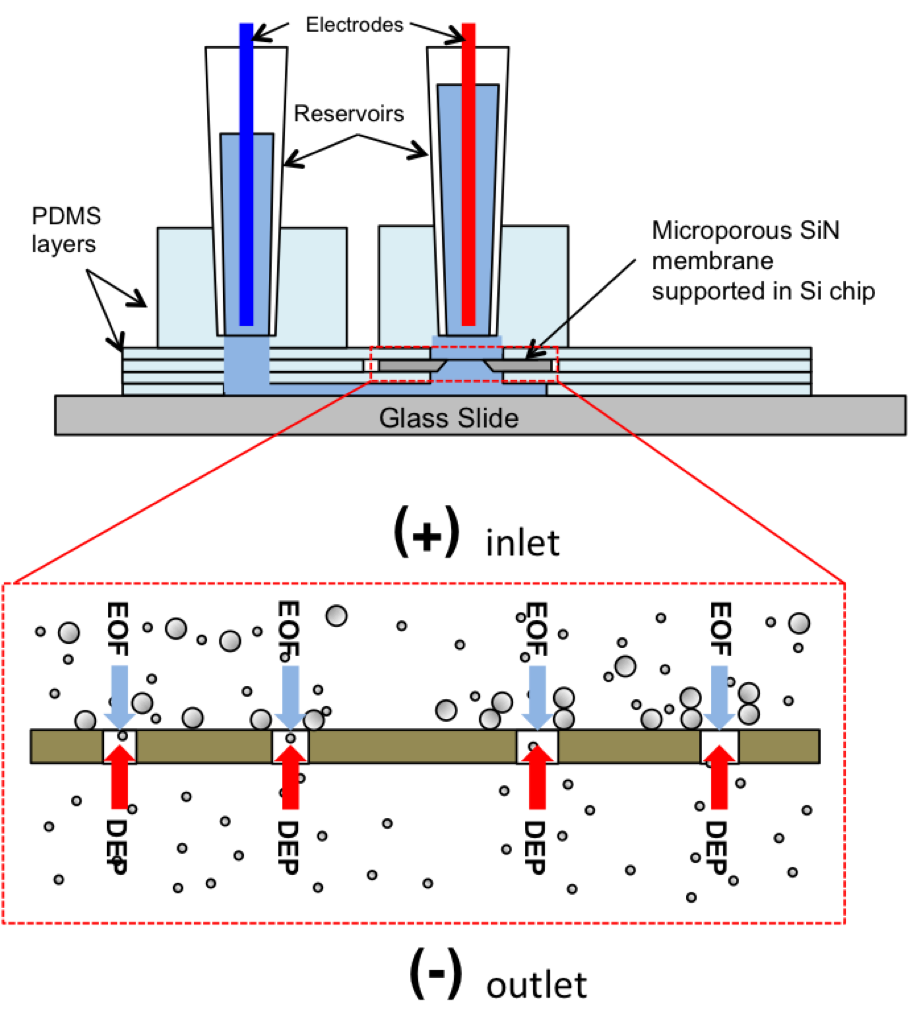
Schematic representation of the membrane dielectrophoresis microdevice. By applying electric potentials two phenomena are obtained: electroosmotic flow (EOF) towards the negative electrode and dielectrophoresis (DEP) where the local electric field becomes distorted by the presence of the membrane which acts as an electrical insulator, producing insulator-based dielectrophoresis. This dielectrophoretic force is the strongest at the pores and pushes the particles away from the constriction. Larger particles will be the most affected and will not be able to pass through the pores, even though the particles diameter is smaller than the pore size. This system has great potential as a dynamic bioparticle filter, that can be turned on and off by manipulated the applied electric potential.
Blanca’s Lab:
F-8821 1-um-diameter, Invitrogen
FluoSpheres® carboxylate-modified microspheres red fluorescent 2% solids
Charge: 0.0175 meq/g
Density: 1.055 g/cm3
Specific surface area: 5.2×104 cm2/g
F-8823 1-um-diameter, Invitrogen
FluoSpheres® carboxylate-modified microspheres yellow-green fluorescent 2% solids
Charge: 0.0175 meq/g
Density: 1.055 g/cm3
Specific surface area: 5.2×104 cm2/g
F-8852 1-um-diameter, Invitrogen
FluoSpheres® Sulfate Microspheres, 1.0 µm, yellow-green Fluorescent 2% solids
Charge: 0.017 meq/g
Density: 1.055 g/cm3
Specific surface area: 5.2×104 cm2/g
F-8826 2-um-diameter, Invitrogen
FluoSpheres® carboxylate-modified microspheres red Fluorescent 2% solids
Charge: 0.1533 meq/g
Density: 1.055 g/cm3
Specific surface area: 2.8×104 cm2/g
F-8834 10- um-diameter, Invitrogen
FluoSpheres® polystyrene microspheres, 10 µm, red fluorescent (580/605)
Density: 1.06 g/cm3
Charge: Not reported for this product
F-8844 15- um-diameter, Invitrogen
FluoSpheres® polystyrene microspheres, 15 µm, yellow-green fluorescent (505/515)
Density: 1.06 g/cm3
Charge: Not reported for this product
CAF-005UM 5- um-diameter, Magspheres
5 um RED Fluorescent Carboxylated Latex sphere (538/584)
Charge: 0.012 meq/g
Density: 1.05 g/cm3
CAFR-500NM 0.5- um-diameter, Magspheres
0.5 um RED Fluorescent Carboxylated Latex sphere (538/584)
Charge: 0.028 meq/g
Density: 1.05 g/cm3
CAYF-002UM 2- um-diameter, Magspheres
2 um yellow-green Fluorescent Carboxylated Latex sphere (538/584)
Charge: 0.010 meq/g
Density: 1.05 g/cm3
Gaborski Lab
FC02F 0.21 µm-diameter, Bangs Laboratories
0.2 µm green Fluorescent Carboxylated polycarbonate sphere (470/525)
1% solids
0.21 µm–diameter, Invitrogen
0.2 µm yellow-green Fluorescent Carboxylated polycarbonate sphere (505/515)
2% solids