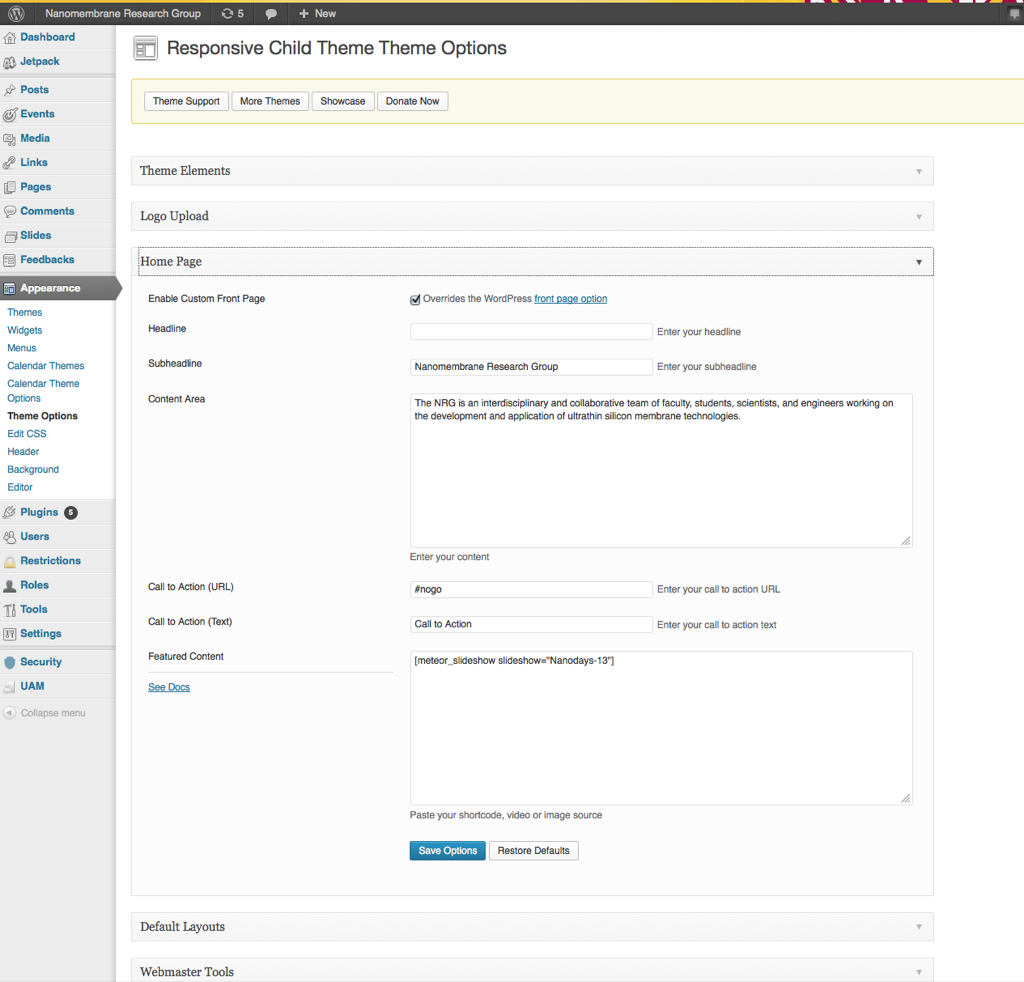
Where to Change the Slide Show
We were worried that Friday’s experiments were giving us a false positive results. If the electrophoresis breaks the membrane, then we’d expect to see the rhodamine rush through just like it was in our experiments. It’s too hard to view the membranes afterward because they tend to break during removal. I designed some simple tests…
Goal: Measure SU-8 shrinkage that have gone through various soft and hard bake conditions To measure the shrinkage, the SU-8 scaffolds needed to be lifted off, but there was some issues. Originally, the SU-8 was spincoated onto an oxide layer, which would be etched away using BOE. The SU-8 had appeared to be disintegrating due…
A bunch of samples from W683 (no RTP) were liquid silanized and used in 3D format to track discoloration in comparison to control sample, in DMEM(-FBS) @ 37C in Oven. I used all the cracked chips which broke while clamping them into Sepcons. Instead of tossing them off, I just wanted to repeat the discoloration…
Last summer, I attempted to modify the surface of SU-8. The purpose of the experiment was to covalently bond poly(ethylene glycol) (PEG) to SU-8, which would be useful when the SU-8 is used as a scaffold on the membranes. The method of surface modification was derived from the attached article, which can be found here. …
I’ve always wondered what the variability was in the pore statistics extracted from TEM images of different fields on the same membrane (SC 141). I took a series of ten images from random positions (corners, edges, center) and ran them through the pore processor. Here are the results: (images taken at 100 kx) position porosity…
Using fresh tips, I re-ran the scans of amorphous Si films deposited at different biases. Recall that our theory states that interface roughness between the Si/SiO2 is an important determinant for ultimate pore morphology. A rough interface will suppress nucleation, which is why we observe low porosity with zero bias. The 05 W condition decreases…