Paper Review… Human Nephron Filter: Nissenson(Watts) UCLA
In researching for the paper for Advances in Chronic Kidney Disease (ACKD) I’ve run across some interesting papers. Here is one describing a proposed Human Nephron Filter…
Human nephron filter proposed by Nissenson1 (1)
1Division of Nephrology, Department of Medicine, David Geffen School of Medicine at UCLA, Los Angeles, California, USA
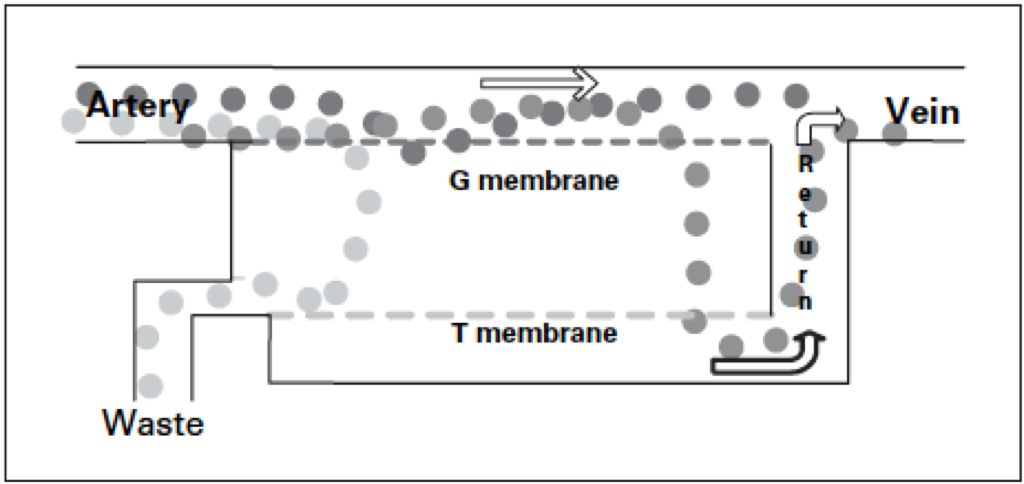
This imagined device was modeled (using two membranes) and achieved a clearance rate of 30 mL/min. They model one membrane with a 2.5 nm thick active filter, which is backed by a much thicker membrane with larger pores (so really there are three membranes). I would say, based on our work, that there is little difference for diffusion or ultrafiltration between 2.5 nm and 30 nm thick membranes especially as they are using a backing structure similar to PES filters..
ASIDE: Other groups have even proposed dialysis in microfluidic systems with no membrane. These rely on the principle that two miscible fluids at very low Reynolds numbers will not mix significantly when flowing in parallel.
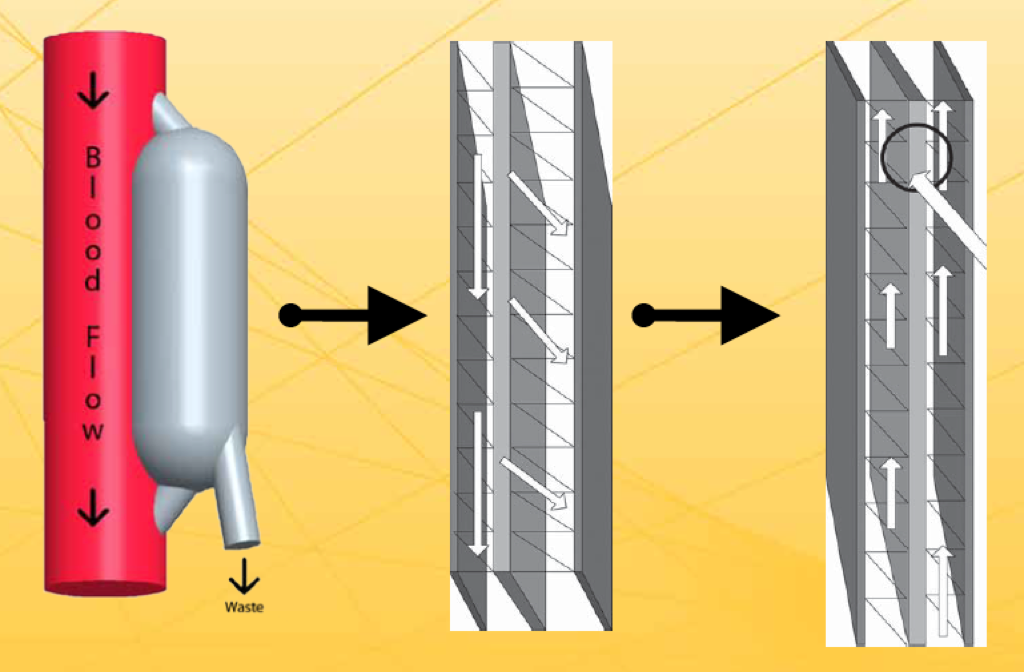
CENTER: G-membrane uses convective transport. Pores large enough to create plasma ultrafiltrate. Large cells pass back to the body (retentate), ultrafiltrate moves to T-membrane (filtrate).
RIGHT: T-membrane. Smaller pores than g-membrane allow water and salt to pass back to the body (filtrate), the waste is shunted to the kidneys (retentate).
The issues with the proposed system are…
1. Dialysis without water removal is nearly pointless. If I’ve learned one thing, it is that water removal for dialysis patients can be as critical as toxin removal. In fact some patients undergo separate ultrafiltration therapies in addition to dialysis.
2. They don’t actually have a membrane with the properties they require. They propose the G-membrane can be manufactured by drilling holes in a silicon diaphragm and the T-membrane can be made by self-assembly of molecules.
3. They don’t address the problems of hemocompatibility at all. I don’t know how long a device like this would last in vivo, especially as the proposed G-membrane is made of silicon.
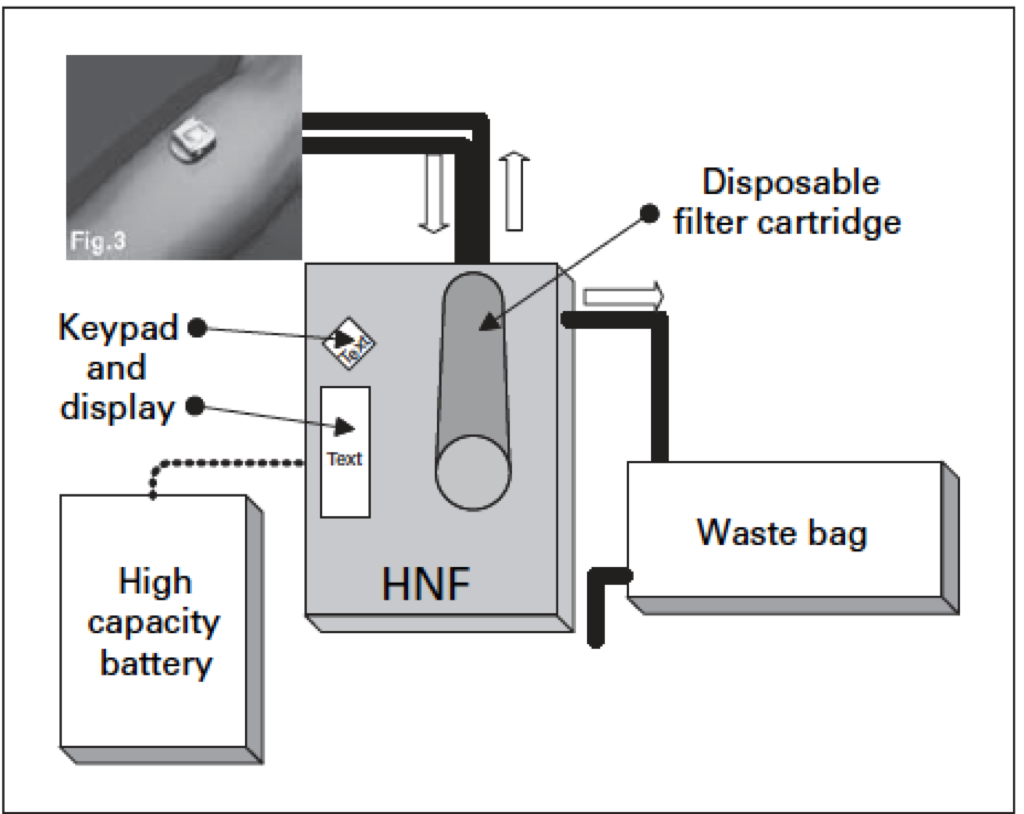
I like the elegance of this mimetic system, especially for implant where waste goes to the kidneys and doesn’t require an external waste bag, but I think a system like this is more suited to a wearable device.
Perhaps by including an active valve controlling how much water is flushed out with the waste and how much is returned to the blood flow this could become more feasible.
What is good about this system is that it doesn’t require any dialysate (no external supply of water/minerals/glucose). This also has its drawbacks.
And this… Nanodialysis Artificial Kidney
1. Nissenson, A. R. (2009) Bottom-up nanotechnology: the human nephron filter. in Semin Dial, United States. pp 661-664