Porosity vs Discoloration II
We know: W683 has no visible pores, W685 has usual porosity, and the recent Wafer 747 is ridden with pinholes. I wanted to test this new wafer for discoloration in comparison to the other two and got the expected result.
In the figure below, there are two sets of images of same samples taken at different angles (the left side is taken on benchtop as usual, whereas the right side is taken using tweezers). This was done because, t=0 images on left side were too shiny.
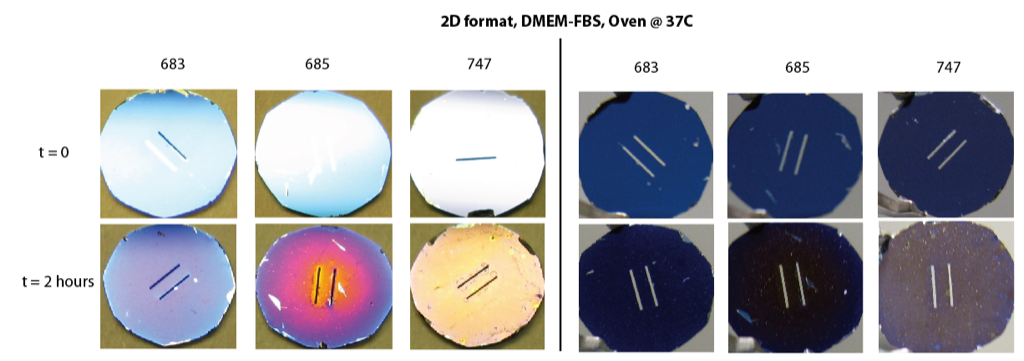
As seen above, the W747 sample which has high pinhole density discolors the fastest followed by sample from W685. W683 sample doesn’t show significant discoloration in the given time frame. Now it can be inferred that discoloration rate is certainly linked to porosity of the material.
Be careful not to confuse the pinhole density with the porosity due to the pores. Is 747 also the most porous, or does it just have the most pinholes? Pinholes don’t count as porosity in this case, since the surface area is tiny compared to the nanopores.
Isn’t having a pinhole equivalent to having a big pore? Here we are looking as how the component attacking the material could penetrate more when there is high porosity/pinhole density and cause corresponding discoloration.
For air flow, you could argue that pinholes are similar to nanopores, but even then there are substantial differences.
For fluid transport (diffusion and convention) pinholes that are microns in size and spaced 100’s of microns apart will behave much differently than the nanopores that are 10’s of nm apart. We can discuss at the next meeting.
The other danger with lumping pinholes and nanopores together relates to the surface area available for chemical attack of the Si material. The nanopores create a texture that may allow highly porous material to be attacked much differently than smooth, non-porous material. Because pinholes are so big, this effect would be minimal for them.
There has been no consistent relationship between the nanopores and pinholes from the fabrication and materials perspective. I look at them as two independent issues.