Preliminary Small Animal Dialysis Experiments
The overall aim of the small animal dialysis is to evaluate the dialysis membranes and compare their urea clearance to commercial materials. The specific aim of this study was to go through the process of ordering and receiving rats, setting up the experiments and working out the connections between the catheters and the test devices. The two rats used were provided gratis from Harlan Laboratories.
Two Sprague-Dawley rats were sourced from Harlan Laboratories. Both animals had been triple catheterized (carotid artery, femoral artery, femoral vein). The first rat, Scott, had a single standard catheter in the CA and Pinports in the FA and FV. The pinports allow access to the catheter via a pinport infuser without using needles or requiring the removal of the standard pin. Patency; the state or quality of being open, expanded, or unblocked; has been reported to be increased from around two weeks to five weeks. Patency checks are required every three days for the standard catheters while pinports require only weekly checks. We requested two pinports, and not three, because Harlan has not done three in one animal before. We are in discussion to have them use three in the future.
Patency checks require drawing out the locking solution in the catheter and a small amount of blood, injecting saline and then heparin. Each operation requires a separate needle and syringe.
Scott’s catheters, one standard and two pinports, were checked for patency before he was placed back in his cage. We will need to check his standard catheter on Friday and Monday before his undergoes the scheduled procedure on Wednesday.
Ralph, pronounced ‘Rafe’, had three standard catheters. We brought him into the procedure room, put him under anesthesia, and checked his catheters for patency.
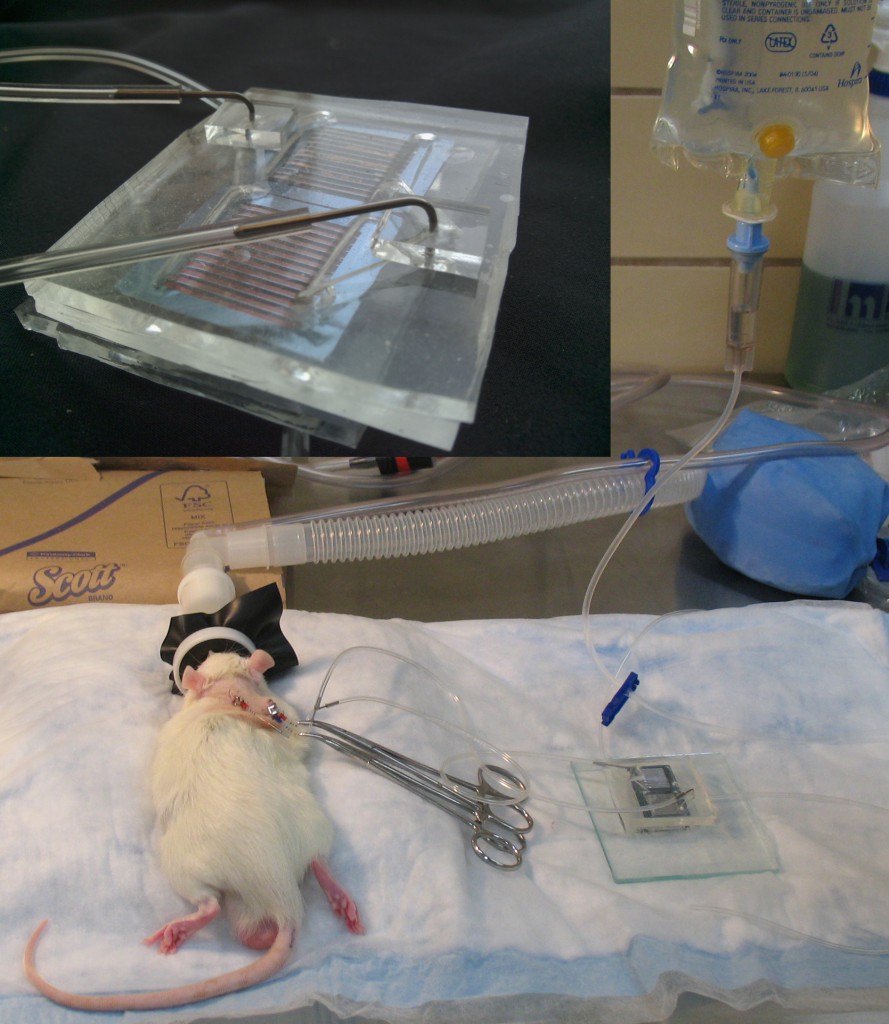
A mock dialysis device was attached to the femoral arterial catheter, FAC, and femoral venous catheter, FVC, via sections of blunt needles. The catheters remained clamped. The purpose of this exercise was to ensure we had the dialysis system details worked out and could connect it to the animal. See Fig. 1. The dialysis device was a two chip system with PDMS fluidics bonded to the chips. The chips were pnc-Si with nitride scaffolding. The scaffolding allowed bonding to the underlying Si on the membrane side of the chip, but the backside nitride would not bond.
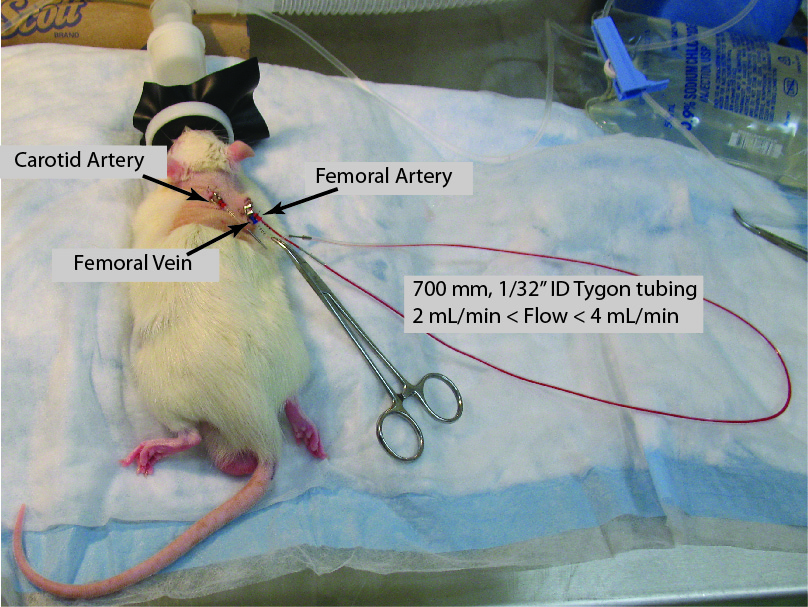
The next experiment was to attach a section of tygon tubing, the same tubing used to connect the dialysis device, to the FAC and FVC. The purpose of this exercise was to go through the actual fluidic connection without introducing air into the blood stream. One end of the tubing, filled with saline and a needles worth of heparin, was connected via the blunt needle section (22 G) to the clamped FAC. The clamp was released temporarily partially filling the tube with blood and removing any air bubbles. The FAC was re-clamped and the other end of the tube was connected to the clamped FVC. Both clamps were released and blood flowed, fairly quickly, through the tubing. The animal, still under anesthesia was observed for five minutes. See Fig. 2. When no signs of distress were observed, the catheters were re-clamped and the tubing removed.
The FINAL experiment was an attempt, for the vet tech, to catheterize the right carotid artery. This was done to ensure we would be able to regain vascular access, for blood pressure measurements, in the case of patency failure. After some trouble finding the artery, being so close to the trachea, Kris Abrams was able to insert the catheter easily. Femoral catheterization should also be possible if needed. I did not take any photos of the surgical procedure.
Next Steps: Since the nitride is not bonding to the PDMS, the next version of the dialysis device will use an acrylic fixture similar to the single slot devices. This will allow more rapid fabrication of devices for animal testing and allow for a wide variety of chip surfaces while work continues on surface functionalization and membrane fabrication development. Next week we will connect Scott to a fixtured two-chip device with non-porous membranes and allow blood to flow.