Instantaneous Clearance per unit area – Animal Study
We’ve calculated our instantaneous clearance numbers for the benchtop studies that use sepcon chips. Even calculating per unit area, our chips are not clearing much volume in these experiments. I believe this is due to the very low flow rate (1 µL/min). Kayli is starting experiments to use higher flow rates with the same chips to see if this number will be increased as expected. I thought to myself, “Dean, you already have clearance data from experiments at 0.5 mL/min in the Sprague-Dawley rats!” Here I calculate the instantaneous clearance from those experiments.
Kt/V is used to evaluate Hemodialysis sessions. It is measured from the ratio of post treatment urea concentration (measured as BUN, blood urea nitrogen) to the initial concentration. Knowing Kt/V, the duration of the treatment (t), and the fluid volume of the animal (V) we can calculate the instantaneous filtration rate (K) in volume per time. If K = 100 mL/min that means that every minute, 100 mL of blood have been completely cleared of urea. To compare our device to other devices (e.g. Frisell and Roy) we want to know our instantaneous clearance per unit area. Our benchtop studies, which Kayli has been doing, have very small flow rate and while it clears a larger proportion of molecules doesn’t clear a large volume so the number is low. (~140 mL/min/m2). This is almost exactly equivalent to the number reported by Frisell and Roy, so we went back to the small animal studies to calculate the instantaneous clearance (K) and the instantaneous clearance per area (KA). The much larger blood flow, rate 0.5 mL/min, should give us a larger number.
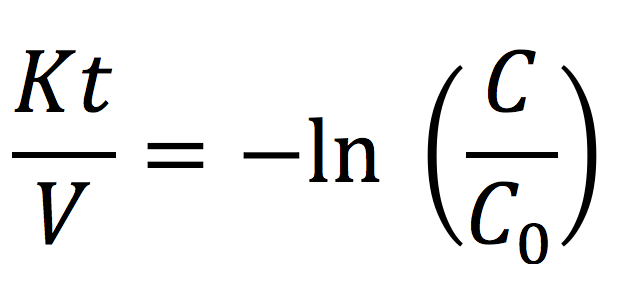
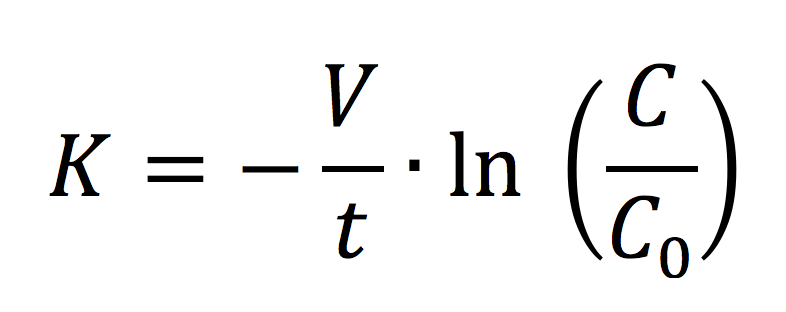
K = instantaneous urea clearance (mL/min)
A = membrane area = 110 mm2 = 1.1×10⁻⁴ m2
KA = instantaneous urea clearance per area = K/A (mL/min/m2)
t = dialysis duration = 240 min; 4 hours
V = fluid volume of animal = 175 mL; 500 g Sprague-Dawley rat
C0 = initial urea concentration = 1 ; normalized
C = final urea concentration = 0.75; normalized
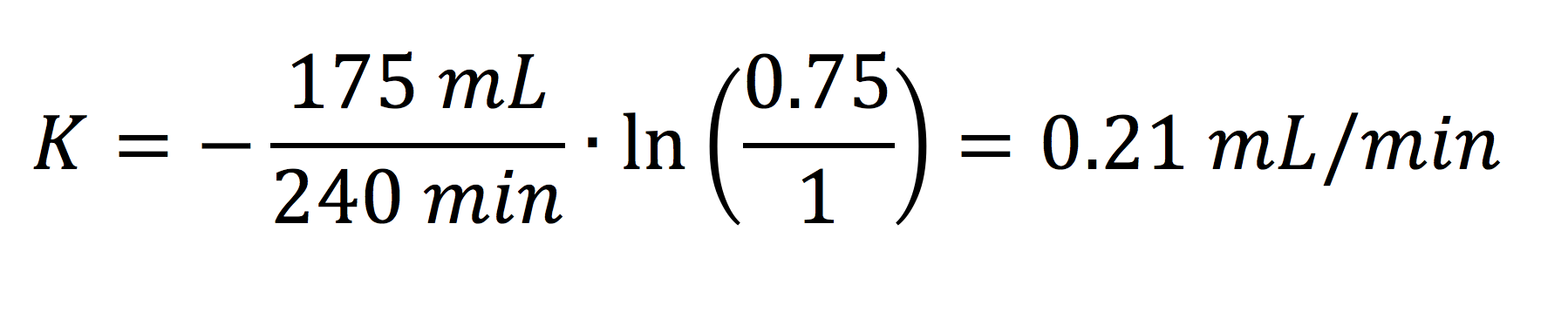
KA=(0.21 mL/min)/1.1x10-4 m2 = 1,910 mL/min/m2
Two things, first the 0.21 mL/min number means that the two chip device is clearing 42% of the urea from the blood. Second, per area, we are two orders of magnitude better than the Fissell/Roy device, which has a porosity of 1%.
This is exactly where we need to be Dean. Thanks! Great news.
If you look forward to human HD…
V = 35 L, 35000 mL
t = 240 min
To reach Kt/V of 1.4 in four hours, K=204 mL/min and since Ka = 2100 mL/min/m^2
We need A=0.097 m^2, 150 sq. inches (this is with our non-optimized rat dialysis device and rates)
Standard HD membranes are ~1.9 m^2
The flow would have to scale with the area, so from .5 mL/min for rats to 485 mL/min for humans. Typical rates are 300 to 600 mL/min. Again, this was non-optimized and we should be able to do better.
Well we need to think continuous or semi-continuous because that is still a helluva lot of membrane.
If healthy kidneys completely clear 120 mL/min (80 to 120 is normal) then we need
25 to 37 sq. inches of our membrane working full time. Of course, people can survive quite nicely on one kidney with a filtration rate of 50 mL/min (15 sq. inches).
Clearance numbers relate to inulin, which is neither excreted nor reabsorbed in the nephrons, so once it is through the glomerulus, it is filtered out and therefore is used for the GFR numbers. 600 mL/min into the kidneys, 120 mL/min pass through the glomerulus to the loop of Henle and onto the ureters. Our system has no secretion nor reabsorption mechanism, obviously.
So what can we do with Tucker’s 9 cm square lift-off membrane (pretty sure he means 81 cm^2)?
We may want to think about earlier stages of renal decline and the reasons for deterioration to ESRD. With some residual kidney function, maybe we build an assist device that operates at lower flow rates and stems further deterioration in kidney function?