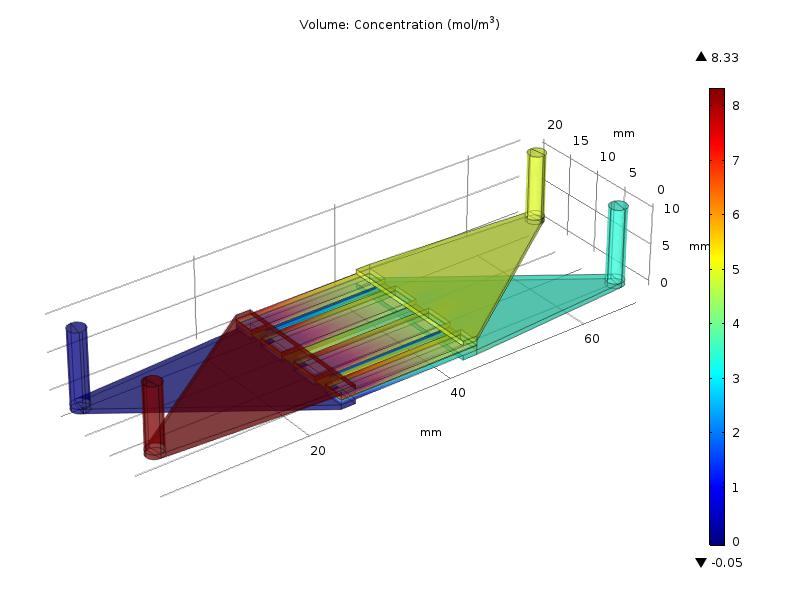
COMSOL model of SiMPore Liftoff device
I drew an approximation of the SiMPore liftoff device and ran the COMSOL model with 1 mL/min urea fluid flow in the upper channels and 2 mL/min dialysate in the bottom channels. With this initial model, the urea was cleared to 40% (60% removed). This is an instantaneous urea clearance rate of K= 0.6 mL/min. The area of membrane in contact with the fluid A=272 mm2 (272e-6m2). KA = 2205 mL/min/m2. The area I used was not the active area of the liftoff, that is I didn’t subtract the SU-8 scaffolding. It’s hard to know the metric to use here, should it be the active area or the total area including scaffolding or chip surface?
At any rate, the number produced above for the modeled liftoff membrane is extremely close to what we have for the chip based device used in the small animal studies. (2100 mL/min/m2). This is so close that I suspect the model is wrong and the results are coincidental. (because I’m skeptical.)
We’ll have to compare this model with the experiments already performed by Jared. We may also have to tweak the geometry to get it matching the actual device.
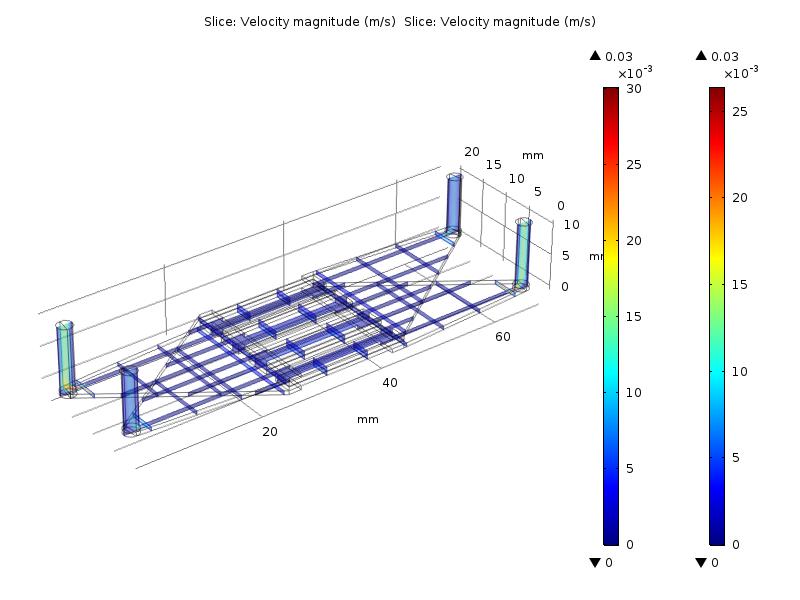

I changed the flow to concurrent (as opposed to counterflow), changed the flow rates to 300 µL/min for both, and set the inlet concentrations to 0 and 8.3333 mM. I did not take the scaffolding into account, which would reduce the area by 20%). The analyte side goes in at 8.333 mM and exits at 4.91 mM (41% reduction). If the 20% reduction of active area corresponded to a reduction of 32%. I’m still working on the porous media model, which will be able to account for the porosity, obviously.
The first model reduced the analyte by 60% even though it was flowing much faster (~3x). I believe this is due to the counter/concurrent flow configurations. As expected, the counter flow setup clears more as it maximizes the analyte gradient along the membrane.