Wafers 510, 511 & 513
Last week I etched three wafers of different silicon thicknesses (10 nm, 15 nm, 20 nm). All the wafers had a TEOS mask with the standard three layer sputtered film on the front.

Not that surprising is the fact that the thinnest membrane showed pores while the 15 and 20 nm membranes did not at this annealing temperature. Interestingly, a TEOS patterned wafer with a thermal oxide on the frontside annealed at 950 C looks like this:
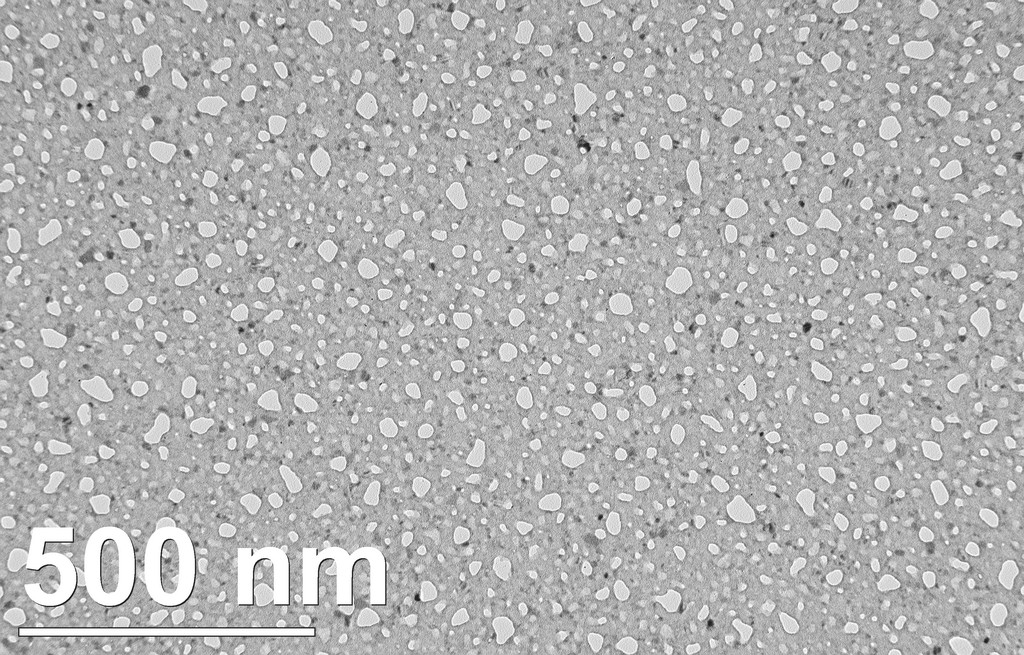
Wafer 415T (0,-5)
We can now confirm that the thermal oxide affects the membrane morphology. The question is why/how? See the earlier thread on thermal vs. sputtered oxide.
Below are the histograms for a inside and outside sample from wafer 511.
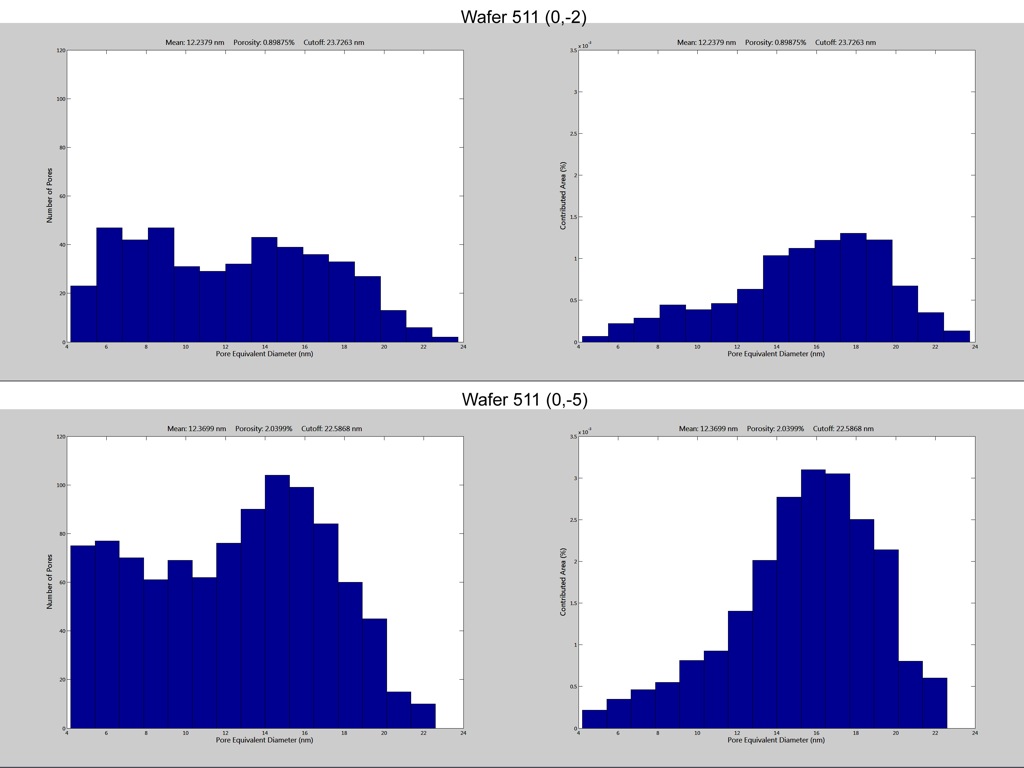
The cutoff and average pore size are very similar, but the porosity differs by 2x. Could it be that the strain in the film from inside to out could also differ by 2x?
Dave – Please check the pore measurement software. I cannot manually measure a pore dimension larger than 25nm. Correct me if I am wrong, but I cannot see how these histograms are correct.
If it is wrong, is this a glitch that we can fix? Thanks!!
I may have used the incorrect pixel:nm conversion. I’ll check it out asap
Do you have to provide the conversion manually? Wouldn’t it be simple to add a capability where the program finds the scale bar, or has the user trace it, and then asks for its actual length?
Maybe we should ping Mike about this, to remove one potential level of error? I think it’s already happened more than once, and will likely happen again…
Yes, I have to specify the number manually. I used the 100kx conversion for a 50kx image, so that’s why the numbers were a factor of two off.
Thanks Dave – The Bio folks will probably like these numbers better, if they can get any protein through <20 nm pores.
Hopefully there will be some type of burst pressure results soon for these thinner membranes…
I’ll make a note of the request for Mike.