Recently, Jim has purchased a Makerbot 2x printer for our group. I’ve spent the last few weeks printing and debugging. It has the capability to print many different types of material, along with 2 separate nozzles. I have been able to get many fine prints done with ABS plastic, and I’ve put together a basic guide that will allow people to run the machine (n = Tejas), printing out previously designed builds. I am currently working on other parts of the guide that will describe how to design and slice up models for printing, how to finish parts, and how to weld printed pieces together.
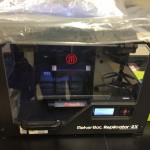
Our Shiny new machine,…missing its lid. I’m told that it is on the way by Top Men. Top Men.
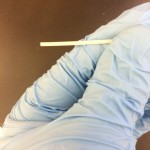
The neatly trimmed ABS plastic, ready for insertion into the extruder. It’s not transparent, unlike PLA.
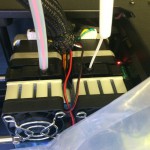
Replicator 2x has 2 extruders! We can print in multiple colors/materials. Dissolvable scaffolds, 2 tone prints are both possible!
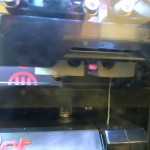
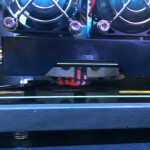
Nozzle extruding a thin line of plastic.
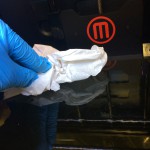
It’s really important to wipe down the build plate with Acetone (ABS dissolves in acetone) to make sure the prints stick. Otherwise, you may have wasted 3 hours for nothing.
Beginning a print. The nozzle purges it’s initial volume of ABS in a line on the front of the build plate..
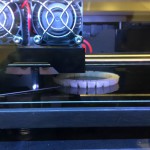
And we are printing (in this case a bracelet)
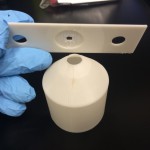
Other larger pieces can be printed simultaneously. Here is a spin cup designed by Meghan.
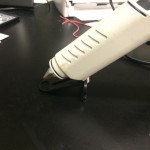
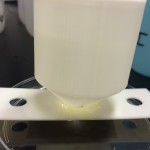
Joining pieces together can be done using a hot glue gun (akin to resin) or ABS slurry (akin to welding). Each have their pros and cons.
Joined with hot glue. It’s water tight!.
We will be able to print PLA and dissolvable filaments in this printer as well, but I haven’t determined the best settings for these yet.
Okay, so after navigating this weird new method for posting, I have a semi interesting post today. I have been working on the experimental validation of my COMSOL predicted capture results and have finally completed the first round of those experiments (I say this after looking at the data). The experiments have been carried out…
For a while now I’ve been running diffusion experiments using bacterial alkaline phosphatase (bAP) as my solute of interest in a solution of 50mM tris buffered saline (TBS) and 20 ug/mL BSA. Initially, the BSA was included as a way of reducing the adsorption of the low concentrations of bAP to the device surfaces —…
Wet Etching of Optical Thin Films As a result of Christian’s trip and Kevin’s discussions with me, I have been wondering if we could make nanoporous MgF2 membranes for Raman spectroscopy. Part of the appeal in using our Si-based nanomembranes is that the volume they occupy in the observation space is extremely minimal. Even…
SET-UP Syringe pump: 5 mL of 7.6-nmol/100µL, 5.6 µL/min pump rate. Single Channel dialyser, 10 mm long, 0.5 mm wide, 0.3 mm high in stirred beaker of DI water Fraction Collector programed to rotate every 30 min. Set up in refrigerator, 40˚C. Figure 1: Long term dialysis clearance set up in refrigerator. Syringe pump, stirred…
Test of Binding/ Unbinding (Carrie and Barrett): Test to see if we can successfully bind Human IgG to the protein A beads and then remove it with buffer B. After ordering the new human IgG and protein A beads, I have been working on a higher-quality analysis of the binding and dissociating of the IgG…
SU-8 3010 has been used to create a scaffold in the fabrication of the liftoff membranes. The supplier of the negative resist, MicroChem, rates it for a 13 moth shelf life. We were having difficulty achieving good liftoff with membranes in the second half of last year. The SU-8 had expired by several months, so…