Discoloration – Water soak
This week, I did a quick discoloration experiment based on Chris’s comment at lab meeting. He wondered if soaking the chips in water for a while would allow potential discoloration-causing contaminants to slowly leech out. I took 2 chips from wafer 622 and soaked them in ~ 300mL DIH20 overnight (with a couple of water changes). I then added them to DMEM/F12 with 10%FBS for discoloration. These are not RTP’d samples.
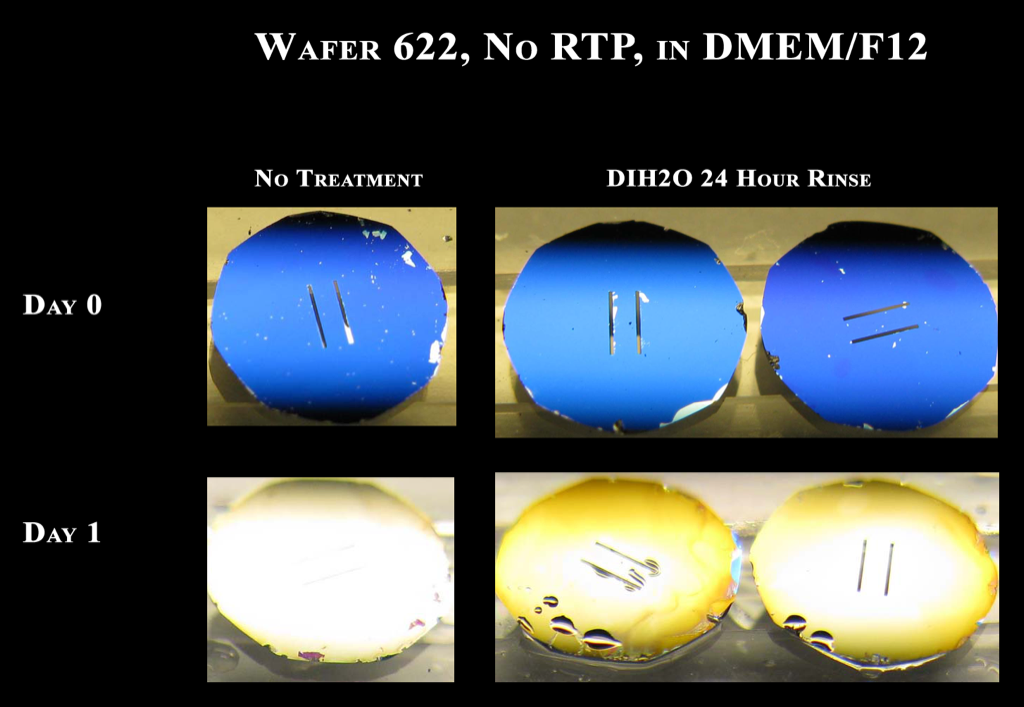
The soaked/rinsed chips discolored as fast as the chip without the rinse. So, either the DIH2O soak was not long enough, or discoloration-causing contaminants are not leaching out of the membranes, or contaminants are not causing the discoloration.
The best experiment would be to take samples that still have the protective oxide, strip it in BOE, and then soak it for some time without drying. I have my doubts about whether this DI soak was able to infiltrate the pores to remove any contaminants that may be present. Do you think DMEM would have an easier time entering the pores? Even a small amount of some proprietary surfactant could make a big difference. Do we make our own DMEM so we are absolutely sure what it contains?
I think the contaminants in the pores idea is a long shot, but before concluding it’s a non-issue, we should be absolutely sure. Thanks!
I can’t think of why DMEM would have an easier time than water getting into pores. DMEM consists of salts, inorganic ions, buffers, glucose and amino acid. It has about 25 different things in it, so it’s not really practical to make in the lab. I doubt that Invitrogen would put in proprietary surfactants without updating the formulation sheet (especially since surfactants tend to disrupt cell membranes). Does all BOE stripping happen in Hopeman, or can I do it the Goergen basement?
I would suggest coordinating with Dave for this experiment. We have a few junked wafers that for one reason or another will not be etched. Dave could break them into a few pieces, strip them, and deliver them to you in DI water. You could then stagger when you take them out of the DI or use them however you want. None of the discoloration work requires membranes and this will also allow us to test if EDP plays any role (these films would never have seen EDP).
We can discuss at the next meeting or get this started whenever you want. Thanks!
If there are other junk wafers that will not be etched, Jess could use them for her protein binding experiments. She needs to increase the amount of surface for adsorption and we just talked about scaling up to a whole wafer on Friday.