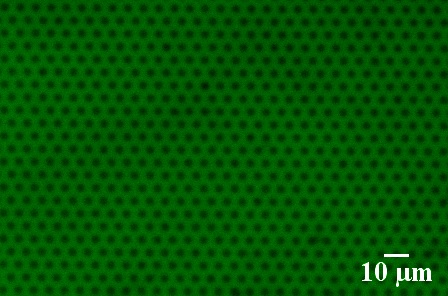
PLL-g-PEG patterning on SiO2 layer
As part of my thesis, I am trying to get a non-fouling pattern on a substrate which resembles our porous membranes to investigate cell behavior including cell adhesion and migration and to compare with our previous results which was obtained on porous membranes. This study can separate the role of pore edges and disrupted surface geometry.
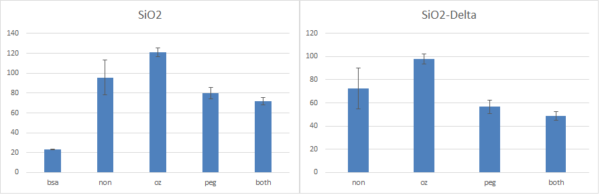
We used PLL-g-PEG for surface modification. First, we tried to have an efficient coating on the substrate with high grafting density which prevents cell adhesion. Different concentration of PLL-g-PEG was used for this coating. Coating efficiency was calculated based on BSA repulsion of the surface. FITC BSA was introduced to the surface after polymer coating and fluorescent intensity was measured to quantify the process. non-labeled BSA and uncoated surface with PLL-g-PEG was considered as positive and negative controls. 0.5mg/ml PLL-g-PEG solution in HEPES buffer was determined as the optimized concentration.
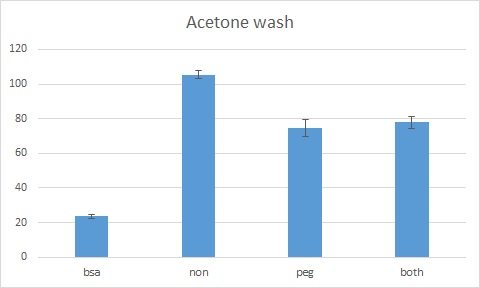
In the next step, coating stability to acetone washing was investigated. It showed that a quick acetone wash does not make any damage to the coating.
In the next step, the obtained optimized condition was used for PLL-g-PEG coating in a lithography process.

The results showed that the pll-g-peg efficiently patterned on the surface. There was a lower intensity in the patterned areas. It can be due to the lower protein adsorption in this areas or it can be the shadow of other areas.