Biphasic migratory response of endothelial cells to membrane porosity
Although most previous studies suggest a weakened cell-substrate interaction over porous membranes, there are variations in the observed cell responses, likely due to the use of different cell types, substrate materials, and experimental methods. We are seeking to develop a computational model using the Active Brownian Particle (ABP) approach to study the role of pore characteristics on cell motility over porous membranes. To do so, we first tried to experimentally determine key physical factors affecting cell migration over porous membranes.
We designed membranes with four different pore sizes and three different priorities (the total of 12 membranes) and used nonporous membranes as controls. To understand cell-substrate forces (to optimize the corresponding coefficient in the model) we reduced cell density to minimize the effect of cell-cell interaction in migratory response.
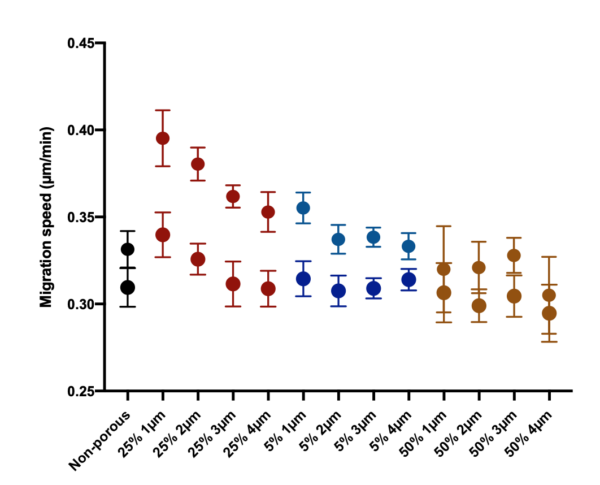
Here is what we found:
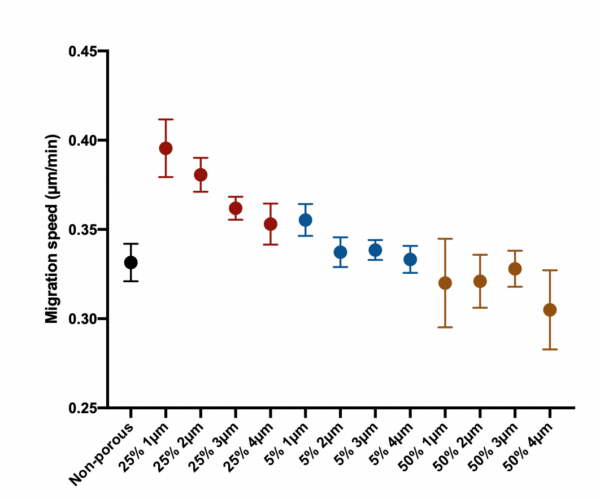
As you can see, the smaller pores induced higher migration speeds. This is consistent with the discussion in our PEG paper in which we suggested the role of pore edges as the potential gripping sites in cell migration.
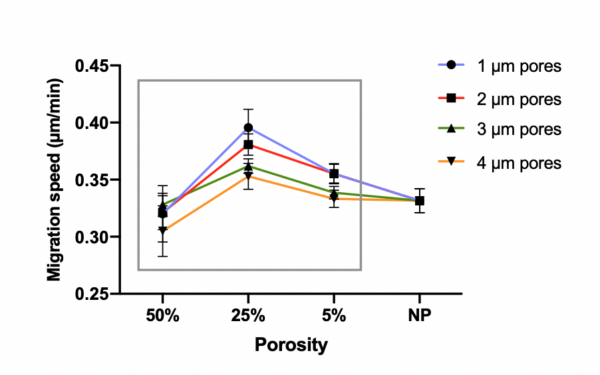
On the other hand, we found a biphasic migratory response with respect to membrane porosity. This biphasic response is very similar to the cell migratory response to membrane stiffness. It also can be understood with the same logic. Porous membranes weaken cell-substrate interactions which in turn may encourage cell migration. Additionally, the potential vertical gripping sites may help cell migration. Both of these effects increase with increased membrane porosity. However, increasing porosity too much can lead to the lack of adhesions and traction forces in the cytoskeleton which are necessary for proper cell migration.

We also studied cell migration with high cell density to minimize the cell substarte interactions and make the cell-cell interaction the dominant force (to optimize the corresponding coefficient in the model).
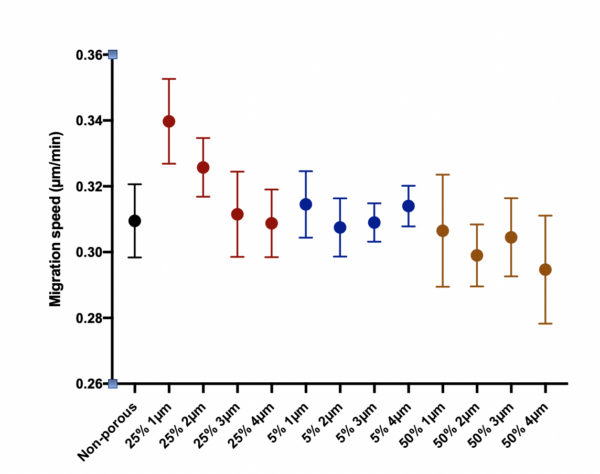
We observed a migitated version of the same response. Since cell-cell interactions make the dominant force in high cell densities, the cell migration speed over porous membranes are very close to its value over nanoporous membranes in most cases. However, similar trend of changes with respect to the pore size and membrane porosity can be observed.
Here is the merged verion of the figure 4 and figure 1 for the reference.
In the next step we are going to use these experimantal results to optimize our model’s coefficients. we will also start to study the pore spacing gradient-guided migration of cells (porotaxis).