Membrane Force Curves
I took some force curves a while ago to see if there was any difference between wrinkled and taut membranes. Here, I present only the data with a 15nm ‘trigger’. The trigger is a user-defined parameter that sets the maximum deflection of the cantilever during a force curve acquisition.
THe y-axis in these graphs is the cantilever deflection in nm (this is the Force/spring constant). The x-axis is the LVDT in nm (this is the z-height of the cantilever). For a supported membrane (an infinitely hard surface), the curve looks good:
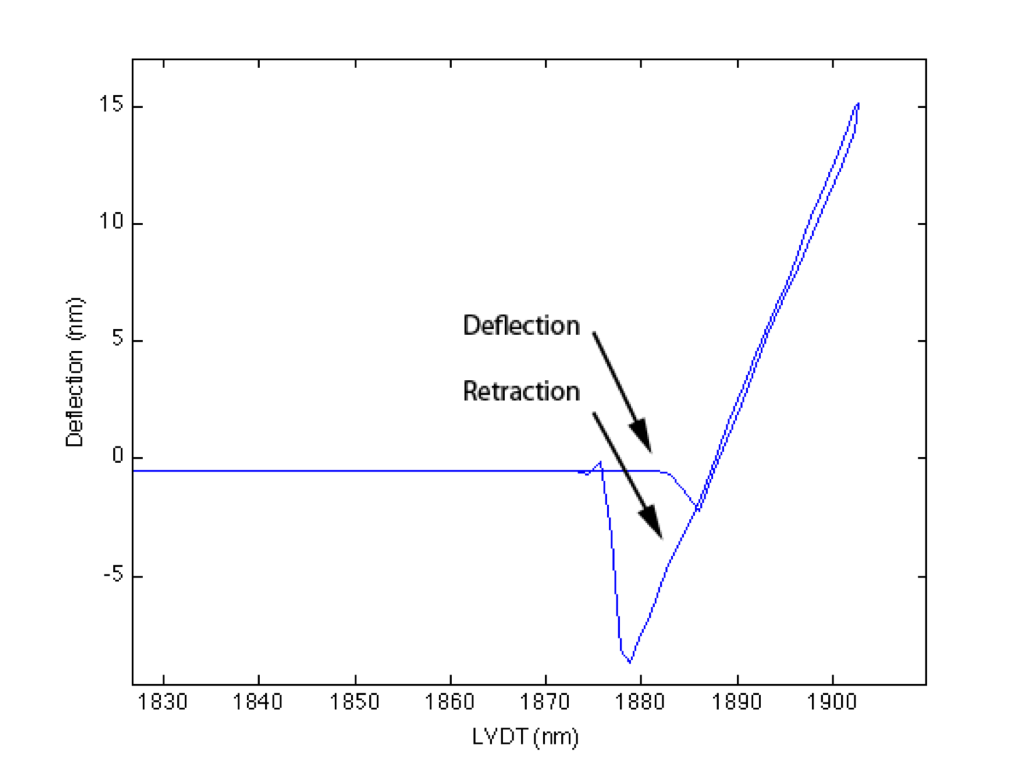 The deflection is the approach – there is a slight attraction (downward dip) due to van der Waals attraction as the tip reaches the surface. There is a little bit of adhesion as the tip retracts and then it snaps off of the surface (steep return to baseline). The 2 curves show little hysteresis. Notice the maximum deflection (the trigger value of 15nm).
Next I plotted the supported membrane curve (in blue) and compared it to free-standing taut membrane.
 Not surprisingly, the membranes are much more compliant (much smaller slope) than the silicon. The red graph represents a force curve taken near the solid silicon and the black curve represents a force curve taken in the middle of the free-standing membrane. If you get rid of the x-offset, these curves are nearly identical. For the black and red curves, there is no attraction as the tip approaches the surface but there is adhesion and a fairly rapid “snap-back” to baseline as the tip retracts.
I then compared a taut to a wrinkled membrane.
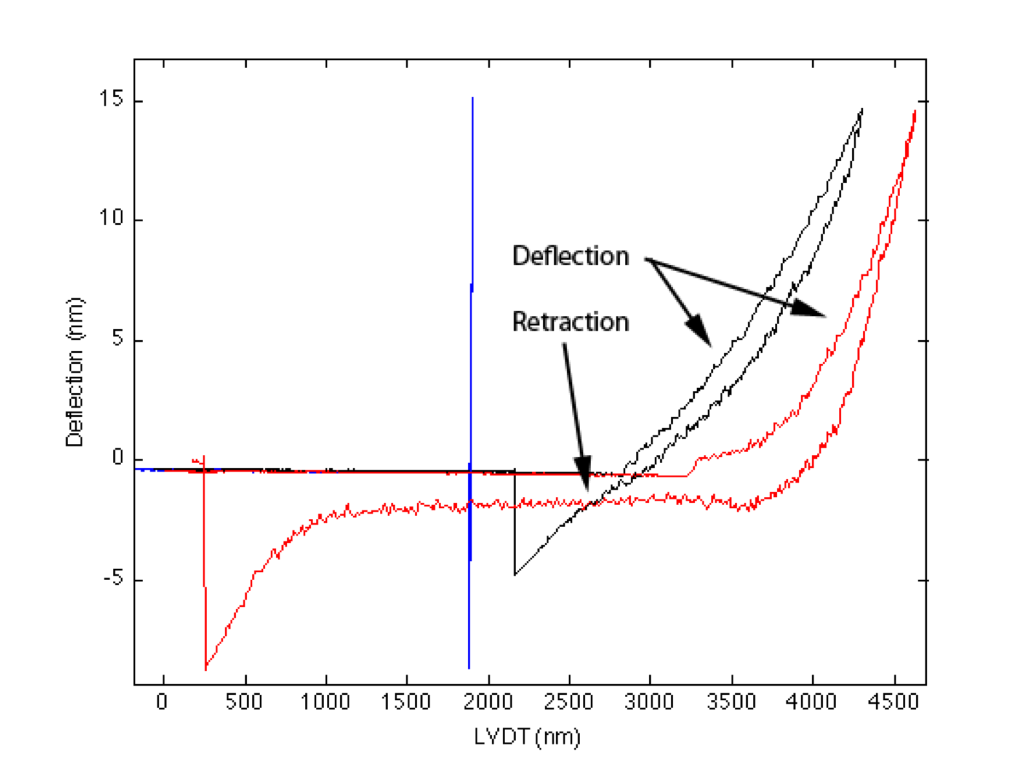 The black curve here is the same as above – the middle of a taut membrane. The blue curve is the infinitely hard supported membrane. The red curve is the wrinkled membrane. The deflection slope is even more shallow because the deflection doesn’t change much as the wrinkles flatten. During retraction, the cantilever remains adhered to the wrinkled membrane but the deflection doesn’t change as the membrane stretches toward the tip. Finally, the tip breaks free.
I just got MATLAB working again on my computer, so I haven’t been able to calculate the Young’s modulus yet. Also, I need to do some more reading before I start writing code to do it.